Key facts
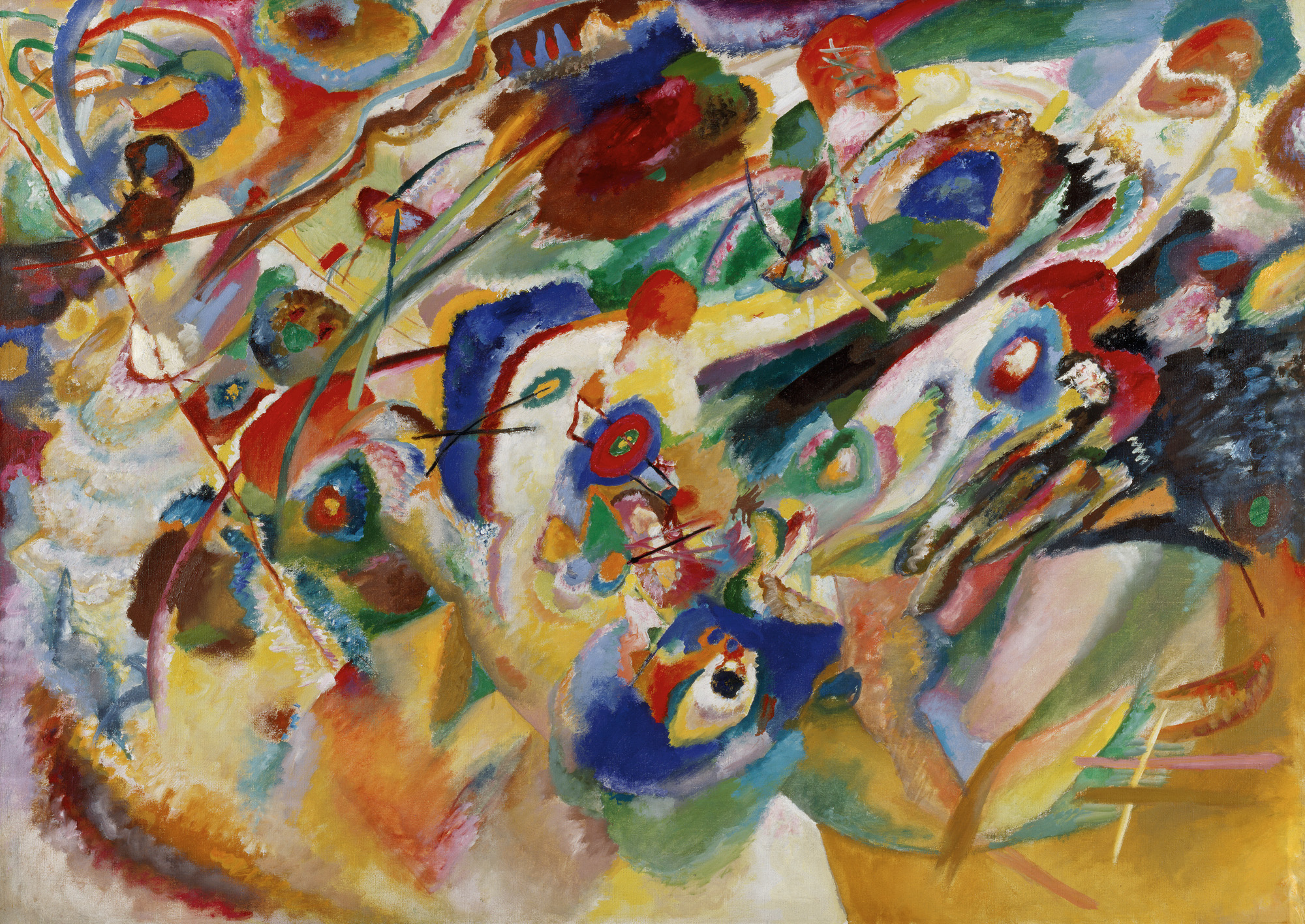
Sketch 2 for Composition VII is a preparatory study painted in 1913 by Wassily Kandinsky (1866-1944), who co-founded the Blaue Reiter in Munich with Franz Marc. It belongs to the group of at least 21 drawings and watercolours and six oil studies that prepared Composition VII. The final canvas was painted between 25 and 28 November 1913 and is held at the Tretyakov Gallery in Moscow. Kandinsky gave the title “Composition” to only ten paintings; the seventh marks the high point of his work before the First World War. Rooted in the Expressionism of the Blaue Reiter and turning towards abstraction, the sketch rests on eschatological themes almost dissolved in colour. It belongs to the Städtische Galerie im Lenbachhaus in Munich.
In front of this canvas, my first impression is one of cacophony: colours clash, shapes overlap, and the eye has nowhere to settle. And yet nothing is left to chance. Wassily Kandinsky himself regarded Composition VII as a complex work, and he prepared it with remarkable rigour: nearly thirty studies, drawings, watercolours and sketches on canvas like this one, already imposing at 100 x 140 cm. This preparation allowed him to paint the final version in just a few days. What first looks like disorder is in fact an orchestrated composition, in the musical sense of the word. It reminds me of the finale of a symphony, that moment when every instrument plays together: the violins soar, the cymbals crash and the trombones ring out. But this complexity does not reveal itself at first glance. You need to take the time to contemplate the canvas, to let your gaze wander from one burst of colour to the next, for tensions, echoes and pauses to emerge. That is exactly what I love about Kandinsky: a painting that does not impose itself, but rewards those willing to lose themselves in it for a while.
See: a circle crossed by two lines
Look at the centre of the canvas, slightly to the left. A small concentric circle of red, green and blue nestles there. Two lines cross it. All around, everything seems to be fighting. The blue swells, the red crushes, the yellow shoots out. Come closer. The brushwork keeps changing in nature. Here, short hatched strokes loaded with paint. There, a wash so thin that the weave of the canvas shows through. Elsewhere, black strokes laid down with a swift gesture. Kandinsky does not paint with a single voice. Each area has its own density, its own timbre. At the bottom, though, everything grows calm. A matte void spreads out, almost silent.
Understand: the order beneath the chaos
Born in Moscow in 1866, Kandinsky gives up law for painting. In 1911, he founds the Blaue Reiter in Munich with Franz Marc. The same year, his essay Concerning the Spiritual in Art is published. He reserves the title “Composition” for just ten paintings. The seventh marks the high point of his work before the First World War. He prepares it with at least 21 drawings and watercolours and six oil studies. Then he paints the final version, two metres by three, from 25 to 28 November 1913. It is held today at the Tretyakov Gallery in Moscow. The Lenbachhaus catalogue entry describes this process in detail. Here lies the paradox. This turmoil rests on precise eschatological themes. The Last Judgement and the Resurrection dissolve into colour. Compare it with the Moscow version. There, the void at the bottom becomes a funnel-shaped vortex. A boat appears in the lower left corner. The sketch still hesitates. The final canvas decides.
Feel: getting lost to see better
Facing this oil on canvas, two instincts collide. One wants to decipher everything, to hunt for the angel, the boat. The other wants to let go. Kandinsky draws on the Apocalypse, then claims his painting has no subject. So let your eye drift. Follow a black line until it breaks. Linger on a blue vibrating against a red. The painter calls his major works “Compositions”, like a musician. Here, painting becomes duration rather than image. Meaning does not arrive all at once. It settles, layer after layer.
News: the Blaue Reiter revisited at the Lenbachhaus
The Lenbachhaus, home to Sketch 2 for Composition VII, is currently devoting a major exhibition to the movement founded by Kandinsky and Franz Marc: “Über die Welt hinaus. Der Blaue Reiter” (“Beyond the World. The Blue Rider”), on view from 10 March 2026 to 5 September 2027. For the first time, the display focuses on the women artists of the group, such as Gabriele Münter, Marianne von Werefkin, Elisabeth Epstein and Maria Franck-Marc, who are given far more space. This new reading continues with the international project “Die Blauen Reiterinnen” (The Blue Rider Women). Presented in Munich, it opens first in Wiesbaden on 23 October 2026, then travels to Bremen and Ascona in Switzerland, before being shown at the Lenbachhaus a year later. Kandinsky enthusiasts can also head to Rome: from 15 September 2026 to 14 February 2027, the Palazzo Bonaparte brings together more than seventy masterpieces on loan from the Centre Pompidou.
Source: Lenbachhaus.
A question for you
Looking at this sketch, do you still see a painting to decipher, or already a piece of music to listen to?
About this work
- Sketch 2 for Composition VII
- Wassily Kandinsky
- 1913
- Oil on canvas
- 100 x 140 cm
- Städtische Galerie im Lenbachhaus und Kunstbau, Munich
- https://www.lenbachhaus.de/en/digital/collection-online/detail/entwurf-2-zu-komposition-vii-30018582