Key facts
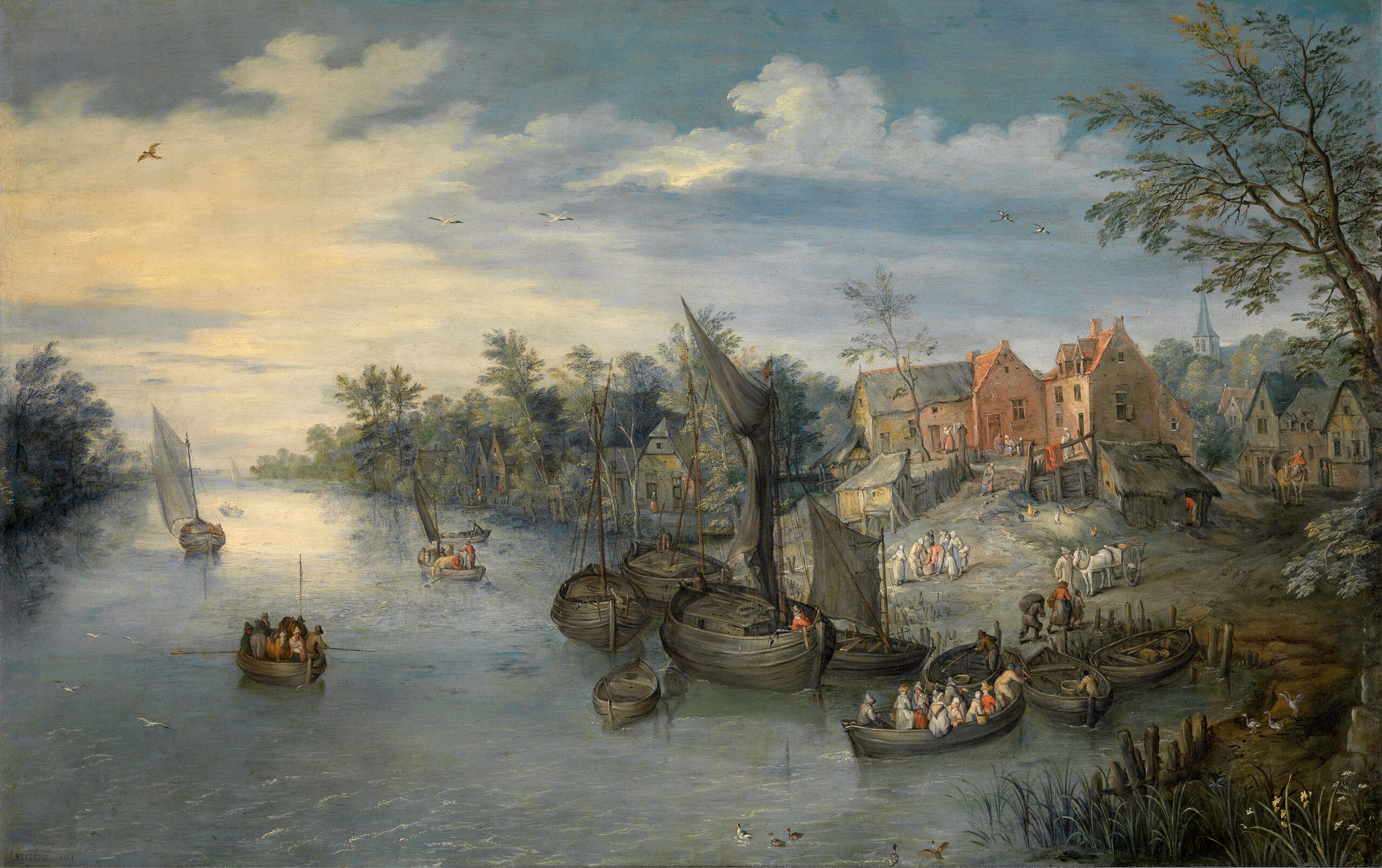
Painted in 1603 by Jan Brueghel the Elder, River Landscape depicts a village harbour on a riverbank, busy with boats, passengers and scenes of everyday life. The son of Pieter Bruegel the Elder, nicknamed “Velvet Brueghel” for the delicacy of his touch, the artist settled in Antwerp in 1596, after a stay in Italy where he took up oil painting on copper. This smooth support gave him a miniaturist’s precision. The painting belongs to early seventeenth-century Flemish painting, a period when landscape was emerging as a genre in its own right. It is held at the KMSKA, the Royal Museum of Fine Arts Antwerp.
This is a fascinating landscape, painted at a time when landscape was only just beginning to assert itself as a genre in its own right, rather than a mere backdrop for a religious or mythological scene. Here there is no biblical pretext: the subject is life itself. Jan Brueghel I offers us a river harbour scene where life on the water and life on land answer one another. We discover the village, the fauna and flora, the bustle of people around the harbour, the boats under sail and those moored at the bank. The longer you look, the more small details and little stories you notice, and that is what makes this painting so alive. The rendering is remarkably precise and fluid, a fine illustration of what earned Jan Brueghel I the nickname “Velvet Brueghel“, for the delicacy and softness of his painting. The copper support plays a large part in this: its perfectly smooth surface allows a miniaturist’s delicacy of touch and gives the colours an almost enamel-like brilliance. It is all the more impressive given that the painting measures only 39 × 60 cm. What I love most is the sky and the light, which are very present in the work. They take up a large part of the composition and give the whole scene a real atmospheric depth. The colour is also very well handled and effectively renders the tones of the season. Finally, I appreciate the discreet signature “BRVEGHEL 1603” in the lower left corner, like a knowing wink from a painter proud of his work.
Three ducks glide along the bottom of the painting. Come closer. Their wake glistens on the grey water. Further up, a boat overflows with passengers packed tightly together, in colourful clothes with hats on their heads. A white horse waits by its cart. You can almost smell the damp scent of the reeds.
Copper, a cold skin beneath the light
Lay your hand on a copper plate: it is cold, hard, without the slightest grain. No canvas weave, no wood fibre. The brush glides without resistance. The metal does not absorb the oil. Each layer stays on the surface, thin and transparent, and the colour keeps its brilliance. Jan Brueghel the Elder took up this support in Italy in the 1590s. In Antwerp, specialist craftsmen later supplied his plates, often stamped on the back. Now look at the sky. On the left, a pale yellow glow dissolves towards the horizon. On the right, the grey-blue clouds thicken. The river gathers all this light like a tarnished mirror. The composition opens along a diagonal. The water recedes to the left, while the village huddles on the right beneath a large leaning tree. The figures in the distance are only a few millimetres tall. You can study them in high definition on vmuseum.fr.
The Brueghel: the son, the father and the river
Jan Brueghel I was born in Brussels in 1568. He was the son of Pieter Bruegel the Elder. After several years in Italy, he settled in Antwerp in 1596. This copper belongs to early seventeenth-century Flemish painting. Yet it tells no fable. No proverb, no lesson. People board, unload, wait. The father moralised about the world. The son watches it breathe. Everything is in motion here, and yet nothing happens.
News: Bruegel and proverbs at the KMSKA
Visitors who come to admire Jan Brueghel the Elder’s River Landscape at the KMSKA will soon be able to place it within the family legacy. From 27 February to 6 June 2027, the Antwerp museum presents Folly Beyond Words. Bruegel and Proverbs in Art, which the institution describes as the first major exhibition devoted to the role of proverbs and figurative language in the visual arts. The exhibition centres on Pieter Bruegel, Jan’s father, and the decade or so he spent in Antwerp. It also shows how Rubens, Rembrandt, Michaelina Wautier, Jacob Jordaens and Jan Steen followed in his footsteps by translating proverbs into images in their turn, with unexpected parallels in Iranian and Chinese ceramics and Japanese prints. It is a fine opportunity to compare the father’s teeming, moralising world with the son’s miniaturist delicacy, of which this small copper from 1603 is a splendid example.
Source: KMSKA.
A question for you
In the boat on the left, horses are crossing the river standing up among the passengers. How do they keep their balance on this rocking hull?
About this work
- River Landscape
- Jan Brueghel the Elder
- 1603
- Oil on copper
- 39 × 60 cm
- KMSKA, Royal Museum of Fine Arts Antwerp
- https://kmska.be/en/masterpiece/river-landscape