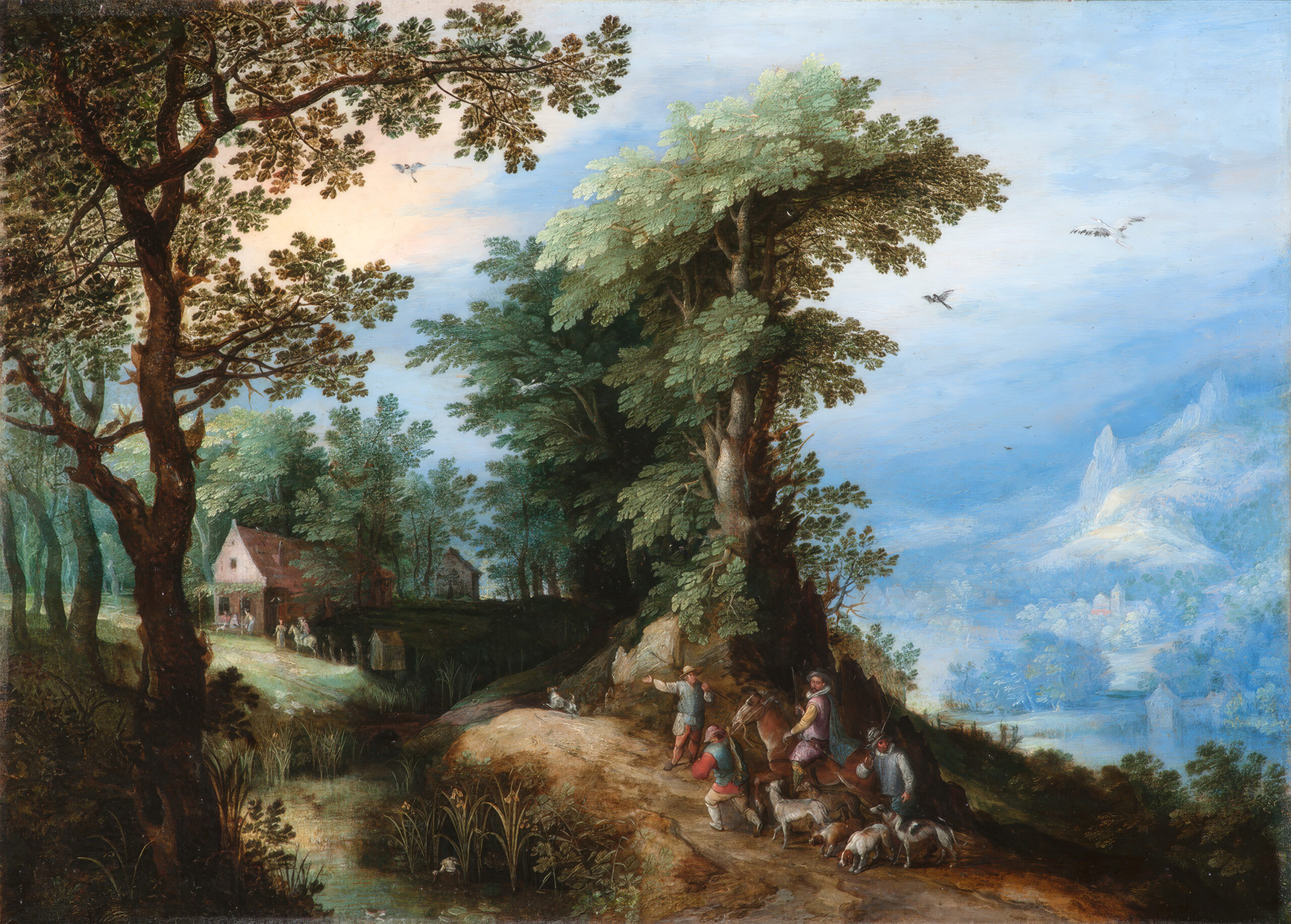
This small copper panel never fails to captivate me whenever I pause before it. Its scale is almost deceptive, barely 35 centimetres wide, and yet Brueghel unfolds an entire world within it. Here we find all the refinement that earned the artist his epithet “Velvet Brueghel,” that distinctive manner of blending tones, of softening colours as one might caress a precious fabric.
The subject, a return from the hunt, is merely a pretext: the true protagonist of the painting is the forest itself, rendered as a veritable panorama stretching toward a bluish horizon. I particularly enjoy observing how Brueghel handles aerial perspective. The dark, richly detailed greens of the foreground gradually give way to increasingly diffuse blues as the eye travels deeper into the landscape, until they dissolve almost entirely in the distance. This is an effect found throughout many of his landscapes, and one that always conveys that sense of infinity so characteristic of Northern painting.
Then there are the details, the ones visible only on close inspection: a few birds crossing the sky, the almost microscopic precision of the foliage, the small animated figures who populate the scene. It is this accumulation of detail that gives Velvet Brueghel’s paintings their particular charm: the longer one looks, the more one discovers.
One might expect a hunting scene, a horn sounding, cries, a beast at bay. This is not that. The eye first falls upon an oversized oak tree, its branches curved like a bow against the sky. The huntsmen and their hounds occupy only a portion of the panel, relegated almost to its edge.
What Lies Beneath the Surface
The panel is copper, smooth and cool beneath the paint layer. This hard, unyielding surface precludes any impasto, any visible texture. Jan Brueghel the Elder applied thin, nearly transparent glazes, layer upon layer. The light seems to emanate from the metal itself. Note the transition from dark green to pale blue, from forest to horizon: the tones blend without interruption, through successive gradations. Beneath the foliage of the foreground, a farmhouse can just be discerned, already swallowed in shadow. Further off, bluish mountains and a town dissolve into the haze. This chromatic gradation constructs a dizzying sense of depth for a format that fits almost entirely within one’s hand. The hunt itself remains but a pretext at the roadside.
The Artist and His Era
Jan Brueghel the Elder was born in Brussels in 1568, the younger son of Pieter Bruegel the Elder. Trained in miniature painting, he developed early on an acute sensitivity to minute detail. Around 1589, he departed for Italy, where he remained for several years, coming into contact with patrons such as Cardinal Borromeo. This painting dates from that fruitful period, circa 1594–1595. Upon his return to Antwerp, he became court painter to the Archdukes Albert and Isabella, and crossed paths with Rubens, with whom he would later collaborate on several major compositions.
Musée de Flandre: Exhibition
In 2025, the Musée de Flandre in Cassel marked the 400th anniversary of Jan Brueghel the Elder’s death. The exhibition Brueghel & Van Balen, artistes & complices brought together exceptional loans from the Louvre, the Prado, and the Mauritshuis, devoted to his collaboration with the painter Hendrick van Balen.
Source: Musée de Flandre, Cassel
A Question for You
💭 What draws your eye first: the huntsmen, or the forest that engulfs them? 👀
About This Work
- The Return from the Hunt
- Jan Brueghel the Elder (known as “Velvet Brueghel”)
- c. 1594–1595
- Oil on copper
- 24.9 x 34.6 cm
- Musée d’Arts de Nantes
- https://www.navigart.fr/museedartsdenantes/artwork/brueghel-de-velours-jan-i-brueghel-dit-le-retour-de-la-chasse-110000000006031