Today we have chosen to focus on the work of Henri Martin, a Post-Impressionist painter known above all for his Divisionist technique.
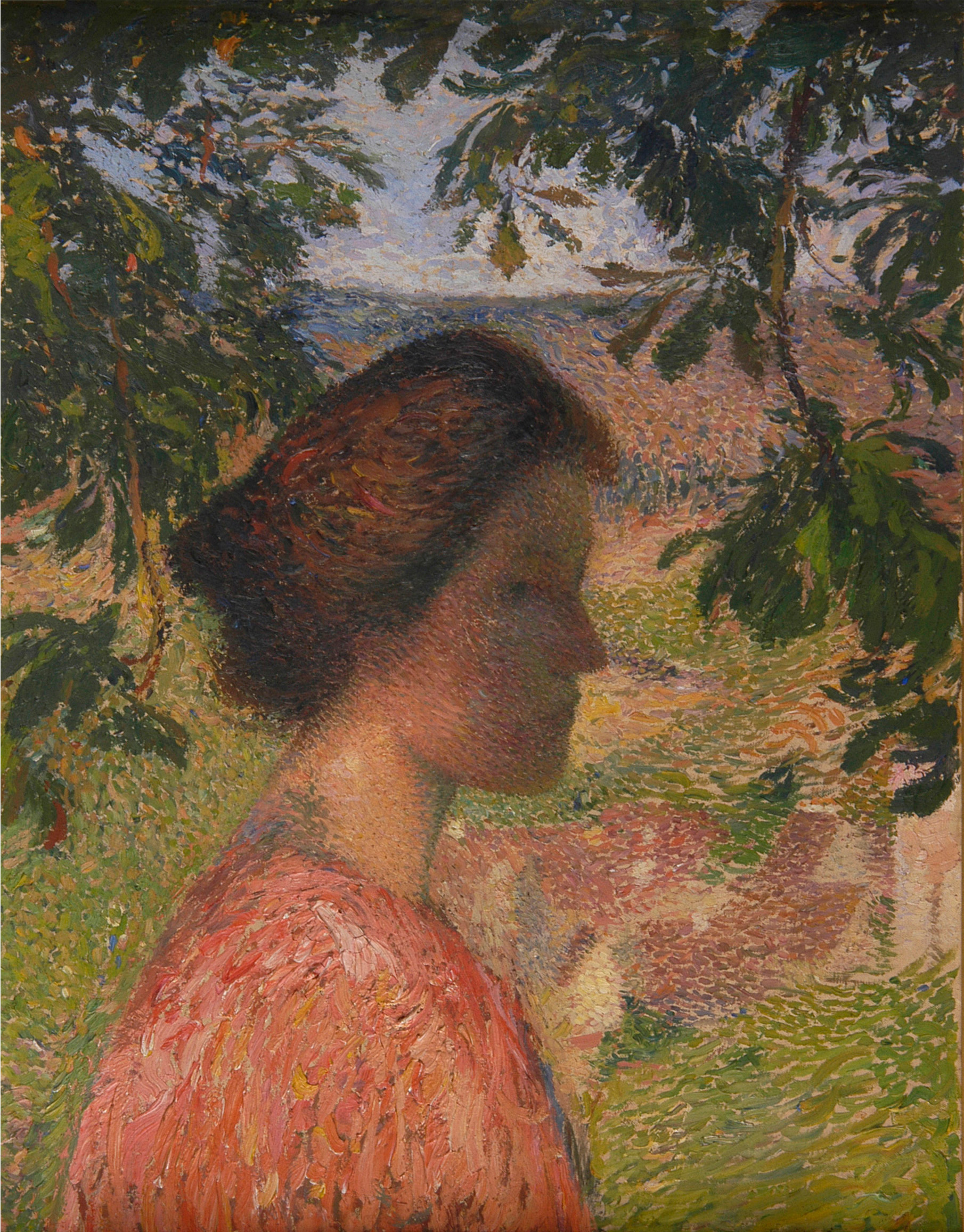
This Young Woman embodies the fullness of his art and the poetic vision he brought to the world around him. Notice the particular treatment of colour, and the meditative quality of this young woman whose face remains in shadow while the landscape surrounding her is bathed in light.
See
A woman’s silhouette emerges in profile. Her dark chignon nestles among the shadows of a chestnut tree. The pink dress shimmers beneath divided brushstrokes. Around her, the landscape sparkles with green foliage, ochre earth, and a pale sky glimpsed between the leaves. The face stays in shadow. In the distance, a bluish valley stretches out. Everything pulses; nothing stands still.
Understand
Henri Martin painted this canvas before 1904, at the height of his Divisionist language. Born in Toulouse in 1860 and trained under Jean-Paul Laurens, he discovered Seurat and Signac in the 1890s. From them he took the fragmented brushstroke, but rejected their scientific rigour. His Pointillist technique remains free, lyrical, almost trembling. The work was destined for the Galerie Georges Petit, one of the leading venues of the Parisian art market. The antique medallion-like profile evokes the Italian Renaissance. A twin canvas, held in Reims, shows the same model seated. Here, Henri Martin composes a silent tribute to youth, somewhere between late Symbolism and southern Post-Impressionism.
Feel
Step closer. Let the brushstrokes dissolve, then reassemble before your eyes. The hidden face invites you to slow down. This woman is dreaming, perhaps, or listening to the rustling of leaves. Light envelops her without revealing her. You are drawn into the same contemplation, into that vegetal silence where time seems suspended. Henri Martin offers a moment of pure meditation.
In the news: Henri Martin in the spotlight
Henri Martin continues to enter public collections. In September 2025, the Musée des Augustins in Toulouse acquired two early paintings, including La Course à l’abîme (1882). In December 2025, the Musée départemental de l’Oise received a self-portrait as Virgil. (Source: La Tribune de l’Art 30/12/2025).
The Musée Henri Martin in Cahors, renovated in 2022, remains the definitive reference.
A question for you
💭 What if beauty resided in what eludes us, more than in what is put on display?
📌 About this work
- Young Woman
- Henri Martin
- before 1904
- Oil on canvas
- 26 × 20⅝ in. (66.1 × 52.3 cm)
- Musée des Beaux-Arts, Reims (inv. 907.19.164), Photo: Christian Devleeschauwer
- https://musees-reims.fr/oeuvre/jeune-femme-329200791636518837