Moscow, 1915. Liubov Popova turns her eyes toward a village, and the world explodes into fragments. Reality dismantles itself. Painting begins.
A Village Fractured into a Thousand Shards
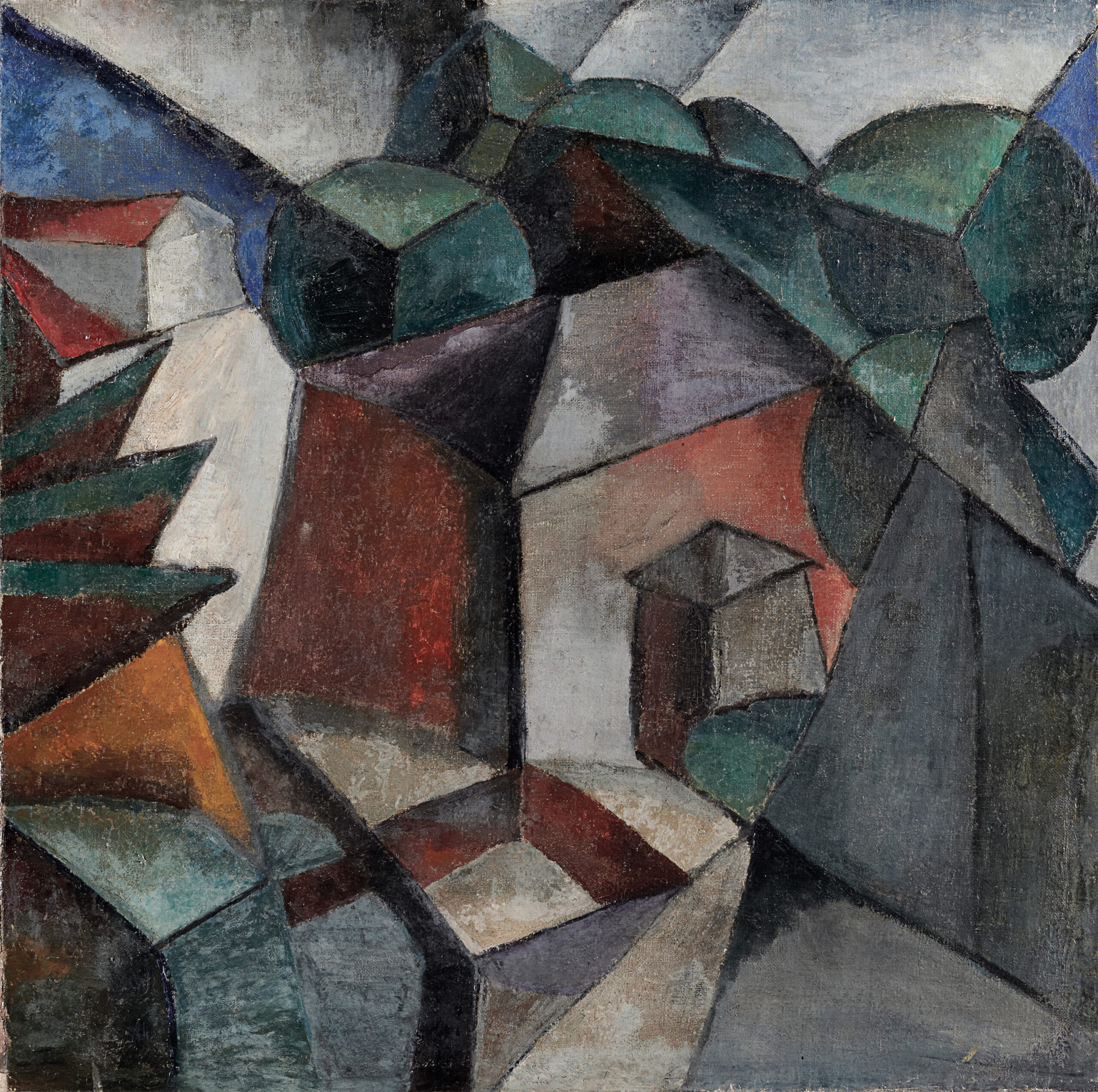
Look carefully. Brick-red rooftops emerge from the chaos. Dark green domes curve at the top of the canvas. Patches of blue sky break through between grey and mauve masses. Popova fragments the landscape into adjoining geometric planes, outlined in thick black. The handling is heavy, rough, almost sculptural. Each facet catches the light differently. The eye slides, catches, moves on. No classical perspective guides the gaze. Notice that brick red at the centre: it pulses like a heart within the composition.
On the Threshold of a New World
This painting belongs to Popova’s series of architectural paintings. In 1915, Moscow is seething. Cubo-Futurism is flooding the studios. Malevich is preparing Suprematism. Popova has absorbed Cézanne, Picasso and Gleizes, encountered during her stays in Paris. Here, objects still exist — rooftops, trees, volumes, but barely. They dissolve into structure. This is a pivotal moment: representation gives way to the pure organisation of forms within pictorial space. The architectural motif is nothing more than a pretext.
Liubov S. Popova
Popova was born in 1889 near Moscow. Trained between Russia and Paris, she embraced Constructivism with rare radicalism. In 1921, convinced by revolutionary ideals, she abandoned painting for design and stage production. She died in 1924, aged thirty-five, leaving behind a decisive body of work.
A Question for You
💭 Before this village collapsing into geometry, what do we still see: a landscape, or already an idea? Where does abstraction begin in the history of art?
About this work
- Untitled
- Liubov S. Popova
- 1915
- Oil on canvas
- 72 × 71.5 cm
- Städel Museum, Frankfurt am Main
- https://sammlung.staedelmuseum.de/en/work/untitled-7
Cubo-Futurism and the Fragmented Village
Untitled is a characteristic work from the Cubo-Futurist period of Liubov Popova (Ivanovskoye, 1889 – Moscow, 1924), depicting a village landscape broken into interacting geometric planes: brick-red and rust roofs, dark green cupolas, openings of blue sky between grey and mauve facets. The thick, textured brushwork gives the surface a materiality close to that of collage. Trained in Moscow and then in Paris, where she worked in Montparnasse studios around 1912-13 and absorbed the lessons of Cézanne and Picasso, Popova brought back to Russia a formal vocabulary she reworked into a personal synthesis between French Cubism and Italian Futurism. This canvas belongs to the moment when that synthesis was at its most taut and productive.
A Brief and Decisive Trajectory
Popova died at thirty-five in 1924 of scarlet fever, leaving a body of work spanning fewer than fifteen years that nevertheless occupies a central place in the history of the Russian avant-garde. After her Cubo-Futurist period she turned toward Constructivism and left easel painting to concentrate on scenography, textile design, and typography, a trajectory that reflects the ambition of 1920s Soviet artists to put art in the service of social transformation. Untitled belongs to the first phase of her career, before this conversion to applied art, and represents one of the most fully achieved expressions of her Cubo-Futurist vocabulary. The Städel Museum in Frankfurt holds this canvas as one of the most significant works of the Russian avant-garde in a European collection, a reminder that the network of exchanges between Moscow, Paris, and the German art world in the early twentieth century was richer and more consequential than the canonical history of modernism has often acknowledged.