Key facts
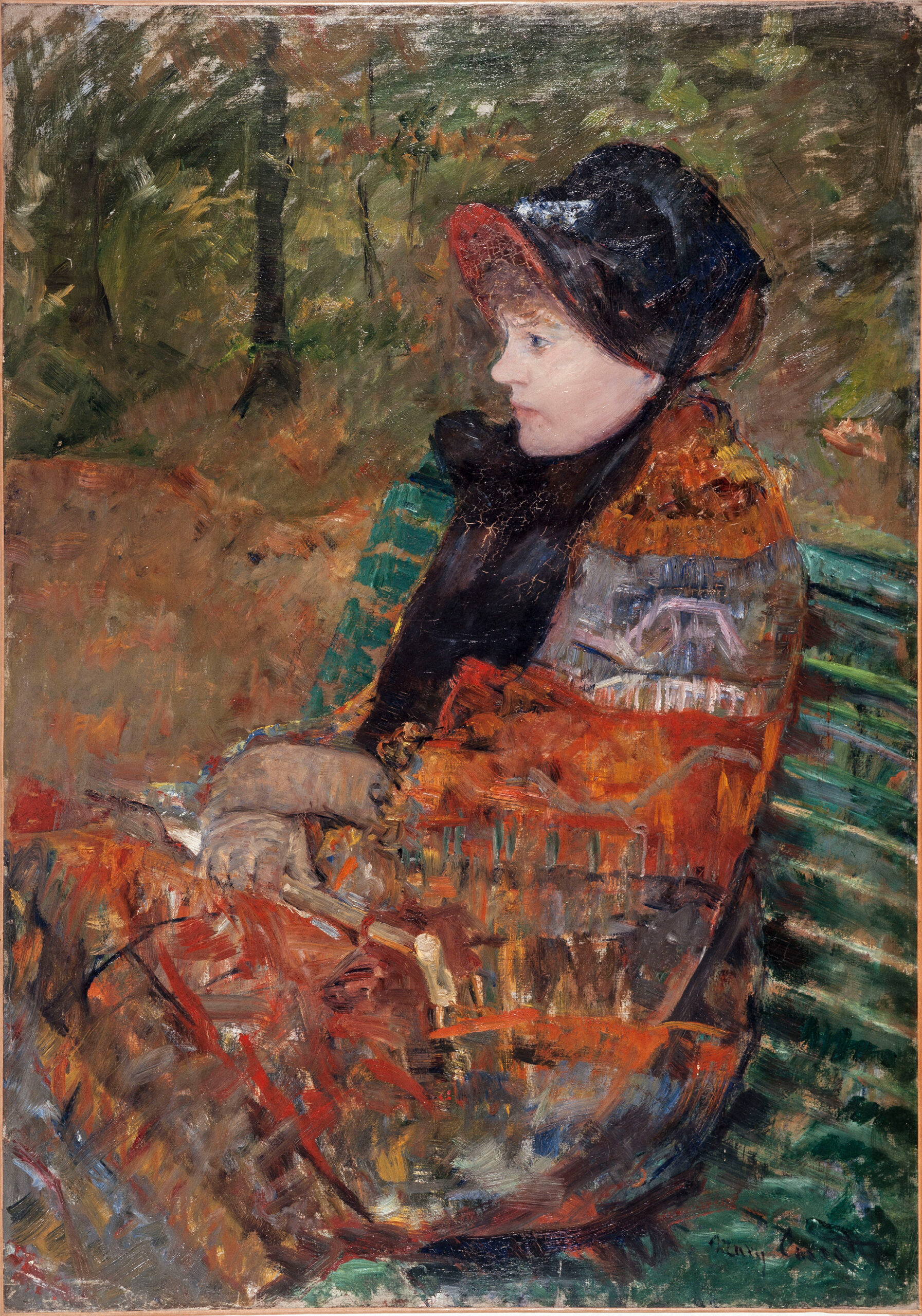
Painted by the American artist Mary Cassatt in 1880, Autumn, Portrait of Lydia Cassatt shows the artist’s sister seated on a bench, wrapped in a multicoloured coat. The canvas belongs to Cassatt’s Impressionist period, when she was exhibiting with the group. It was shown at the sixth Impressionist exhibition in 1881 under the title Autumn. The contrast between a finely modelled face and the quick brushwork of the clothing and landscape is characteristic of her manner at that time. Lydia died in 1882. Mary Cassatt later gave the painting to the Petit Palais, the City of Paris Museum of Fine Arts, under the title Portrait of a Woman.
The moment I first saw this painting, I saw autumn in it. The colours of the setting and of the figure, her coat in particular, all evoke the autumn season: browns, ochres, faded greens, as if the dead leaves had rubbed off onto the canvas. The cold seems present too; I can sense it in the tightly wrapped scarf and in the way Lydia, the artist’s sister, sits bundled up, slightly folded in on herself. Her gaze is lost in the distance. She is daydreaming. It is this suspended moment that moves me: Mary Cassatt does not paint a pose, she captures a thought. I love the atmosphere this canvas gives off, both peaceful and slightly melancholic, and it is hard not to think back on it knowing that Lydia, already ill, would die two years later. The title itself then takes on a different resonance. The face is rendered with great precision and delicacy, almost with tenderness, while the rest is laid down in broad strokes of paint, in a lively, rapid style. For me, this contrast is the whole point of the painting: the eye goes straight to the face, and the background becomes a mere vibration of colour, very Impressionist. You can feel that the artist knows her model perfectly and that, above all, she is painting someone she loves.
You are standing before two grey gloves, resting one on top of the other. The leather still seems warm. Beneath the fingers, a pale knob pokes out from the folds of the coat.
What the canvas tells us
Move closer to the face. The paint is thin there, blended, almost smooth. The profile stands out sharply against the background. A faint pink rises to the cheekbone. Now look down at the multicoloured coat. Everything changes. The paint thickens; the brush hatches and crosses its strokes. Oranges, brick reds and mauve greys jostle without blending. The pattern of the fabric comes apart before your eyes. Behind her, the green bench runs in long parallel slats. This green answers the orange of the coat: two complementary colours keeping each other alert. The trees are nothing more than slanting strokes of green and rust. Look at the black bonnet. Its red lining lights up the cheek like an ember. The cold shows in her body: shoulders hunched, collar pulled up to the chin. The handle of the cane is just a comma of white. At the bottom right, the signature melts into the green of the bench. This oil on canvas moves at two speeds. The face is slow. Everything else runs.
What the period tells us
Summer 1880. Mary and Lydia Cassatt are staying at Marly-le-Roi, west of Paris. According to the Petit Palais label, they remain there until mid-October. That same summer, Mary paints Lydia in the garden, in full light. That other canvas, Lydia Crocheting in the Garden at Marly, belongs to the Metropolitan Museum in New York. Compare the two. There, Lydia is busy, wearing a white bonnet, bathed in sunlight. Here, her gloved hands do nothing at all. The two paintings share almost the same dimensions, roughly 65 by 92 centimetres. One is horizontal, the other vertical. The Impressionists chased the sensation of the moment. Cassatt chases it in a face. She keeps careful drawing for the figure and lets the brush loose everywhere else. In 1881, the canvas appears at the sixth Impressionist exhibition under the title Autumn. Lydia dies the following year. Later, Mary gives the painting to the Petit Palais. She then titles it Portrait of a Woman. Her sister’s name has left the title. So has the season.
Mary Cassatt was born in Pennsylvania in 1844. She came to France in 1866 to study, then settled there for good. In 1877, her parents and Lydia joined her in Paris. That same year, Degas invited her to exhibit with the Impressionists. Her older sister then became one of her most frequent models.
News: the Mary Cassatt centenary
2026 marks the centenary of Mary Cassatt’s death (1844–1926), and Paris is paying her a major tribute: the Musée d’Orsay is presenting “Mary Cassatt: Being Independent” until 31 January 2027. Bringing together nearly 80 paintings, pastels and prints spanning her entire career, the exhibition sheds new light on her work by drawing on unpublished letters, and is part of the museum’s 40th-anniversary celebrations, in collaboration with the National Portrait Gallery in London and the Museum of Fine Arts, Boston. The exhibition notably features Lydia, the artist’s sister and favourite model, who joined Mary in Paris in 1875. Across the Atlantic, the Art Institute of Chicago is also devoting an exhibition to the artist, “Mary Cassatt: After Impressionism”, from 6 September 2026 to 3 January 2027. At the Petit Palais, where Autumn is held, the season also celebrates women artists: “Eva Gonzalès: A Free-Spirited Artist’s Journey” runs from 15 September 2026 to 24 January 2027, while Prune Nourry’s free exhibition pays tribute to 18 pioneering women sculptors from 20 October 2026 to 24 January 2027. Finally, “Brussels 1900” has just opened at the Petit Palais, running from 10 November 2026 to 25 April 2027.
Source: Musée d’Orsay.
A question for you
The Impressionists often painted their loved ones. If you were to paint a portrait of someone dear to you, which season would you choose?
About this work
- Autumn, Portrait of Lydia Cassatt
- Mary Cassatt
- 1880
- Oil on canvas
- 92.5 x 65.5 cm
- Petit Palais, City of Paris Museum of Fine Arts, Paris Musées
- https://www.parismuseescollections.paris.fr/fr/petit-palais/oeuvres/automne-portrait-de-lydia-cassatt