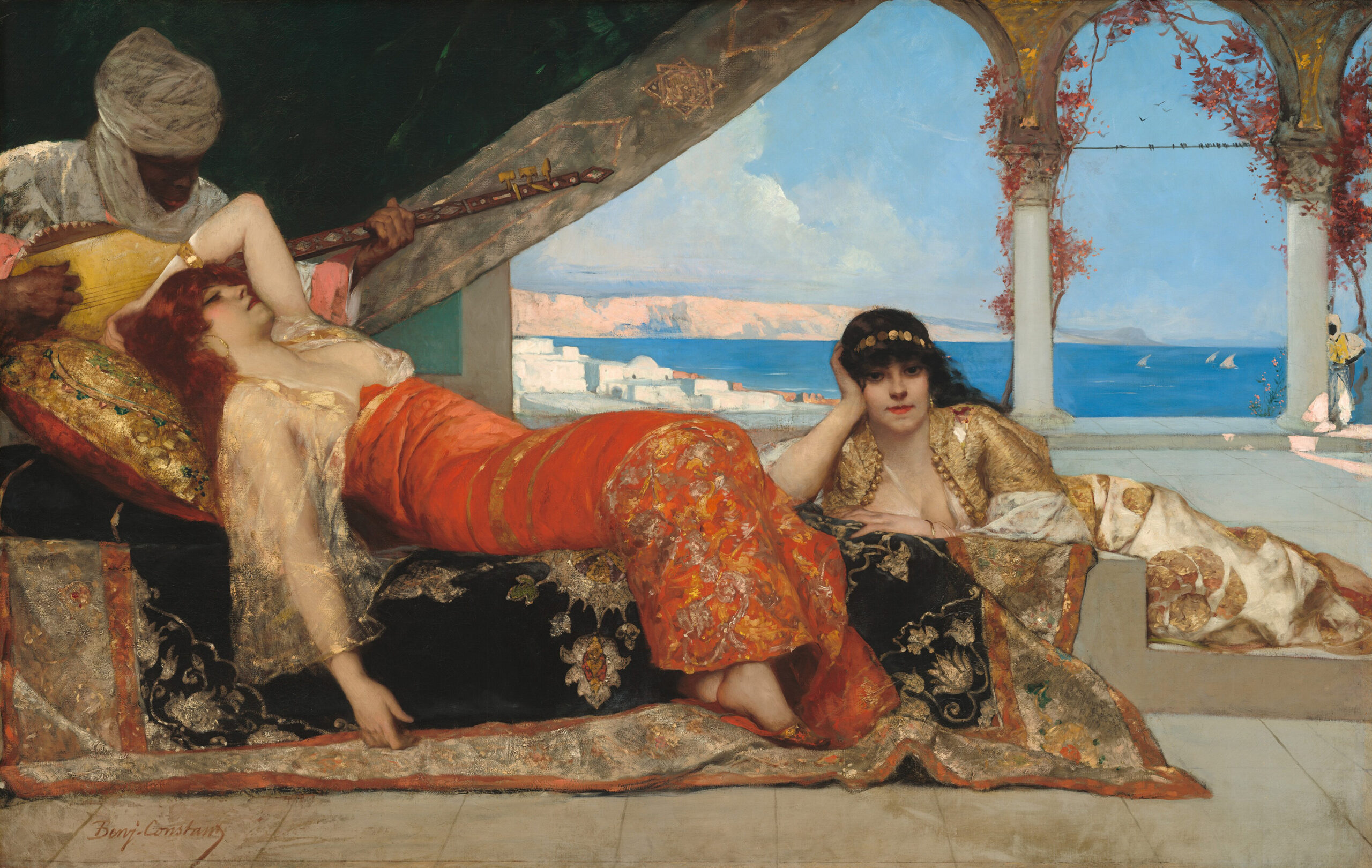
A touch of Orientalism never hurt anyone. That was the thought that crossed my mind when I first encountered this imposing canvas, more than two meters wide, in the collections of the National Gallery of Art. The Emir’s Favorite distills everything that makes Benjamin-Constant so compelling: the warm light that seems to radiate from the fabrics, the architecturally precise composition organizing the harem space with an almost theatrical rigor, and the heavy silence that envelops the female figures.
What captivates me is less the Orient itself than the gaze nineteenth-century Western painting directs toward it. Benjamin-Constant never set foot inside a harem, almost no one could, and that is precisely where the tension of this work resides: between its undeniable pictorial virtuosity and the construction of a colonial fantasy. The woman depicted is not a portrait. She is a projection. A dreamed scene, reconstructed in a Parisian studio from fabrics purchased at the souk in Tangier.
This does not diminish the aesthetic pleasure, quite the contrary, it deepens it. To look at this canvas today is to look simultaneously at a technical achievement and at the mirror of an era that readily conflated exoticism with eroticism, otherness with fantasy.
This scarlet brocade burns before anything else. Your eyes find it first. They do not leave it.
What the Surface Conceals
The carmine fabric draping the auburn-haired woman is oil on canvas. Benjamin-Constant renders it thread by thread, reflection by reflection. The warmth of the cloth is felt before it is seen. It throws into relief the pale, almost cold skin of the abandoned arms. To the right, the dark-haired woman meets your gaze directly. Her look yields nothing. Behind the two figures, a loggia opens onto a blue sea and ochre cliffs. Air moves through the space. And yet the guard stationed at the far right closes it. This luminous terrace is also a gilded cage.
Benjamin-Constant and the Imagined Morocco
In 1871, Benjamin-Constant spent sixteen months in Morocco. He brought back sketches, fabrics, objects. He was received by the sultan. The harem, however, remained beyond reach. The 1879 scene was born in a Parisian studio. The Orientalist painter summons Delacroix, his model, in the richness of the palette and the vibrancy of the brushwork. He departs from him in the spatial construction, more architecturally structured, more austere. The auburn-haired woman, too fair-skinned for the Orient, feeds a precise fantasy of the period: that of the European captive. Benjamin-Constant did not invent it. He committed it to paint with a disquieting virtuosity.
Benjamin-Constant: Market and Institutions
Benjamin-Constant remains an artist of sustained scholarly and commercial interest. Several works came to auction in 2025 and 2026, including Page orientale in November 2025 and On the Roofs in March 2026 at Bonhams. Major Orientalist compositions have reached considerable prices: Marchand de tapis à Tanger was hammered at over €458,000 and The King of Morocco at nearly €349,000. The Emir’s Favorite is held in the permanent collection of the National Gallery of Art, Washington D.C., where admission is always free. The painting was also featured in the first major retrospective devoted to the artist, co-organized by the Musée des Augustins, Toulouse, and the Montreal Museum of Fine Arts, an exhibition recognized as being of national importance by the French Ministry of Culture.
Source: millon.com
A Question for you
💭 Can one admire the virtuosity of a painting while simultaneously questioning what it constructs?
About this work
- The Emir’s Favorite
- Jean-Joseph Benjamin-Constant
- c. 1879
- Oil on canvas
- 142.2 × 221 cm
- National Gallery of Art, Washington D.C.
- https://www.nga.gov/artworks/75181-favorite-emir