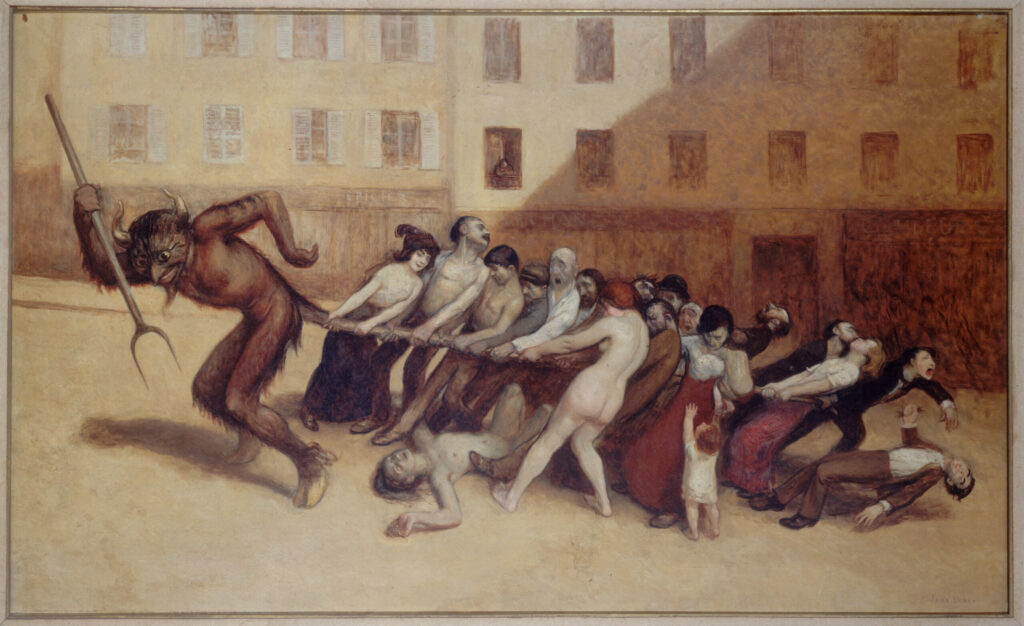
This expressive masterpiece by Jean Vébert brilliantly illustrates the French idiom for financial struggle through a bold composition merging the fantastic with everyday life.
Set against an urban backdrop of sepia tones evoking post-war Parisian façades, a line of figures strains in collective effort to pull a grimacing demon. The diagonal progression of characters, from bourgeois gentleman in frock coat to laborers in smocks and women in dramatic poses, creates dynamic visual movement across the canvas.
The devil, a hybrid creature of exaggerated proportions, brandishes his pitchfork in a theatrical gesture. The chromatic palette, dominated by ochres and browns, reinforces the simultaneously grotesque and melancholic atmosphere, while the treatment of bodies, balanced between realism and caricature, demonstrates remarkable technical mastery.
Further information
- “Parisians Pulling the Devil by the Tail” by Jean Vébert, c. 1920
- 88 x 145 cm
- Musée Carnavalet – Histoire de Paris, Paris Musées
- https://www.parismuseescollections.paris.fr/fr/musee-carnavalet/oeuvres/les-parisiens-tirant-le-diable-par-la-queue
Jean Vébert (1864-1928) remains an underappreciated singular talent. Trained at the École des Beaux-Arts in Paris, he developed a unique style blending social realism with fantastical symbolism. His career, marked by unwavering commitment to social themes, produced numerous works that ironically critique the hardships of daily life in interwar Paris. This painting represents the pinnacle of his artistic achievement, combining technical excellence with an incisive vision of contemporary society.
Jean Veber and Social Satire
Parisians Pulling the Devil by the Tail is one of the most distinctive works by Jean Veber (Paris, 1864 – Paris, 1928), a painter and illustrator trained at the École des Beaux-Arts who built his reputation on a powerful satirical vein fed equally by the French caricatural tradition and a socially conscious realism attentive to working-class life. The canvas shows an urban procession moving left to right across the picture plane: from a bourgeois in formal dress to bare-handed workers, all are literally harnessed to a grimacing devil armed with a pitchfork, which the crowd hauls behind it like a stubborn animal. The palette, dominated by sepia and ochre tones, lends the scene a gravity that tempers what might otherwise have been merely comic.
The Symbolic Expressionism of Veber
Jean Veber occupies an unusual position in French painting of the Belle Époque and interwar years: neither straightforwardly a caricaturist nor an academic painter in the strict sense, he developed a visual language blending social realism with fantastic symbolism, sharing certain affinities with James Ensor and Félicien Rops while remaining rooted in a distinctly Parisian reality. The painting’s French title takes a popular idiom, “tirer le diable par la queue” means to scrape by, to struggle to make ends meet, and renders it literal, giving body to a social metaphor in an image that belongs as much to the vanitas tradition as to political commentary. Painted around 1920 in the immediate aftermath of the First World War, the canvas reflects a moment of deep social tension in France, when the inequalities exposed by the conflict and the disillusionment of the returning generation found expression in art that aimed to be simultaneously popular in its language and ambitious in its moral reach. The Musée Carnavalet holds this work as part of its collection dedicated to the visual history of Paris and its people.