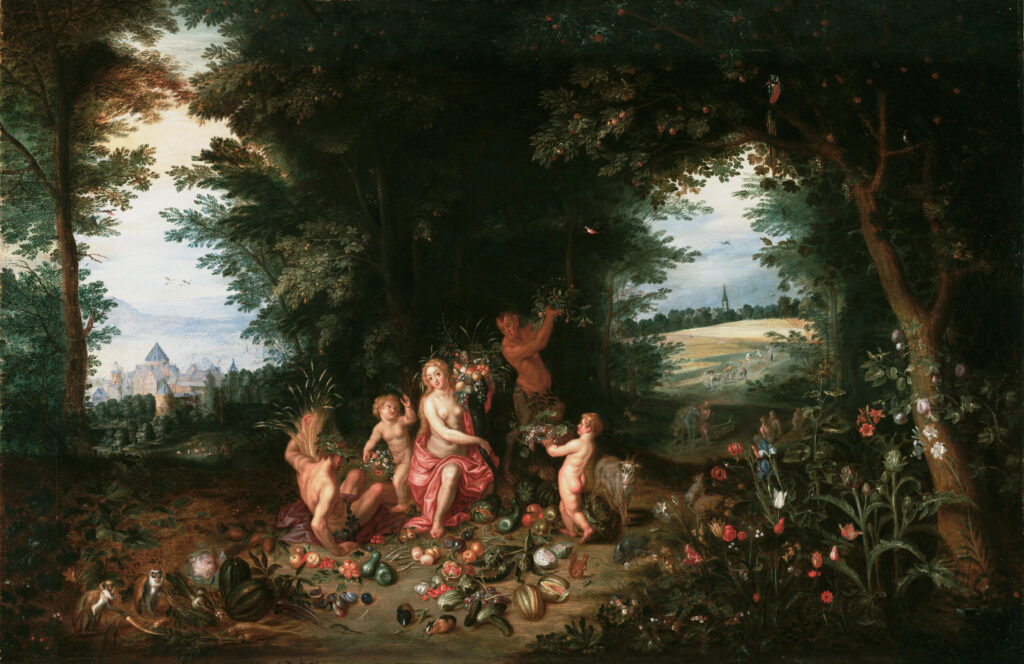
Antwerp, 1630s. Jan Brueghel the Younger and Hendrick van Balen unite their talents to celebrate the Earth. At the heart of a luxuriant landscape, Ceres, Roman goddess of agriculture, radiates surrounded by her mythological attributes.
A Symphony of Fertility
Observe this composition. At the center, Ceres in her coral pink dress draws the eye. Chubby putti and satyrs surround her. In the foreground, a still life overflows with meticulously rendered fruits, vegetables, and flowers. Each tulip, each gourd possesses its own texture. In the background, a landscape of golden fields, fortified castle, church with pointed steeple. The mixed technique of the two Flemish masters harmonizes perfectly. Van Balen excels in delicate nudes with pearly flesh. Brueghel deploys his talent for botanical and atmospheric details.
The Legacy of an Artistic Dynasty
This canvas belongs to a prestigious family tradition. Jan Brueghel the Younger perpetuates the ornamental style of his father, Jan Brueghel the Elder, who already collaborated with Van Balen. This allegory reflects the era’s fascination with classical mythology and visual encyclopedism. The fertile Earth symbolizes the abundance and prosperity sought by the bourgeois patrons of Antwerp, a flourishing commercial city.
Jan Brueghel the Younger and Hendrick van Balen
Jan Brueghel the Younger (1601-1678) inherited his father’s workshop at sixteen. He developed a luxuriant style where miniaturized landscapes and still lifes abound. Hendrick van Balen (1573-1632), his elder, contributed his mastery of mythological figures. Together, they created a sophisticated work destined for erudite collectors.
Think about it
💭 How do you view this celebration of nature in our era of ecological questioning?
About This Work
- Landscape with Ceres (Allegory of Earth)
- Jan Brueghel the Younger and Hendrick van Balen
- 1630s
- Oil on canvas
- 52.5 × 81.5 cm
- The J. Paul Getty Museum, Los Angeles
- https://www.getty.edu/art/collection/object/103RBD