Key Facts
The Artist’s Wife with Flowers is an oil on canvas painted around 1928 by the Austrian painter Viktor Planckh, held at the Belvedere in Vienna. A member of the Vienna Hagenbund from 1927 to 1938, Planckh worked within the New Objectivity movement (Neue Sachlichkeit), which in Austria favoured a return to clear, legible forms following the abstract experiments of the early twentieth century. Born in Troppau in 1904 and died in Athens in 1941, the artist left behind a body of work that remains little known to the general public. Through its restrained composition and precise detail, this portrait illustrates the aesthetic principles characteristic of this interwar movement.
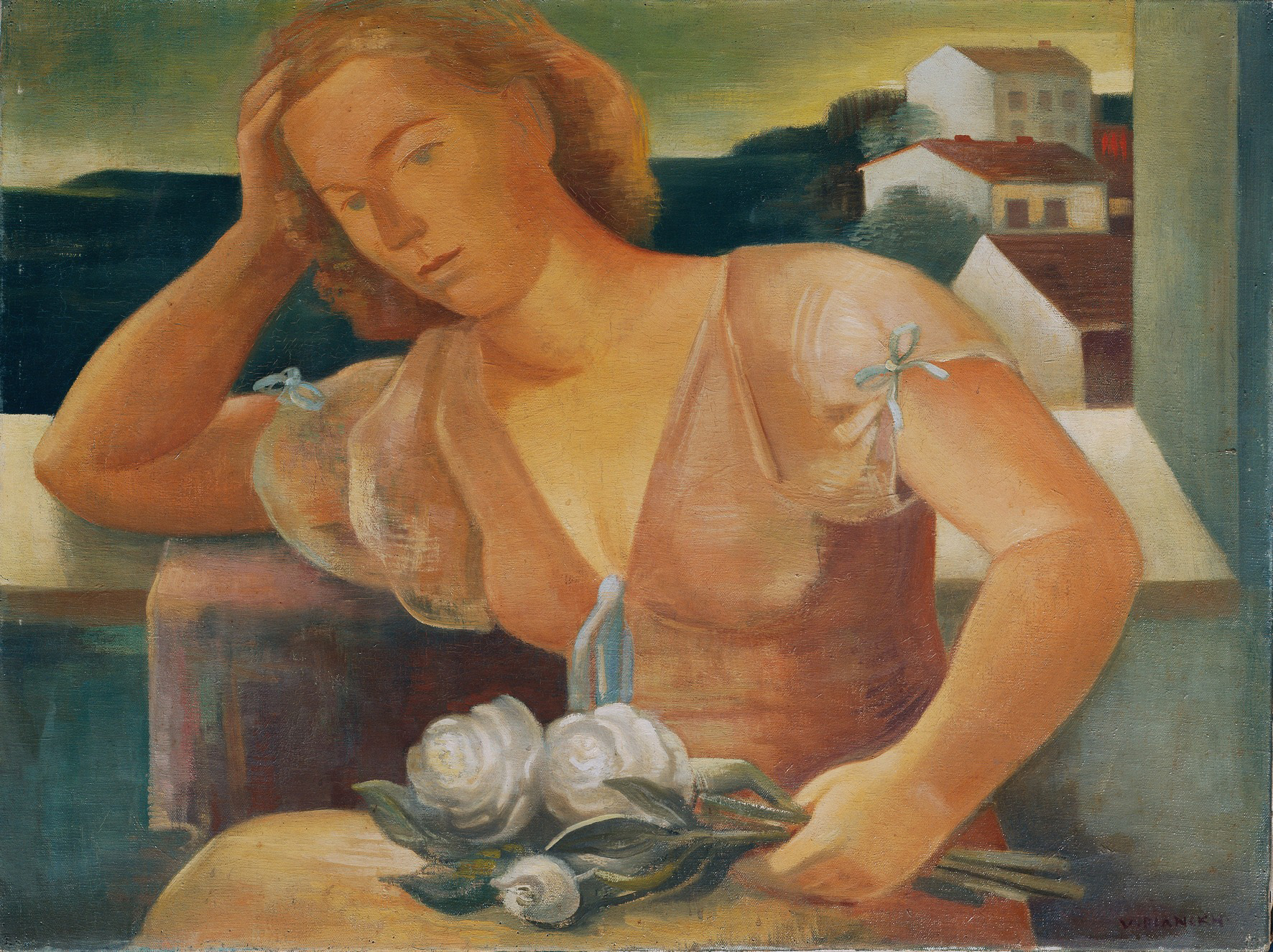
This is a period and a style I love deeply. In the 1920s, forms become simplified, almost stylised, and colours turn soft, almost muted. This work captures that particularly well. What is depicted here is a moment of reverie: the young woman leans on the windowsill, her gaze distant, while behind her a landscape and village houses seem to hang suspended, out of time. Despite this simplification of line, I find precise, careful details remain, almost tender ones: the bows tied at the shoulders of her dress, the texture of the flowers resting on her lap, or the delicacy with which her skin is rendered. That contrast is what moves me every time in this kind of painting: a composition that is tightly constructed, almost geometric, yet one that never keeps emotion at bay.
A blue ribbon, tied in a simple gesture, holds the strap against her bare shoulder. You are standing before The Artist’s Wife with Flowers. Viktor Planckh painted this oil on canvas around 1928. It is now held at the Belvedere in Vienna.
What the Painting Tells You
The background is reduced to broad flat planes. The village houses are rendered as simple, almost geometric blocks beneath a pale yellow sky. This flatness contrasts with the young woman’s body, modelled in soft, almost sculptural volumes. Planckh builds the skin through successive glazes, with no visible impasto, giving the flesh tone its smooth, golden quality. The blue bows on her dress are painted with a clean, almost graphic line, as though laid on top of the surface. The white flowers are handled more loosely. A few touches of pure white suggest crumpled petals. This economy of means makes every detail more visible.
What the Era Tells You
Vienna emerges shaken from the First World War. Austrian artists turn away from the abstraction and Expressionism of the 1910s. They return to clear, recognisable forms. This movement has a name: New Objectivity, or Neue Sachlichkeit. Viktor Planckh adopts its principles. A member of the Vienna Hagenbund from 1927 to 1938, he exhibited alongside other artists of the group. The clarity of the drawing, the restraint of the palette: all of it belongs to this pictorial vocabulary.
Viktor Planckh
Born in Troppau, present-day Opava, in 1904, Viktor Planckh studied at the Kunstgewerbeschule in Vienna. He died in Athens in 1941, leaving behind a body of work still largely unfamiliar to the wider public.
Current Context
The Belvedere devotes a significant part of its permanent collection to the interwar period. This movement, New Objectivity, is embodied in Austria by artists such as Rudolf Wacker, Franz Sedlacek and Marie-Louise Motesiczky. Viktor Planckh, a member of the Hagenbund from 1927 to 1938, belongs to this same current.
Source: Belvedere Museum
A Question for You
If you could take away a single detail from this canvas, which would you choose: the young woman’s distant gaze, or the flowers resting on her lap?
About This Work
- The Artist’s Wife with Flowers
- Viktor Planckh
- c. 1928
- Oil on canvas
- 60 x 80 cm
- Belvedere Museum, Vienna
- https://sammlung.belvedere.at/objects/2687/die-gattin-des-kunstlers-mit-blumen