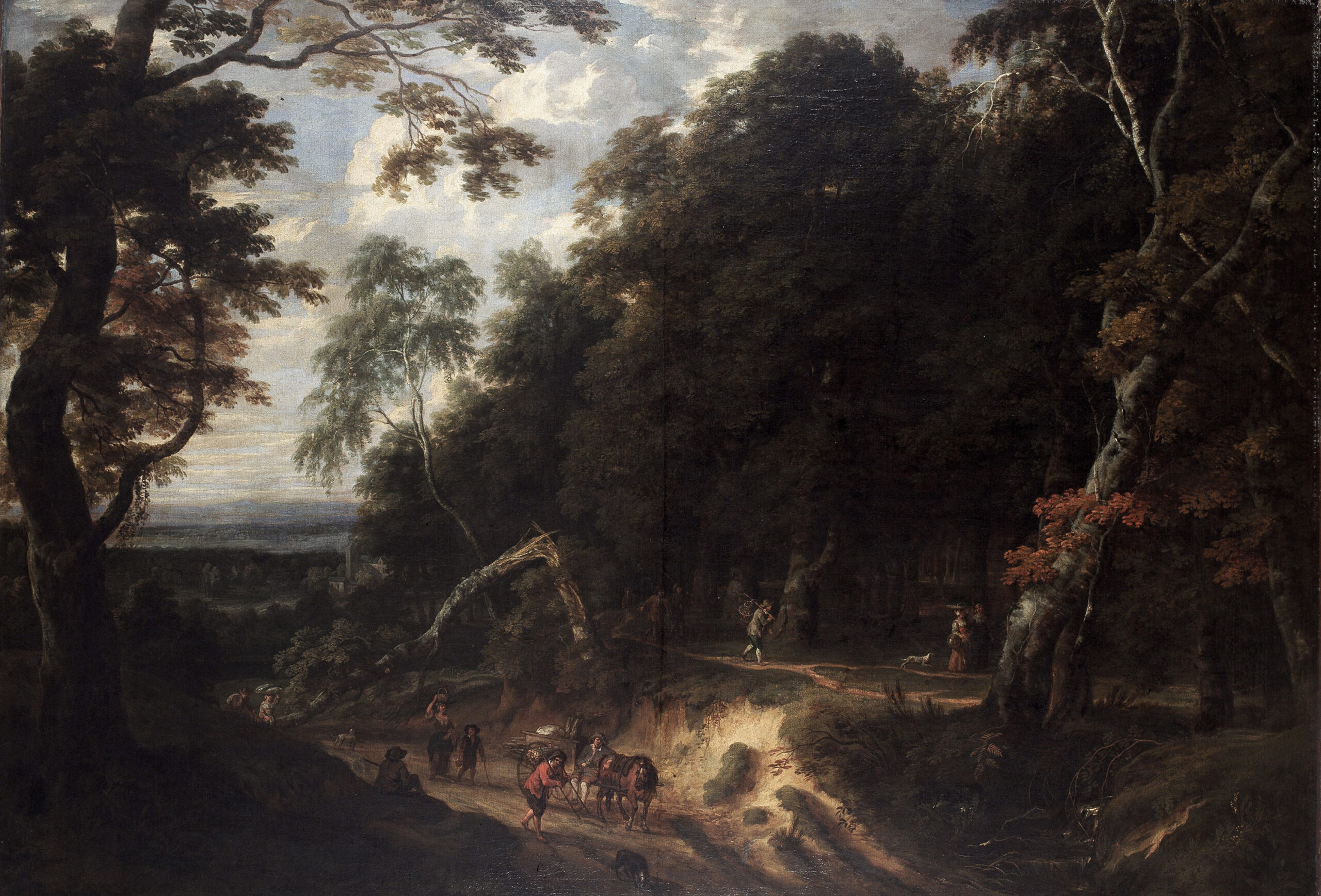
Brussels, 1686. On a dirt track, travellers press forward, unaware that they are entering one of Belgium’s greatest forests. Jacques d’Arthois immortalises the scene.
Light Captured Beneath the Canopy
On the left, a cloudy sky filters cold light over the distant plain. On the right, the forest absorbs everything. D’Arthois works with a broad, vigorous touch: the foliage is dense, almost oppressive. Rough bark emerges from the shadow. At the centre, a dead tree collapses diagonally. It breaks the verticality of the great trunks. This vegetable corpse catches the eye immediately. The figures, tiny against these masses of vegetation, are lively and animated — yet crushed by nature.
The School of the Sonian Landscape Painters
The Soignes Forest is not simply a backdrop. In 17th-century Flanders, this woodland mass at the gates of Brussels fascinated painters. D’Arthois founded, alongside Lodewijk de Vadder, the school of Soignes landscape painters — a movement specialising in these verdant undergrowths, sandy ravines and silent ponds. To paint the forest was also to assert a powerful regional identity. The human figures were most likely executed by David Teniers the Younger.
Jacques d’Arthois
Jacques d’Arthois (1613–1686) was born and died in Brussels. Court painter to the archdukes, he devoted himself to forest landscapes with incomparable mastery. His broad touch, earthy palette and monumental compositions define the visual identity of late Flemish landscape painting.
A Question for You
💭 While Jacob van Ruisdael was simultaneously painting his turbulent forests in Holland, d’Arthois was imposing in Brussels a radically different vision. Two countries, two ways of inhabiting the forest in paint. Which speaks to you more?
About this work
- The Soignes Forest with Figures
- Jacques d’Arthois
- 1686
- Oil on canvas
- 134 × 239 cm
- Museum of Fine Arts Ghent (MSK Gent)
- https://www.mskgent.be/fr/collection/1882-e