Key facts
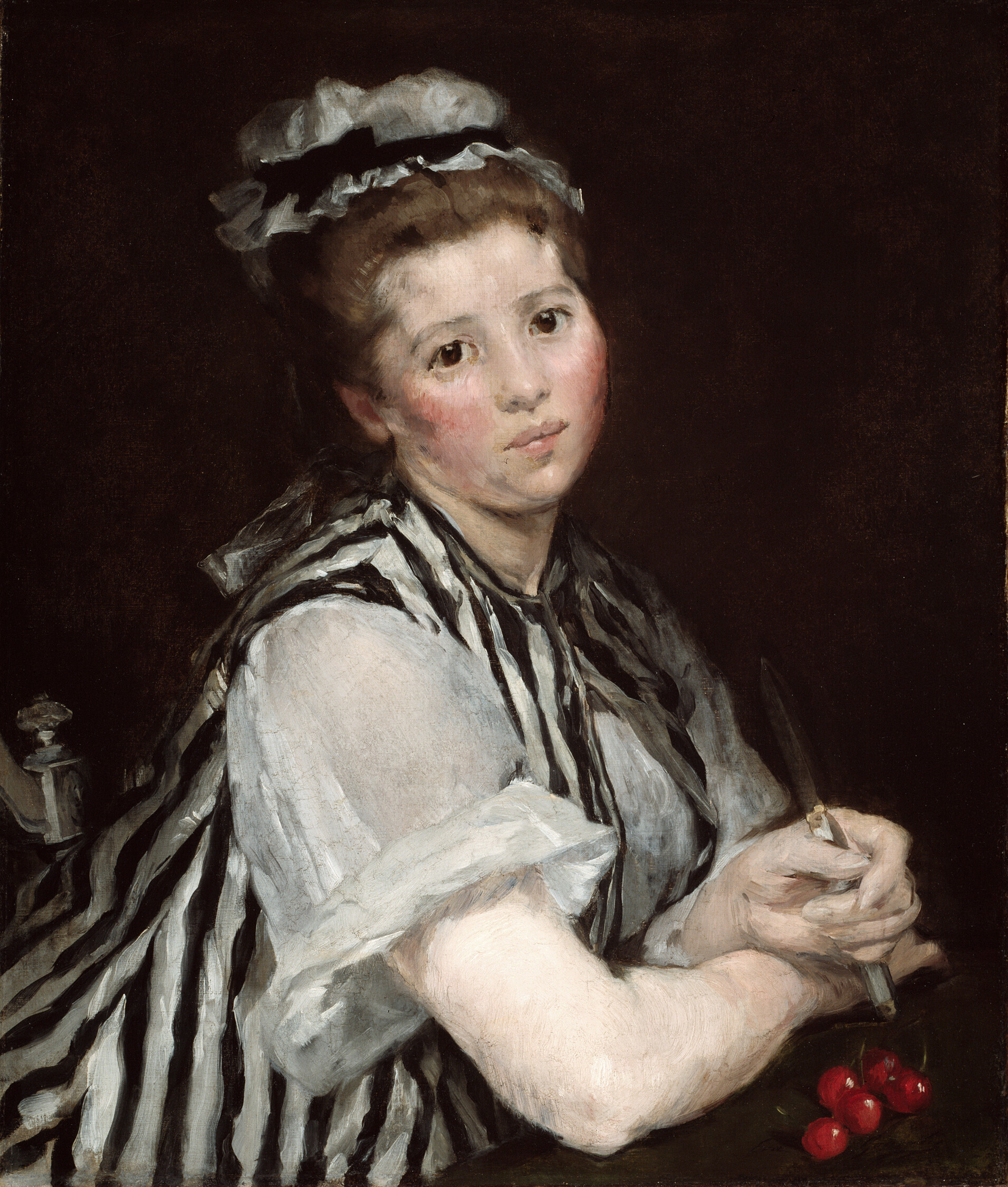
Painted around 1870 by Eva Gonzalès (1847–1883), Girl with Cherries is in the collection of the Art Institute of Chicago. The painting shows a young woman dressed as an 18th-century servant, a knife in her hand, beside a few cherries, against a dark background. As Édouard Manet’s only pupil, Gonzalès borrows her master’s theatrical lighting and his taste for costume. Her work belongs to the modern realism that ran alongside Impressionism, though she never joined the group. The canvas is in dialogue with Manet’s Young Man Peeling a Pear (1868). It is featured in the artist’s first major retrospective, held at the Petit Palais in 2026–2027.
Manet’s influence is felt immediately in this painting, don’t you think? The way the figure turns toward us, that frank gaze fixing us without hesitation, the barely modelled face, and the outfit: the linen cap, the striped gown and the rolled-up sleeves of an 18th-century servant recall Edouard Manet’s fondness for models in disguise. Even the dark background from which the figure emerges, with its almost theatrical lighting, evokes his “Spanish” paintings. Yet I find that Eva Gonzalès’s personal style is already clearly visible: her skill with colour, with whites and blacks answering each other in the stripes, brought to life by the red of the cherries; her sure, direct brushwork, free of needless retouching; and the way she approaches the figure she portrays. Where Manet often keeps a certain distance, she seems more interested in the young woman herself, in her quiet presence. I love this painting for showing a simple situation, caught in the moment, that doesn’t feel posed. That is in fact what strikes me most: although the model is in costume, and therefore necessarily staged, she gives off a surprising naturalness, as if we had interrupted a moment of everyday life. For an early work, painted shortly after she began studying with Manet, it already bears the signature of an artist who knows what she wants.
You are looking at a blade. A small knife, held point upward, catches a grey glint. Below, a few cherries gleam on the dark table. Between the two, a young woman looks at you. She isn’t really working. She isn’t quite posing.
What Girl with Cherries tells us
Look at the dress. The black and white stripes fall in broad brushstrokes, with no concern for outline. On the sleeve, the paint remains visible: thick, almost raw. The face, by contrast, takes only a few touches: two brown eyes, flushed cheeks, a barely sketched mouth. The brushwork is loose and quick. It seems laid down in a single pass, with no visible pentimento. The black background ought to crush the figure. Instead, it holds her up. Look to the left at the metal vessel, almost swallowed by shadow. A single warm accent crosses this range of greys: the red of the cherries. The whole painting rests on this tiny shift of colour.
What the era tells us
Around 1870, the École des Beaux-Arts is still closed to women. Gonzalès first trains with Charles Chaplin, then joins Manet in 1869. She becomes his only pupil. Here, she answers him. Manet’s Young Man Peeling a Pear (1868, Nationalmuseum, Stockholm) already brings together a fruit, a knife and a figure in costume. Gonzalès takes up the arrangement. But her model raises her eyes. The gesture stops, and it is you who step into the scene. Even the date is elusive. The Art Institute of Chicago’s catalogue entry gives c. 1870. Other specialists place it closer to 1873–1874. A servant from another century, painted by a daughter of high society. A costume, and no pose.
Born in Paris in 1847, the daughter of the novelist Emmanuel Gonzalès, Eva Gonzalès exhibits at the Salon from 1870 to 1883 without joining the Impressionist group. She marries the engraver Henri Guérard in 1879. She dies in 1883, shortly after the birth of her son.
News: Girl with Cherries on view at the Petit Palais
Until January 24, 2027, Girl with Cherries has left Chicago for the Petit Palais in Paris, which is devoting its first major retrospective to Eva Gonzalès: “Eva Gonzalès (1847–1883): A Free-Spirited Artist.” No museum in France or elsewhere had ever staged a major exhibition of Manet’s only pupil. The show brings together nearly one hundred paintings, pastels and prints. It also restores the place of three people who shaped her career: her sister Jeanne, her favourite model; her husband, the engraver Henri Guérard; and Manet himself. Organised with the Van Gogh Museum and with the support of the Musée d’Orsay, the exhibition will travel to Amsterdam in February 2027. Meanwhile, the Art Institute of Chicago is presenting “Mary Cassatt: After Impressionism” until January 3, 2027, a fine opportunity to compare two painters long filed under the same label of “women Impressionists.”
Source: Petit Palais.
A question for you
💭 Why did Eva Gonzalès, a contemporary of the Impressionists, never exhibit with them, choosing the official Salon instead?
About this work
- Girl with Cherries
- Eva Gonzalès
- c. 1870
- Oil on canvas
- 56.2 × 47.4 cm
- Art Institute of Chicago
- https://www.artic.edu/artworks/36678/girl-with-cherries