Key Points
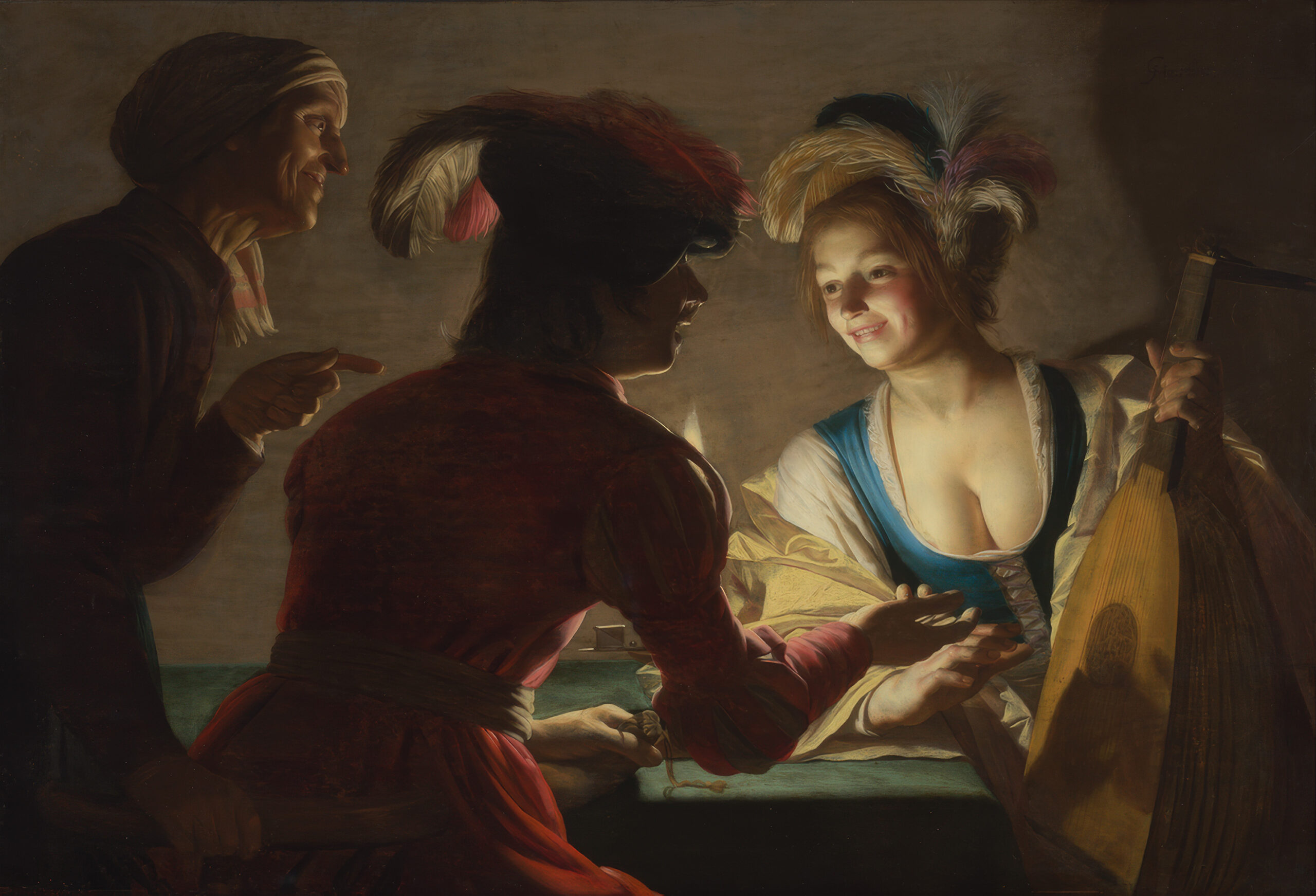
Painted in 1625 by Gerrit van Honthorst, The Procuress is an oil-on-panel work housed at the Centraal Museum in Utrecht. It depicts a scene of procuration illuminated by a single, concealed candle, a technique of indirect lighting that the artist helped pioneer. A leading figure of the Utrecht Caravaggisti, Van Honthorst had brought Caravaggio’s chiaroscuro style back from Rome, earning him the nickname “Gherardo delle Notti” (Gerard of the Nights). The painting illustrates the theme of the procuress, linked to the Parable of the Prodigal Son, which was widespread in Dutch Golden Age painting. It is one of the works that established the artist’s reputation for nocturnal scenes.
Standing before this painting, what strikes me first is the economy of light: a single candle, with only its tip visible behind the central figure’s shoulder, suffices to structure the entire scene. This stylistic choice, a hallmark of the Utrecht Caravaggisti that Van Honthorst brought back from Italy (where he was nicknamed Gherardo delle Notti), is not, in my view, merely a decorative effect. I find that it perfectly suits the subject matter: this low, conspiratorial light, which isolates faces within the shadows, reinforces the furtive nature of a transaction best kept hidden. The title places the old woman, the procuress, at the heart of the composition, leaving no doubt as to the nature of the exchange. The coins held out by the man, along with the young woman’s low-cut bodice and lute, tell the whole story. What captivates me most is the handling of chiaroscuro on the young man’s profile; that shadowed face, defined by a mere sliver of light, demonstrates, to my mind, remarkable powers of observation and a mastery that transcends mere technical prowess to serve the narrative. How can a scene depicting prostitution radiate such joy, smiles, and light?
A scene of complicity
First, look at the candle hidden behind the young man’s shoulder. Its flame warms the young woman’s skin and glides across her décolletage, reaching up to the feathers of her headdress. She smiles, radiant. Facing her, the man holds out a few coins. Everything in this warm light breathes an air of complicity.
A moral reading
This woman is no ordinary citizen. Her feathers signal her frivolity, while her lute carries an erotic charge well-known in the 17th century. In the shadows, the old procuress points a finger: she has sold the young woman and is pocketing her share. The motif, originating with Dirck van Baburen, extends the parable of the Prodigal Son. Yet, nothing here passes judgment.
The artist. Gerrit van Honthorst was born in Utrecht in 1592. In Rome, he was deeply influenced by Caravaggio. His candlelight scenes earned him the nickname Gherardo delle Notti (“Gerard of the Nights”). Upon his return around 1620, he became a leading figure of the Utrecht Caravaggisti.
Van Honthorst: A rediscovery in 2026
Long overshadowed by his contemporary Rembrandt, Gerrit van Honthorst is now the subject of renewed interest. From April 25 to September 13, 2026, the Centraal Museum in Utrecht, where The Procuress is housed, will present In alles anders dan Rembrandt (“In every way different from Rembrandt”). This will be the very first major retrospective dedicated to the painter in the city where he was born, married, and died. The exhibition brings together some sixty works, including loans from the Louvre and the Galleria Borghese, tracing the career of the chiaroscuro master known as “Gherardo delle Notti.” An opportunity to re-evaluate a major figure of the Utrecht Caravaggisti, a movement for which The Procuress (1625) stands as a key milestone.
Source: Centraal Museum
A question for you
💭 If you could keep just one detail, which would you choose: the smile, the flame, or the lute?
About this work
- The Procuress
- Gerrit van Honthorst
- 1625
- Oil on panel
- 71 x 104 cm
- Centraal Museum, Utrecht
- https://collectie.centraalmuseum.nl/details/collection/7069