Key facts
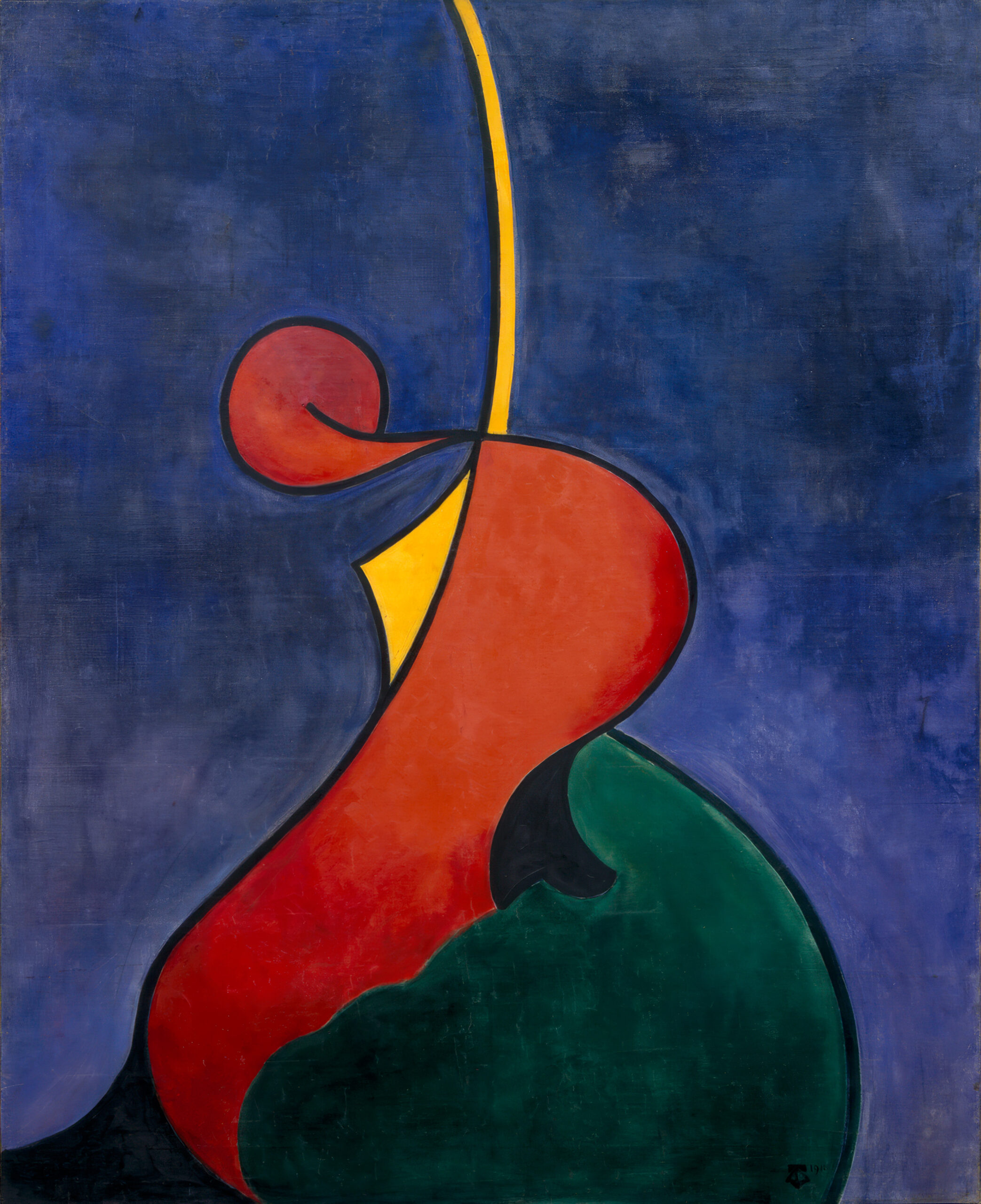
Painted by Theo van Doesburg in 1916, Mouvement héroïque (“Heroic Movement”) marks a turning point in the Dutch artist’s career, poised between the naturalistic painting he inherited from the Hague School and a geometric abstraction built with ruler and compass. Held at the Centraal Museum in Utrecht, the painting predates by one year the official founding of the De Stijl movement, which Van Doesburg launched in 1917 together with Piet Mondrian. It draws on two very different sources: mystical encounters with painters of “thought-forms,” and the dancing figures of Matisse. This dual origin, at once rational and intuitive, makes the work a pivotal step toward the abstraction that would come to define both Van Doesburg’s career and the history of De Stijl.
Another artist discovered while wandering through a museum’s collection. This time it’s Theo van Doesburg who caught my attention, with his Mouvement héroïque. What strikes first is the almost mathematical rigour of the composition: circles, diagonals and flat planes of colour arranged with real precision, infrared reflectography carried out in 1982 revealed that the painting is built on a grid of nine sections crossed by diagonals, with compass points still visible at the intersections. Yet far from being abstraction for its own sake, the work grows out of something concrete: a sketch of a walking figure, hands drawn up to the chest, which Van Doesburg had already made in 1915. The title, long recorded in the artist’s catalogue as “Heroïsche beweging (La Danse),” invites us to read this geometrised movement as a kind of surge, almost a trance.
Painted in 1916, a year before the official founding of De Stijl with Mondrian, the canvas captures a hinge moment: Van Doesburg, still marked by the mystical visions born of his meeting with the esoteric painter Janus de Winter, was already trying to translate movement through geometry and colour alone. The word “heroic” may seem an odd fit for so stripped-down a figure, but it makes sense once placed back in its time: to attempt such formal radicalism, at a moment when it was still misunderstood and rarely exhibited, already took a certain conviction.
Utrecht, 1916. Van Doesburg, ruler in hand, compass open on the canvas. One expects a free, spontaneous gesture. There is none: every curve follows a plan laid out in advance, almost in spite of him.
A figure ruled into place
A red mass coils in on itself, like a head tilted toward the shoulder. A taut yellow line, stretched like a cord, connects it to an orange torso that curves downward. A green form closes the composition, resting on a black base. The deep blue ground absorbs the bright colours without ever dimming them. Every coloured plane stops sharply against a black line, with no gradation, no hesitation. The movement seems to surge upward. Yet the canvas does not shift an inch: everything in it is fixed, measured, held within its own momentum.
A conversion under dispute
For a long time, Van Doesburg painted in the naturalistic style of the Hague School. In Utrecht, where wartime mobilisation had kept him, he met Erich Wichman and Janus de Winter. Both men painted aura portraits and “thought-forms.” In 1915, he tried his hand at this mystical vein himself, drawing on a theosophical text. He also sketched figures in motion, close to the dancers Matisse had painted in 1910, of which he kept a reproduction. Mouvement héroïque grew out of this crossing of influences. Van Doesburg dated the preparatory sketch to 1913. Nothing in his output from that period supports this; spring 1916 seems far more likely. In July 1916, he wrote to the architect Oud that years of pent-up life had finally poured into this canvas. Critics at the time judged the painting both too rational and too spontaneous.
Theo van Doesburg
Born Christian Emil Küpper, he lost his photographer father before he was even a year old. He took the name of the stepfather who raised him. Theorist, poet, critic, organiser, he also played the Dadaist under the name I.K. Bonset. He signed his poems, too, as Aldo Camini. He had once dreamed of becoming an actor: whichever role he took on, he played it with total conviction.
A house still standing
Van Doesburg founded De Stijl with Mondrian in 1917, a year after this painting. In Utrecht, the Centraal Museum manages the Rietveld Schröder House, the only fully realised piece of De Stijl architecture, listed as a UNESCO World Heritage Site since 2000. It can still be visited today, by booking ahead.
Source: Rietveld Schröder House
A question for you
💭 Can a painting built from curves and diagonals foreshadow a movement that would go on to ban them?
📌 About this work
- Mouvement héroïque (“Heroic Movement”)
- Theo van Doesburg
- 1916
- Oil on canvas
- 136 x 110.5 cm
- Centraal Museum, Utrecht
- https://collectie.centraalmuseum.nl/details/collection/21759