Key facts
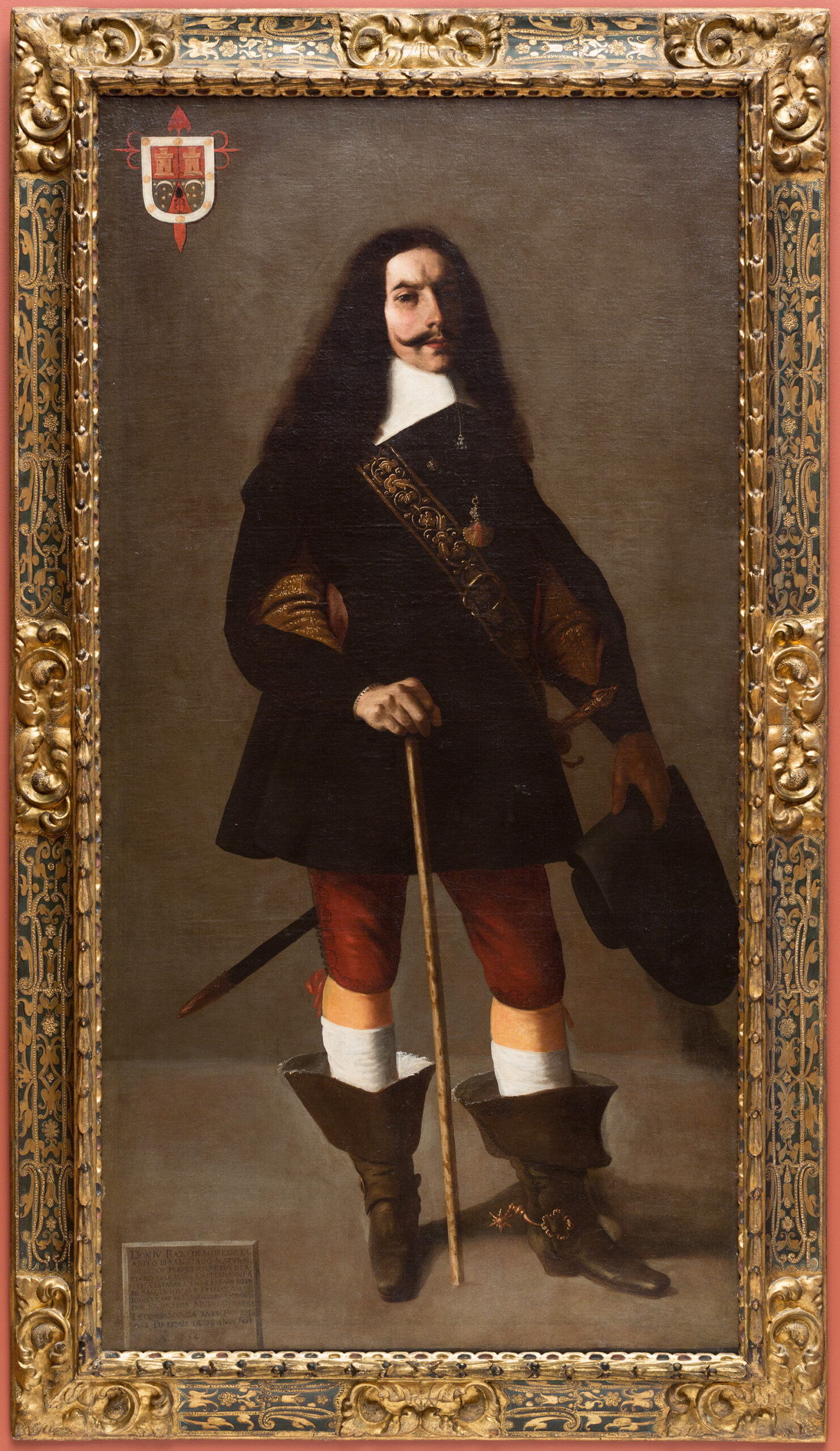
Painted around 1655 by Francisco de Zurbarán (1598-1664), Don Juan Bazo de Moreda is one of the few known secular portraits by the Sevillian master, a major figure of Baroque painting during the Spanish Golden Age. The oil on canvas shows, life-size, an infantry captain and sergeant major of the tercios, a knight of the Order of Santiago, leaning on his staff of command. An inscription states that the sitter died in 1654 at the age of 38: the portrait is therefore posthumous, conceived as a commemorative tribute. Acquired in 2015 by the Detroit Institute of Arts, it is on view in Paris in the Louvre’s exhibition “Zurbarán 1598-1664” in 2026-2027.
I have just visited a fascinating exhibition at the Louvre: Zurbarán 1598-1664. Fascinating because it offers a wide selection of works by the Sevillian master. You discover many sacred paintings, a few mythological subjects, still lifes of great intensity, and a rare military portrait that I am presenting here. It interests me particularly because it belongs to a little-known side of the artist: secular portraiture. Standing before the canvas, almost life-size, you find everything that makes Zurbarán so powerful: the precise rendering of fabrics, from the black velvet of the doublet to the gold-embroidered sleeves, the sculptural treatment of volumes, and that characteristic white, brilliant on the collar and stockings, catching the light. The painting depicts an officer of the Flanders tercios, Don Juan Bazo de Moreda, standing, leaning on his staff of command, a wide black hat in his hand. The background is deliberately bare, almost abstract, and only a cast shadow anchors the figure in space: nothing distracts the eye from the sitter. I took the time to look at the details that tell his story: the coat of arms topped by the red cross of the Order of Santiago in the upper left, the scallop shell hanging on his chest, the sword, the spur on his boot. But it was the inscription in the lower left that struck me most: it states that the sitter died in 1654, at the age of 38. This portrait, painted around 1655, is therefore posthumous, and that changes the way we see his proud stance and his half-shadowed face, like a final tribute paid to a man already gone.
What the portrait of Don Juan Bazo de Moreda tells us
Look at the face first, then the boots. They don’t quite speak the same language. The face is compact, lit from the side, almost restrained. The costume unfolds with a tactile ease, from the embroidered baldric to the flared cuffs of the boots. The Detroit museum puts forward a hypothesis: the family may have supplied a likeness, perhaps a miniature. Zurbarán would then have enlarged a small face to the scale of a full body. Notice, too, the three ways of painting on the surface. At the top, the coat of arms floats, flat, heraldic, without shadow. At the bottom, the inscribed plaque imitates stone, like a stele set on the ground. Between the two, a body modeled by chiaroscuro, with a very real cast shadow. Portrait, coat of arms and epitaph all fit on a single canvas.
What Zurbarán’s era tells us
The inscription unfolds an entire career. A native of Logroño, Don Juan served there as a regidor perpetuo, a town councillor for life. He served in Flanders as an infantry captain, then as sergeant major of the Tercio Viejo. He was also governor of Oudenaarde. At the time, the tercios were the most feared regiments of the Spanish monarchy. The red cross and the scallop shell mark the Order of Santiago, a reward for his services to the Crown. A man painted to be seen, by a painter who had probably never seen him. The Detroit Institute of Arts’ catalogue entry gives the full transcription.
Born in 1598 in Fuente de Cantos, in Extremadura, Francisco de Zurbarán built his career in Seville. He is ranked alongside Velázquez and Murillo among the great Spanish painters of the 17th century. A painter of saints and monks, he left few secular portraits.
News: Zurbarán at the Louvre
Until 25 January 2027, the Musée du Louvre presents “Zurbarán 1598-1664”, an exhibition co-organized with the National Gallery, London, and the Art Institute of Chicago. The portrait from Detroit is on view there. The exhibition will then travel to Chicago, from 28 February to 20 June 2027. More information: louvre.fr.
A question for you
Next to the portraits by Velázquez, his contemporary, does this one feel more alive or more frozen to you?
About this work
- Don Juan Bazo de Moreda
- Francisco de Zurbarán
- c. 1655
- Oil on canvas
- 199.7 × 102.2 cm
- Detroit Institute of Arts (on view at the Louvre until 25 January 2027)
- https://dia.org/collection/don-juan-bazo-de-moreda/103061