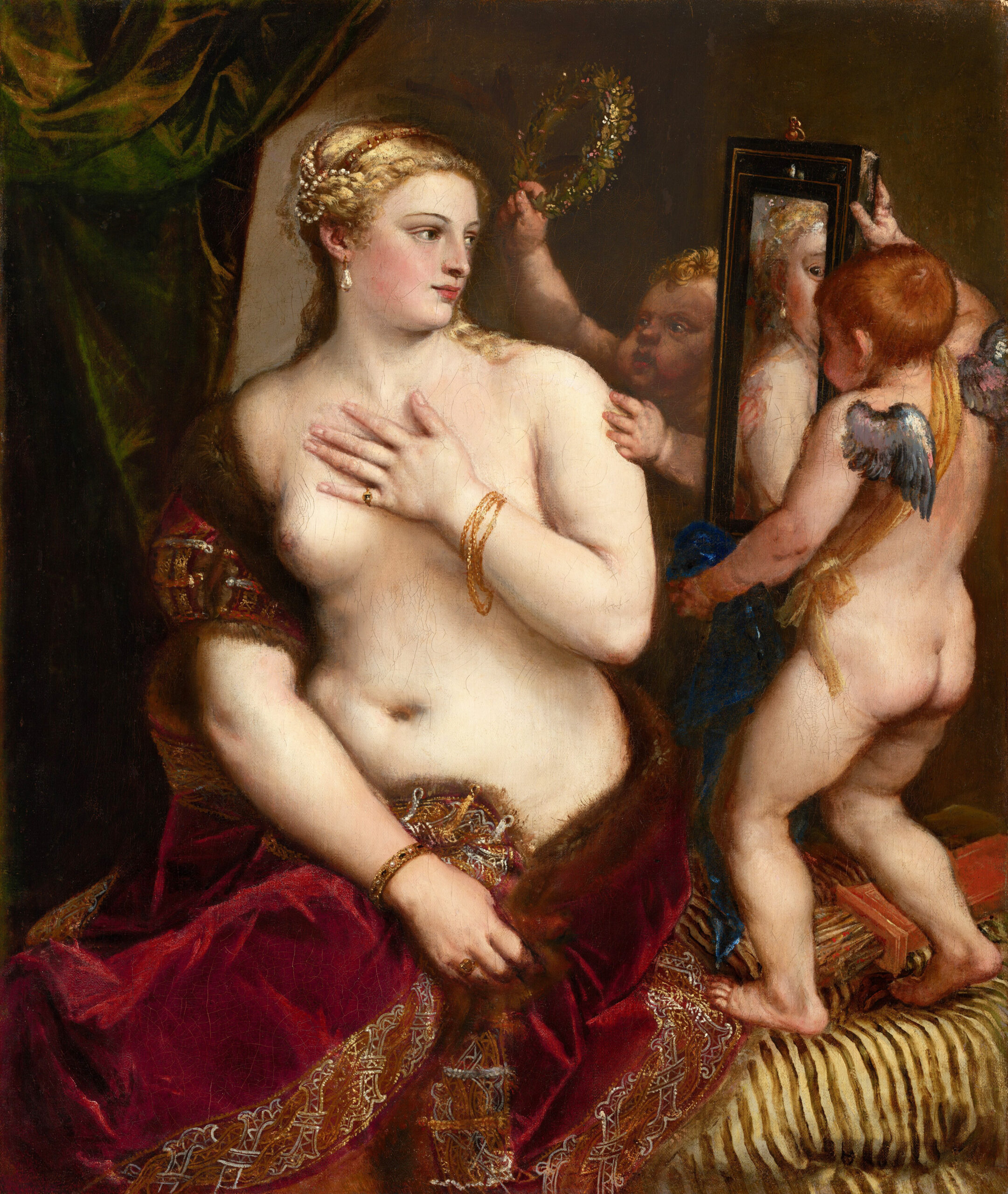
Titian made Venus one of the central subjects of his career, painting and repainting her throughout his life, each time from a new angle. Among all these variations, this is the one I chose to present to you today, and the choice is not arbitrary. In my eyes, this Venus with a Mirror is the most accomplished, the most unsettling too. Look at the texture of the skin: Titian achieves here that particularly carnal modelling, almost alive, that he spent decades perfecting. Observe the rendering of the fabrics and the fur, each material with its own density, its own weight, its own light. The jewels glitter with a goldsmith’s precision. But what holds my attention most is Venus’s gaze. She does not contemplate her own reflection as one might expect: she seems to look at us, through the mirror. A subtle detail that transforms the entire painting, we are no longer mere spectators, we become part of the scene. It is this ambiguity, this play with the gaze, that makes this work far more than a celebration of feminine beauty.
What you notice first is that crimson velvet, heavy, dense, almost tangible, draped around Venus’s hip. It draws all the light before your eye even travels up to her face. Then comes the skin, pearlescent white against the warm shadow of the background. And finally, the mirror: small, dark, held by a Cupid with tawny wings, reflecting back not the expected profile, but something else, something unresolved.
What Lies Beneath the Surface
Titian, the undisputed master of the Venetian Renaissance, constructs here an illusion on several levels. The technique is one he refined over decades: successive oil glazes, laid down in light touches until achieving that almost breathing complexion. The velvet itself conceals a secret of craft: Titian reused an earlier canvas depicting two figures side by side, rotated 90 degrees. What you take for luxurious embroidered cloth was, in a former life, the jacket of a male figure, and the painter allowed the underlying composition to surface, transforming a portrait into fabric. The composition exists in at least thirty variants from the workshop. This one is considered the most accomplished. Titian kept it until his death, more than twenty years after painting it. Why hold on to a canvas of such value without ever selling it? The answer remains open.
The Artist and His Time
Born in Pieve di Cadore around 1488, Titian dominated Venetian painting for more than half a century. Portraitist to the powerful, colorist of rare exception, he reinvented the female figure through his many Venus paintings, establishing a carnal and sensual ideal that would shape European painting well into the seventeenth century. Venus with a Mirror, held in the National Gallery of Art in Washington, is one of his last great statements on the subject.
National Gallery of Art: News from 2026
The National Gallery of Art in Washington, home to Titian’s Venus with a Mirror, is enjoying a particularly eventful year in 2026. The museum is marking the 250th anniversary of the United States with an ambitious program: its American galleries have been expanded to include additional historic works, alongside two special exhibitions.
Source: https://www.nga.gov/press/america-250
The museum is also devoting a major exhibition to the centenary of Mary Cassatt’s death, Mary Cassatt: An American in Paris, on view through August 30, 2026. An opportunity to rediscover this American artist, one of the very few women to have participated in the Impressionist movement, and every reason to visit this essential museum, and linger before the masterworks of its permanent collection, among them Titian’s Venus with a Mirror.
Source: https://www.nga.gov/exhibitions/mary-cassatt-american-paris
A Question for You
💭 Velázquez, Rubens, Boucher would each paint their own Venus with a Mirror after him: but can one still look at theirs without seeing Titian’s beneath?
About This Work
- Title: Venus with a Mirror
- Artist: Titian (Tiziano Vecellio, c. 1488–1576)
- Date: c. 1555
- Medium: Oil on canvas
- Dimensions: 49 x 41 1/2 in. (124.5 x 105.5 cm)
- Museum: National Gallery of Art, Washington D.C.