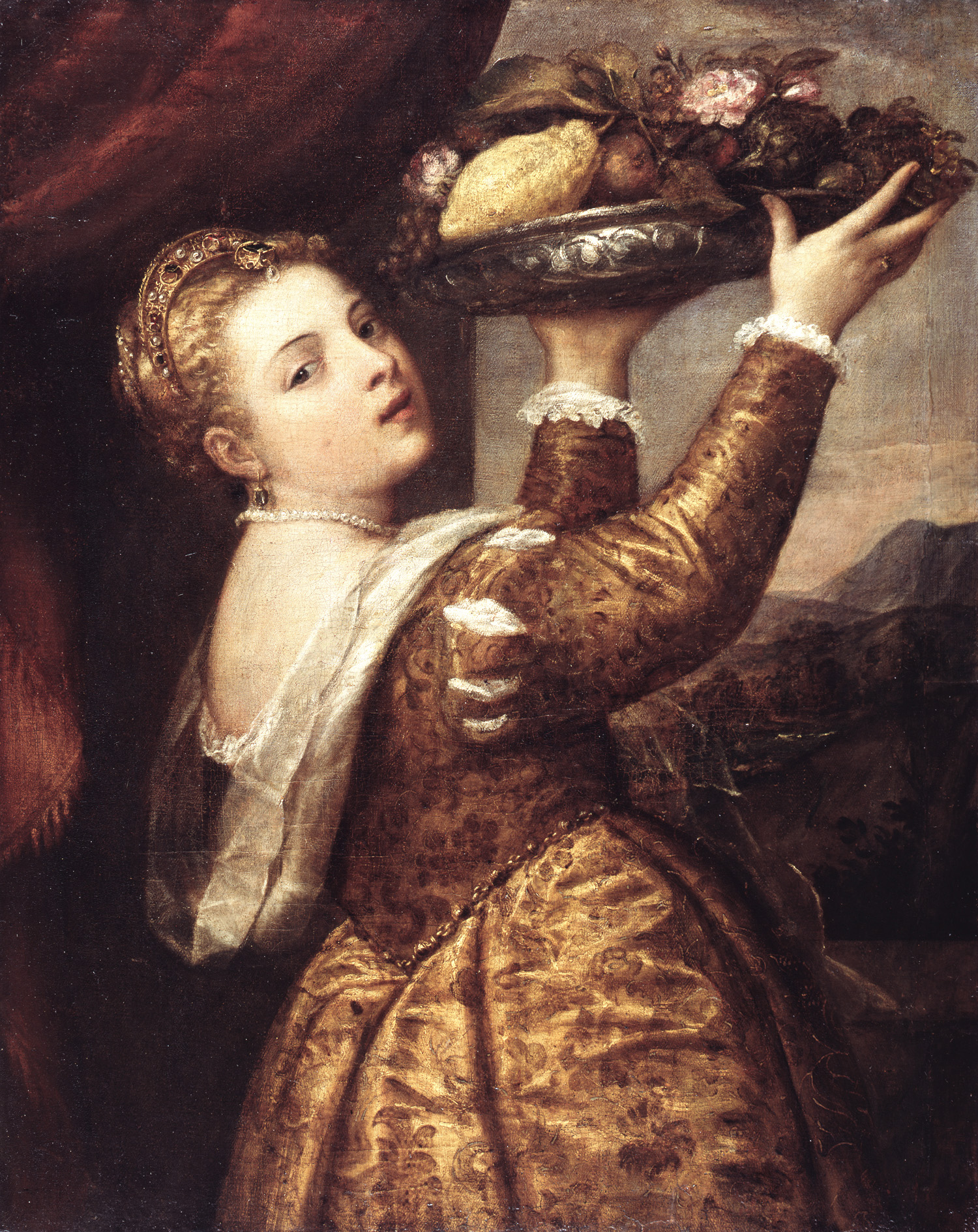
Venice, c. 1555. Titian catches a young woman in a suspended moment. She turns her head. Her gaze grazes yours, almost by chance. The basket of fruit she lifts seems alive.
A balance between grace and richness
Look at the dress. Gold burns in every fold of the Venetian brocade. Light slides across the white satin, rests on the pearls of the necklace. The complexion of the neck is luminous, painted in delicate glazes. The chiselled silver basket overflows with fruit and pink flowers — symbols of youth and abundance. In the background, a softened landscape opens the composition toward the horizon. Titian paints in broad, blended strokes. Everything breathes.
A prototype with many faces
This canvas is a founding work. Titian paints it over a broadly sketched seated female portrait visible beneath the surface. From it he draws several versions: one belongs to the Abbott collection in London, another to G. Encil, and a third is held at the Museo del Prado in Madrid under the title Salome. The same figure — young, elegant, holding a tray — moves across identities. Servant, saint, or allegorical figure? The Renaissance delights in these ambiguities. In Venice, representing feminine beauty is a genre in its own right, poised halfway between portrait and ideal.
Titian, undisputed master of Venetian painting
Tiziano Vecellio, known as Titian (c. 1488–1576), dominates Italian painting of the Renaissance and Mannerism. Portraitist of the powerful, supreme colourist, he revolutionised the treatment of light and pictorial matter. This work concentrates his entire art: colour as language, the body as presence.
A question for you
💭 What if this young woman were not a servant, but an ideal? What does her gaze say to you, today?
About this work
- Girl with a Basket of Fruit
- Titian
- c. 1555
- Oil on canvas
- 106.2 × 84.8 cm
- Staatliche Museen zu Berlin, Gemäldegalerie
- photo Jörg P. Anders / Public Domain Mark 1.0
- https://recherche.smb.museum/detail/865682/m%C3%A4dchen-mit-fruchtschale