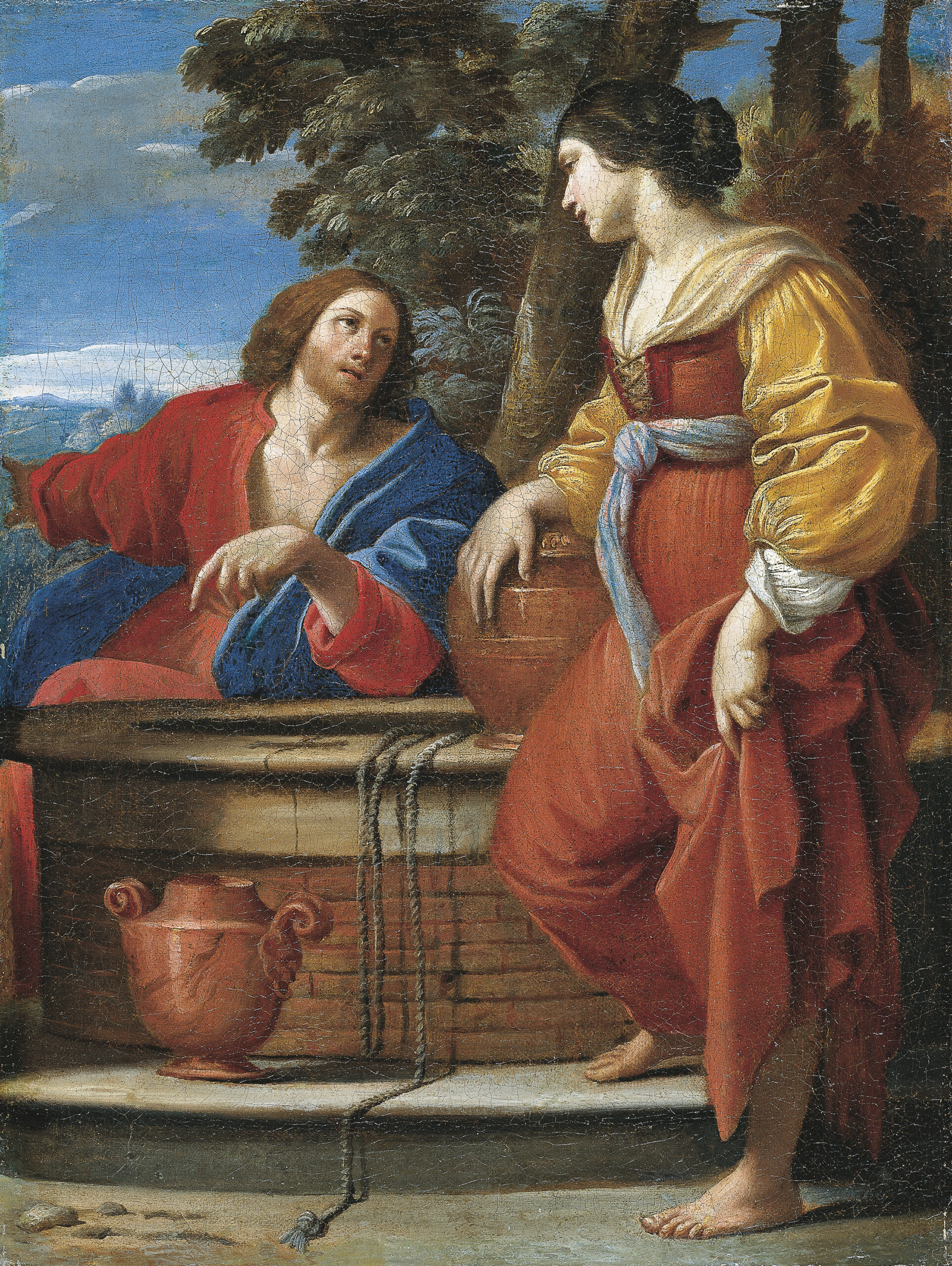
The encounter between Christ and the Samaritan woman at the well is a subject that recurs throughout the history of art, from the Italian primitives to the Baroque. What draws my attention here, beyond the intimate scale of a work remarkably accomplished for its modest dimensions, is the benevolent quality that Badalocchio brings to the scene. We are at the heart of the classicising Baroque that emerged from the Carracci school, of which this painter is one of the direct heirs, and one finds in this canvas that commitment to balance and human truth which defines the movement: the exchanged glances, the composed bearing of the figures, the restraint of the composition. Nothing ostentatious, nothing theatrical. The gesture of Christ conveys, with quiet precision, a welcome free of judgment, which is precisely the theological core of this Gospel episode. In my view, this is a fine example of intimate painting from the early seventeenth century, where the story is told less through brilliance than through presence.
This is not a scene of miracle. Or rather, nothing here resembles what one might expect of an encounter between the divine and the human.
What the canvas keeps to itself
Look at the hand of Christ. One finger extended, almost hesitant. No thunderbolt, no spectacular revelation. The Samaritan woman holds her pitcher. She is listening, or still resisting; one cannot say. That is the tension Sisto Badalocchio leaves unresolved. The technique is one of sober precision: oil on canvas, small format, 39.3 by 29.4 cm, with luminous highlights on the red and gold draperies that anchor the composition. The craquelure of the varnish adds a patina that seems almost to breathe. The painter works the exchange of gazes with a rare economy of means.
A painting for the dining room
This is what moves me in the history of this work. Around 1609 to 1610, Badalocchio painted this scene as he was leaving Rome, after years in the studio of Annibale Carracci. He returned to Parma, shaped by the Bolognese school, steeped in a classicising naturalism that sought truth in the figure rather than in symbol. Centuries later, this small-format work hung in the dining room of the Brentano family, prominent Frankfurt merchants. The inventory of their collection, compiled before the Städel acquired several of these pictures at auction in 1870, records this without ambiguity. A painting made for closeness. For the shared meal. To be seen at close range, almost in confidence. Badalocchio, a pupil of the Carracci, remains today one of the quieter representatives of this tempered Baroque, poised between Rome and Parma, between the breath of Raphael and the long shadow of Caravaggio.
The Städel Museum in 2026
The museum that holds this canvas is particularly active this season. From 19 March to 5 July 2026, the Städel presents a major exhibition devoted to the artistic discovery of Étretat, bringing together some 170 works including twenty-four paintings by Monet. A programme that confirms the standing of this institution among the great museums of Europe.
Source: staedelmuseum.de
A question for you
If you were to place this canvas on a line between Raphael and Caravaggio, where would you set the cursor, and why?
About this work
- Christ with the Samaritan Woman at the Well
- Sisto Badalocchio
- c. 1609-1610
- Oil on canvas
- 39.3 x 29.4 cm
- Städel Museum, Frankfurt am Main
- https://sammlung.staedelmuseum.de/en/work/christ-with-the-samaritan-woman-at-the-well