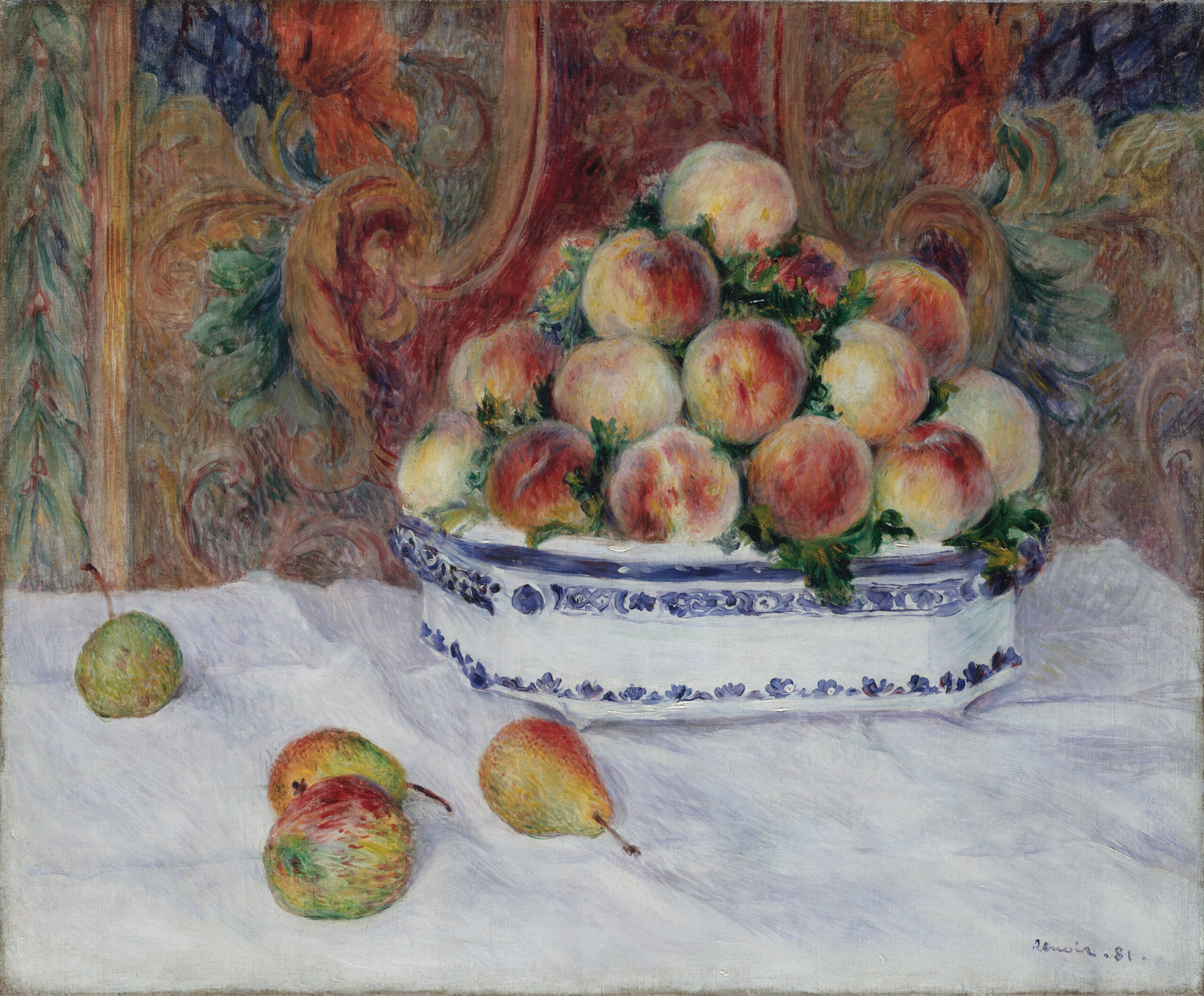
A still life so alive : that is what strikes me at first glance in this canvas by Renoir. The peaches feel almost tangible: one can imagine their soft down beneath the fingertips, their sweet fragrance, their flesh heavy with sunlight. They are perfectly ripe, caught in that fleeting moment of perfection that only a painter devoted to joy knows how to hold.
What moves me most is the way Renoir confounds the genre itself. The still life is traditionally an exercise in stillness, in immobility. Here, everything vibrates. His broken brushwork, inherited from his Impressionist years, breathes a shifting light into the fruit, the luminous white tablecloth, the warmly patterned decorative background. Nothing is fixed. Painted in 1881, this work belongs to the pivotal period when Renoir sought to move beyond Impressionism without disowning it, a creative tension felt here in the balance between the spontaneity of the brushstroke and the solidity of the composition. It is precisely this duality that makes the painting so compelling, and explains why the Metropolitan Museum of Art holds it among its most prized works. A painting I never tire of looking at.
Look
This is not a still life. Or rather, it is the exact opposite. Peaches spill from a blue-and-white faience dish. They pile up, touch, press against one another. Other fruits have escaped onto a tablecloth of almost vibrating white. Behind them, a swirling background of orange and green arabesques pulses like a living tapestry. Renoir signs at lower right: Renoir. 81. Laconic. Assured.
Understand
Summer, 1881. Renoir is a guest of Paul Bérard, his patron, at his country house in Normandy. He paints these peaches the way one fixes a perfect moment before it slips away. The faience dish will reappear in a second version, also held at the Metropolitan Museum of Art in New York. Critics at the 1882 Impressionist exhibition are dazzled, describing the handling as “velvety,” bordering on trompe-l’œil. Renoir stands at a crossroads. His Impressionist touch, fragmented, luminous, has begun reaching for structure. This canvas carries both: the impulse and the control, the vibration and the form. Neither fully one, nor fully the other.
Feel
Come closer. Look at the surface of these fruits. Renoir does not smooth: he lays colour down in small strokes that conjure the peach’s down more faithfully than any photograph. Pale yellow turns to carmine with no clean break. The flesh looks warm. We are far from the Flemish vanitas and its memento mori. Here, nothing decays. Nothing threatens. This is happiness stilled, for the duration of a canvas.
Renoir in Focus: 2026
This period, 1865-1885, Renoir’s most inventive, is being celebrated this year in London. The National Gallery presents Renoir and Love from 3 October 2026 to 31 January 2027, the most significant British retrospective in twenty years, co-organised with the Musée d’Orsay and the Museum of Fine Arts, Boston.
Source: National Gallery
A question for you
💭 If you had to describe this painting with a single word from the Impressionist vocabulary, light, touch, instant, sensation, which would you choose?
About this work
- Still Life with Peaches
- Auguste Renoir
- 1881
- Oil on canvas
- 53.3 × 64.8 cm
- The Metropolitan Museum of Art, New York
- https://www.metmuseum.org/art/collection/search/437429