Key facts
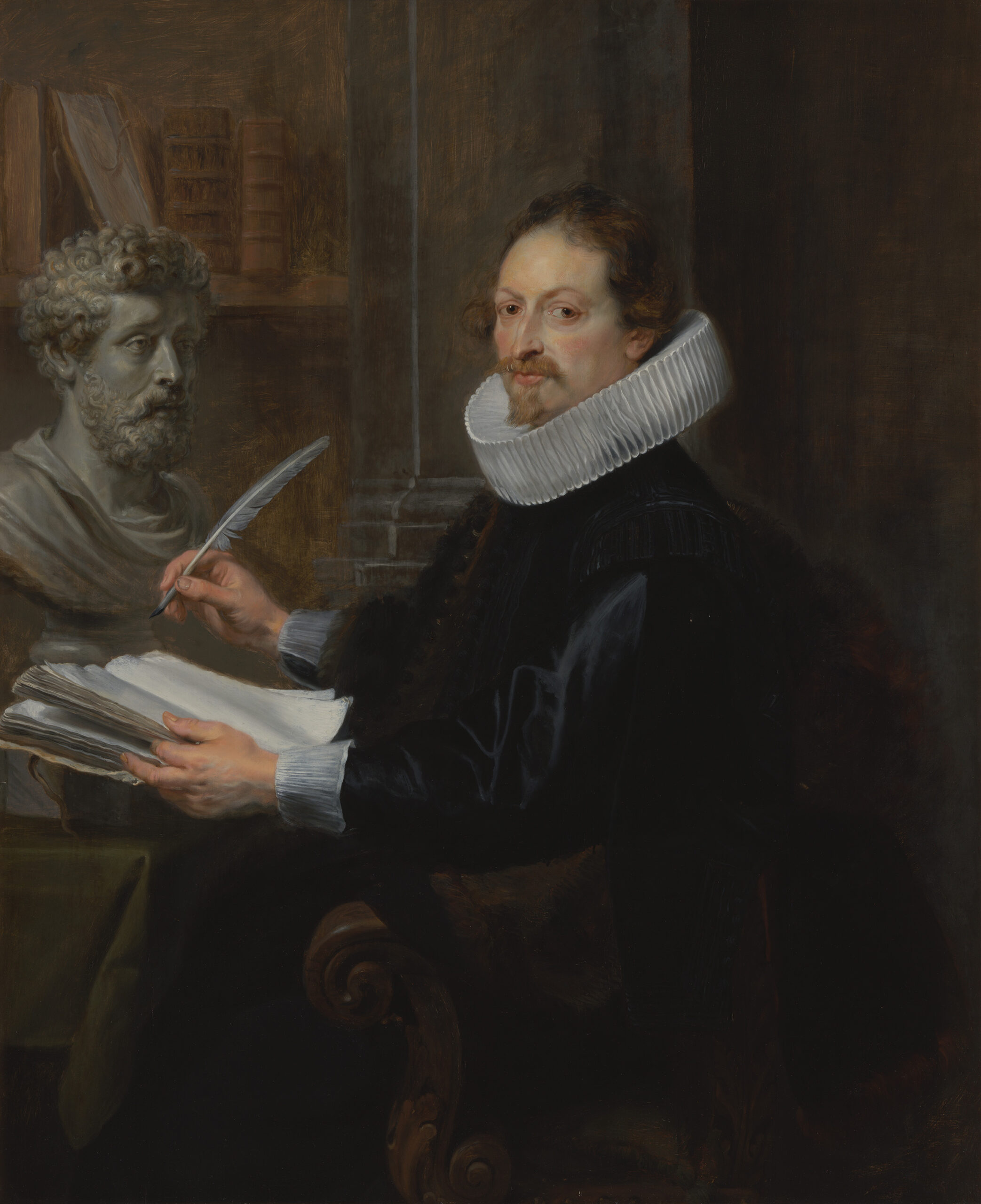
Jan Gaspard Gevartius (1628-1631) is an oil-on-panel portrait by Peter Paul Rubens, held at the KMSKA, the Royal Museum of Fine Arts Antwerp. It shows the humanist (1593-1666), city clerk of Antwerp and friend of the painter, in front of a bust of Marcus Aurelius. Linked to Flemish Baroque painting, the work belongs to Rubens’s last stylistic period (1630-1640). It is the mirror-image pendant of the portrait of Gevartius’s father. Rubens painted the face and hands, and an assistant painted the costume and background.
A portrait of a famous 17th-century Antwerp figure, painted by Rubens. I find it interesting because it bears witness to its time through the depiction of Gevartius, a scholar at work. Pen in hand, he writes under the gaze of the bust of Marcus Aurelius, Roman emperor and philosopher. This face-to-face between the humanist and his ancient model is, for me, the heart of the painting: knowledge and reflection are staged as true values. I also like the detail of the two still-blank pages of the manuscript, which gives the impression of catching Gevartius in the middle of his work, as if the writing were about to resume at any moment.
The portrait is also more reserved than other portraits of humanists painted by Rubens, which are often more frank and direct. This is explained by the fact that it was meant to be a pendant to that of Gevartius’s father, with the same composition reversed. This restraint seems to me rather fitting for a city clerk, a man of letters and of ceremony.
Also interesting because we know that Rubens mainly painted the noble elements of the portrait, the face and the hands, leaving the costume and the background to his workshop, a common practice in the 17th century. The choice seems coherent to me: the black garment and the discreet background focus the eye on the face and the hands, that is, on thought and on the act of writing. Finally, knowing that Gevartius was a friend of the painter, and that he wrote the epitaph for his tomb, gives this portrait an even more personal dimension.
Look first at the tip of the goose quill. It hangs above two blank pages. Seated at his writing desk, Jan Gaspard Gevartius turns his head toward you. His white ruff, finely pleated, stands out against the black of his garment. To the left, an ancient bust gazes at him.
What this portrait of Jan Gaspard Gevartius conceals
The light strikes the face, the ruff and the hands. The black garment absorbs it. This oil on panel changes handling from one area to the next. The pages thicken into white impasto, while the black sleeve keeps its bluish highlights. Next, look for the monogram “MV” in the background. It is the mark of Michiel Vriendt, a panel maker whom Rubens often used. Around 1611-1612, in The Four Philosophers (Florence), Rubens already surrounds himself with scholars beneath a bust said to be of Seneca. His brother Philip is among them. Here, the circle is gone: a lone man, facing an emperor who stares back at him.
Peter Paul Rubens and his time
The hand that writes works for Antwerp: Gevartius has been the city’s clerk since 1621. On 29 December 1628, Peter Paul Rubens writes to him from Madrid, on a peace mission. It seems Gevartius asked him to look there for texts by Marcus Aurelius in private libraries. The portrait, painted around 1630, belongs to the master’s last period, within Flemish Baroque painting. In 1634, they prepare together the Joyous Entry of Cardinal-Infante Ferdinand. To the painter, the decorations; to the scholar, the inscriptions. The KMSKA, the Royal Museum of Fine Arts Antwerp, holds the painting (official page).
News: Rubens in Valencia
Rubens on show in Valencia (Spain). Until 4 October 2026, the Museo de Bellas Artes de València (Valencia Museum of Fine Arts, Spain) is presenting the exhibition “Rubens. El florecimiento de un genio” (“The Blossoming of a Genius”), curated by Ana Diéguez-Rodríguez. It brings together 61 works tracing his artistic training under masters such as Tobias Verhaecht and Adam van Noort. The exhibition follows the young painter from his apprenticeship to his admission as a master in the Guild of Saint Luke in Antwerp in 1598, then to his return from Italy, when his privileged relationship with the Archdukes Albert and Isabella begins.
Source: Museo de Bellas Artes de València
A question for you
If you had to pick a single detail to attribute this painting to Rubens, which would you settle on?
About this work
- Jan Gaspard Gevartius
- Peter Paul Rubens (1577-1640)
- 1628-1631
- Oil on panel
- 118.5 × 97.7 cm
- KMSKA – Royal Museum of Fine Arts Antwerp
- https://kmska.be/fr/chefdoeuvre/jan-gaspard-gevartius