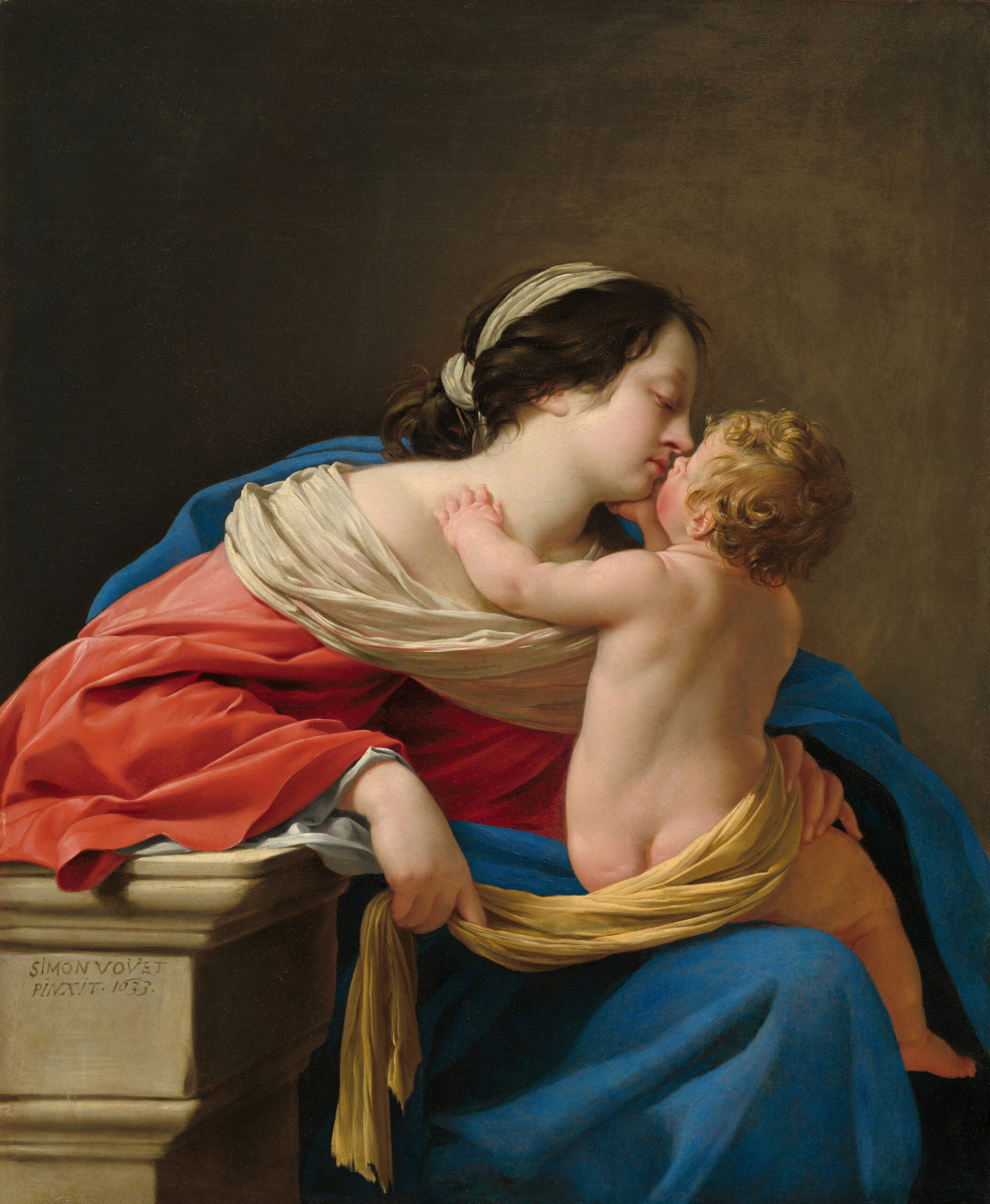
What strikes me first about Simon Vouet is his extraordinary ability to make matter live on canvas: drapery that seems to carry actual weight, an intense blue robe catching the light, flesh tones glowing softly against a dark ground. This master of French Baroque painting knows how to dress a canvas like no other. And the choice of this Madonna and Child for VMuseum is deliberate. What arrests me here is Vouet’s radical decision to deny us the Child’s face. Christ is seen from behind, his body curling into his mother, hands reaching for her face. The entire composition tips toward Mary. She is the true subject. Her downcast gaze, her slight smile, the natural ease of her posture, nothing here of the hieratic Virgin or the hagiographic icon frozen in glory. Vouet paints a mother. Concrete, physical, present. It is precisely this vitality — this living pulse, to use an expression that feels exact : that explains why this canvas continues to resonate nearly four centuries after its creation.
You are standing before a hand. Small, plump, resting on a mother’s shoulder. That is where everything begins, in this painting that Simon Vouet signs and dates in 1633 on a stone stylobate.
What the canvas tells you
The blue of the mantle is almost physical. It has weight. Red silk slides beneath a white veil; Mary’s flesh glows against the dark ground. Vouet builds light through touches of matter, in the manner of Caravaggio, learned in Rome.
Look at the Christ Child. His bare back, arched toward his mother’s face. His body twists, his hands reach for her skin. You will never see his face. Vouet erases it deliberately. The entire canvas tilts toward Mary, her heavy eyelids, the ivory nape of her neck freed by a cloth band. This oil on canvas (110.3 x 89.4 cm) gathers absolute tenderness into a gesture of premonitory gravity.
What the period tells you
Paris, 1633. Vouet had returned from Rome six years earlier, summoned by Louis XIII to serve as court painter. He ran the most important workshop in the capital.
The Marian cult was then at its height. The Counter-Reformation multiplied images of the Virgin to reach the faithful. Vouet answered this demand with more than a dozen similar compositions. This one is exceptional: signed, dated, and almost certainly made for the private chapel of a wealthy Parisian patron. Unlike the other versions, it was never engraved, as though its intimate tenderness rendered it resistant to reproduction.
Simon Vouet (Paris, 1590-1649) trained an entire generation of painters. Nicolas Poussin, his successor at the royal court, owes him as much as he owes Roman classicism.
In the news
Vouet’s Madonna and Child (1633), held at the National Gallery of Art in Washington, continues to assert itself well beyond the circle of art historians. The International Psychoanalytical Association has selected it as the cover image for its podcast Talks on Psychoanalysis (talksonpsychoanalysis.podbean.com), a testament to the enduring resonance of this image of the mother-child bond.
The NGA meanwhile continues to deepen its Vouet holdings: the museum holds several works by the artist, including Saint Jerome and the Angel (c. 1622-1625) and The Muses Urania and Calliope (c. 1634), and in 2021 acquired an etching of 1633, Holy Family with a Bird, contemporary with this Madonna and Child. Source: https://www.nga.gov/artists/1959-simon-vouet
A question for you
If you were to place this canvas in a contemporary setting, no longer a private chapel, but somewhere today, where would you choose?
About this work
- Madonna and Child
- Simon Vouet
- 1633
- Oil on canvas
- 110.3 x 89.4 cm
- National Gallery of Art, Washington D.C.
- https://www.nga.gov/artworks/206070-madonna-and-child