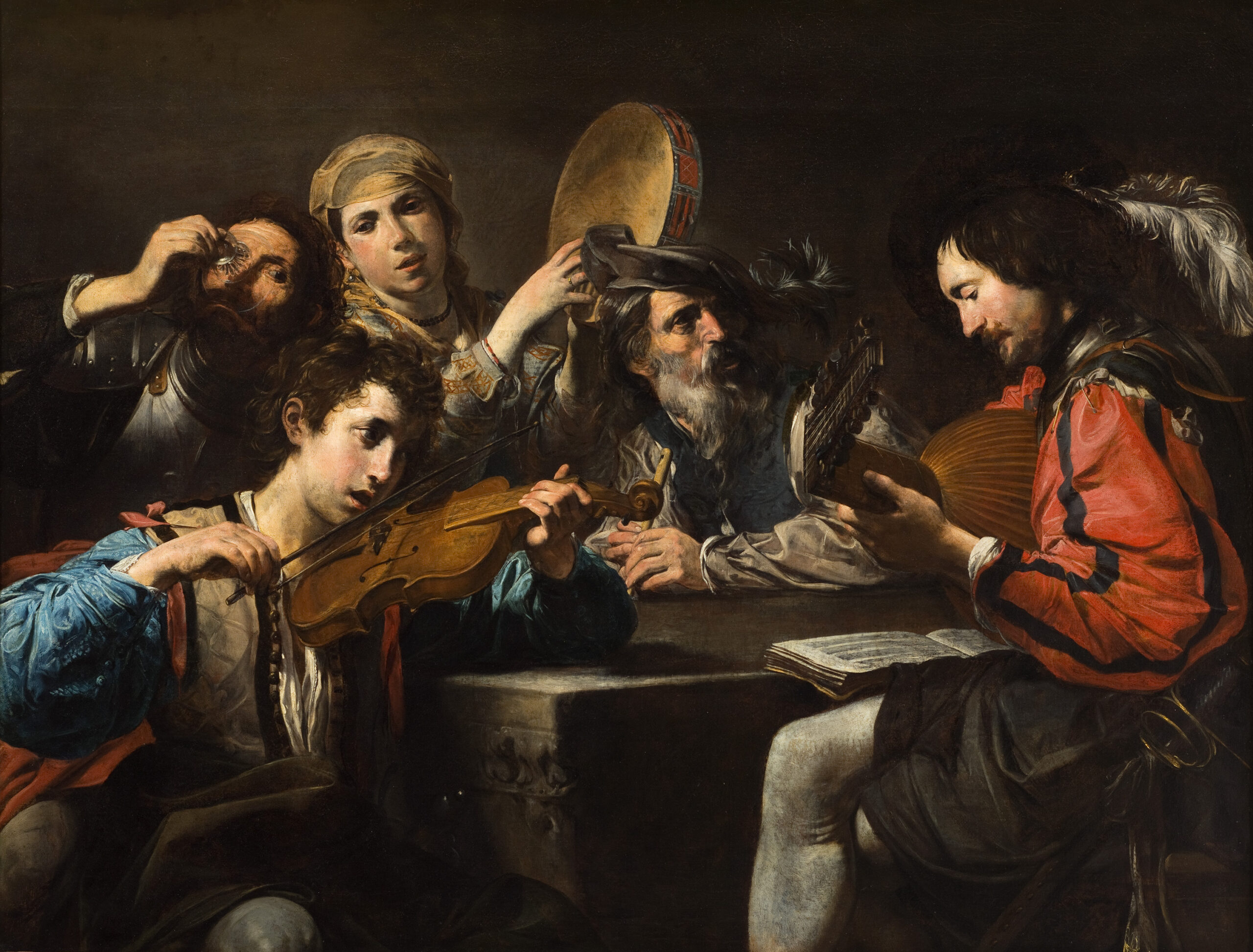
Rome, c. 1624. In the half-darkness of a tavern, five musicians gather around a fragment of an ancient sarcophagus. The light catches them. The music begins.
When light plays its part too
A young boy draws his bow taut across a golden violin. To his right, a lutenist in a feathered hat bows his head over his sheet music. Further along, a woman strikes a tambourine. An old lute player leans his instrument against the carved stone. Valentin de Boulogne paints in the manner of Caravaggio: raking light, deep shadows, living flesh. The touch is carnal, almost sculptural. Every hand, every gaze carries a story.
An entire society in five figures
Why this tavern scene? In 17th-century Rome, musical painting was undergoing a radical transformation. Elite concerts gave way to popular revelry. Valentin de Boulogne, following in the wake of Bartolomeo Manfredi and the Caravaggist movement, captures this social tension with sharp precision. The lute belongs to bourgeois circles. The violin and drum, to peasant festivities. A delicious paradox: according to the collector Vincenzo Giustiniani, the lute was already considered old-fashioned at the time. The variety of ages evokes the allegory of the four ages of man. A celebration, yes — but one heavy with meaning.
The painter Valentin de Boulogne
Valentin de Boulogne (1591–1632), a Frenchman who settled in Rome from 1612, established himself as one of the greatest Caravaggist painters. His work, intense and deeply human, explores the margins of Roman society. A Musical Party distills his entire sensitivity to the fragile bonds between people.
A question for you
💭 Caravaggio painted concerts in the muted light of palaces. Twenty years later, Valentin sets them in a tavern. What does this shift tell us about the trajectory of Caravaggism?
About this work
- A Musical Party
- Valentin de Boulogne
- c. 1623–1626
- Oil on canvas
- 111.76 × 146.69 cm
- Los Angeles County Museum of Art (LACMA)
- https://collections.lacma.org/object/82630