Key facts
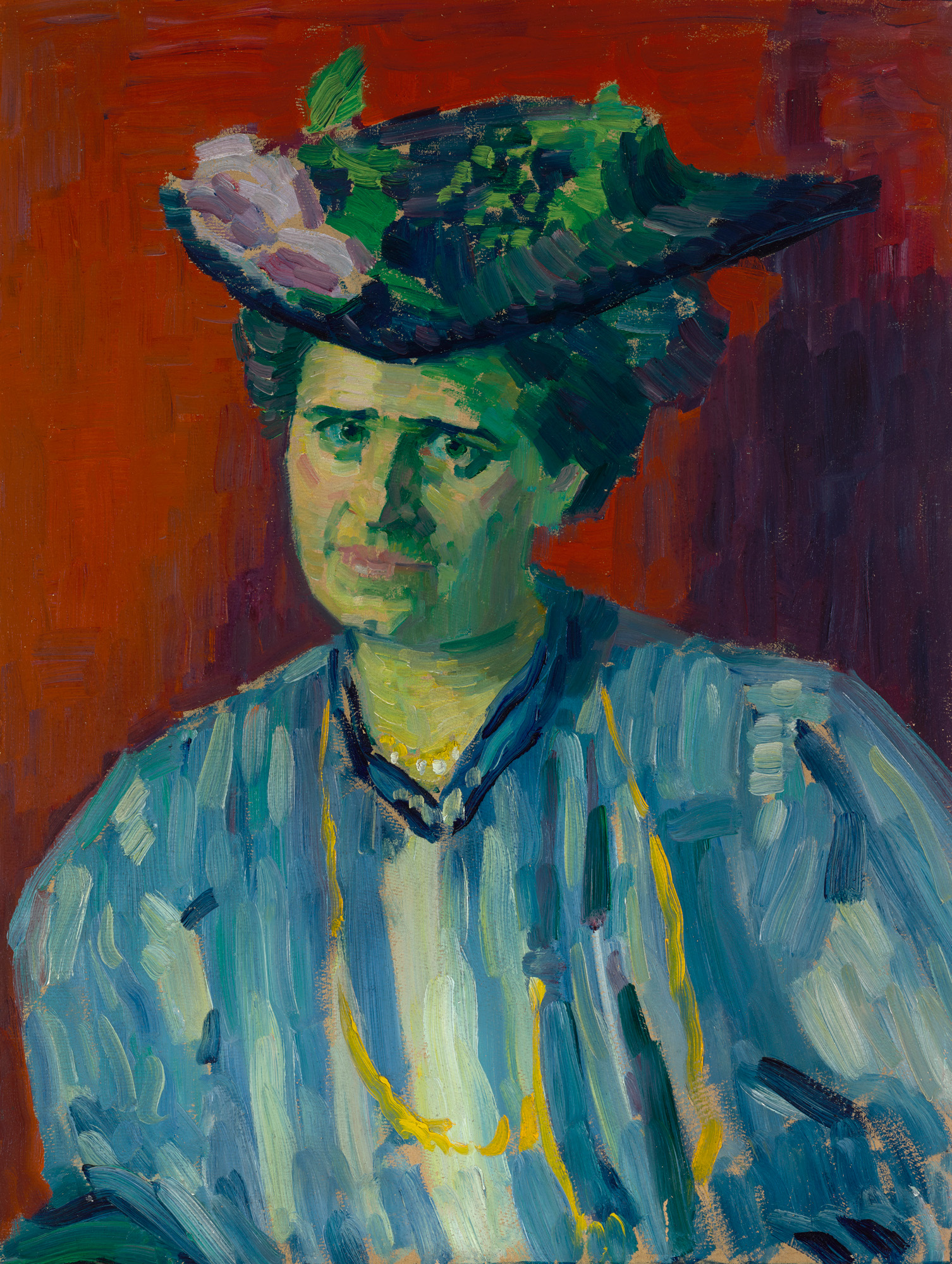
Painted in Munich in 1906 by Alexej von Jawlensky, the Portrait of Hedwig Kubin depicts the wife of the Austrian draughtsman Alfred Kubin. Executed in oil on cardboard, it still combines the fluidity of late Impressionism with a liberated use of colour drawn from Fauvism: green shadows on the face, a red and violet background, and bare support left visible between the brushstrokes. The painting dates from the year after Jawlensky took part in the 1905 Salon d’Automne alongside the Fauves. It thus marks the painter’s entry into Munich Expressionism, which would lead to the Neue Künstlervereinigung München and then to the Blaue Reiter. The work is held at the Städtische Galerie im Lenbachhaus in Munich.
What colours in this portrait! That first impression is what guided today’s choice. After the classical portraits of recent days, by François de Troy or Girodet for example, the contrast is striking: with Jawlensky, colour is everywhere, and always slightly off-key. The influence of the Fauves, whom the painter rubbed shoulders with at the 1905 Salon d’Automne, is unmistakable: colour is no longer there to imitate reality, it expresses and it builds. And that is exactly what strikes me most here. Despite this boldness, the result is anything but a cold or merely experimental portrait, quite the opposite. That is what I love in Jawlensky’s work: painting that breaks the rules without ever losing the humanity of its sitter.
A green shadow, laid just beneath the cheekbone. You are standing before the Portrait of Hedwig Kubin, painted by Alexej von Jawlensky in 1906. That green ought to shock. Instead, it almost soothes. The face remains solid, present, human. The colour lies about the skin, and yet it tells the truth about the person.
What this portrait of Hedwig Kubin tells us
Look at the background first. A brick red fills the whole left side, then slides into a muted violet on the right. Against this red, the dark hat spreads out like a wing. It carries touches of bright green and a pale pink flower. The face blends lemon yellow, almond green and a frank pink for the lips. The green shadows, noted in the Lenbachhaus catalogue entry, do not muddy the complexion. They build the modelling. The blue blouse falls in long vertical strokes. A yellow chain winds across it, and a string of pearls closes the collar.
Now move closer to the edges. Between the strokes, the cardboard is left bare, beige, almost golden. Jawlensky does not cover it. Around the hat and along the shoulders, these reserves form a kind of halo. Look at the blouse: every stroke of blue lets the brown of the support show through. The choice of support matters. Cardboard absorbs part of the oil’s binder. The paint dries faster and stays more matte than on a primed canvas. So the painter sets down each stroke once, without reworking or blending it. No glazes, no smoothed gradients. These gaps let the colour breathe. They also betray the speed of execution. The brush moves fast. The eye, however, lingers.
Because this face resists. The brows are slightly furrowed. The mouth hesitates between a smile and restraint. Welcoming, said the first impression. Worried, replies the forehead. The painting does not choose.
What Jawlensky’s era tells us
Munich, most likely in the first months of 1906. Hedwig and Alfred Kubin pay a visit to Jawlensky on Giselastraße. Alfred Kubin draws dark visions, teeming with demons and dreams. Hedwig, a widow and considerably older, married him in 1904, after the young man suffered a severe breakdown. Ill herself, she remains his lasting support. By May 1906, she is already preparing their move to Zwickledt, in Upper Austria. This portrait thus captures a woman on the threshold of another life. She would live there until her death in 1948.
Jawlensky, for his part, is emerging from a decisive year. In 1905, he exhibits in Paris at the Salon d’Automne, alongside the Fauves. There he meets Henri Matisse. The painting keeps one foot in late Impressionism, through the fluidity of the dress. The other foot is already elsewhere. In 1909, painter and draughtsman are among the first members of the Neue Künstlervereinigung München. The sitter, by then, has already left the city.
First trained for a military career in Russia, Alexej von Jawlensky settles in Munich with Marianne von Werefkin. He later joins the Blaue Reiter circle. Eventually, his art narrows down to meditative heads, almost abstract.
News: the Blaue Reiter rehung at the Lenbachhaus
The Lenbachhaus has presented its Blaue Reiter collection in an entirely new light with the exhibition “Über die Welt hinaus. Der Blaue Reiter” (“Beyond the World. The Blue Rider”), on view from 10 March 2026 to 5 September 2027. Bringing together more than 240 works, the display puts particular emphasis on the movement’s women artists, who played leading roles within it, including Marianne von Werefkin, Jawlensky’s companion. Jawlensky is among the artists on show, notably with his Bildnis des Tänzers Alexander Sacharoff (1909) and Spanierin (1913). The exhibition is part of the run-up to the museum’s centenary, “100 Years of Lenbachhaus 1929 / 2029”. Meanwhile, from 27 October 2026 to 25 April 2027, the museum is devoting the first solo exhibition in Germany to the Polish avant-garde artist Maria Jarema. Finally, German Expressionism is travelling: in London, the National Gallery will present “German Expression: Modern Painting 1900–1918” from 20 March to 1 August 2027, its first exhibition devoted to modern German painting, bringing together Die Brücke and the Blaue Reiter, with a still life by Jawlensky on loan from the Museum Wiesbaden.
Source: Lenbachhaus.
A question for you
Does a colour have to be true for a portrait to ring true?
About this work
- Portrait of Hedwig Kubin
- Alexej von Jawlensky
- 1906
- Oil on cardboard
- 75 × 57 cm
- Städtische Galerie im Lenbachhaus und Kunstbau, Munich
- https://www.lenbachhaus.de/en/digital/collection-online/detail/portraet-hedwig-kubin-30012020