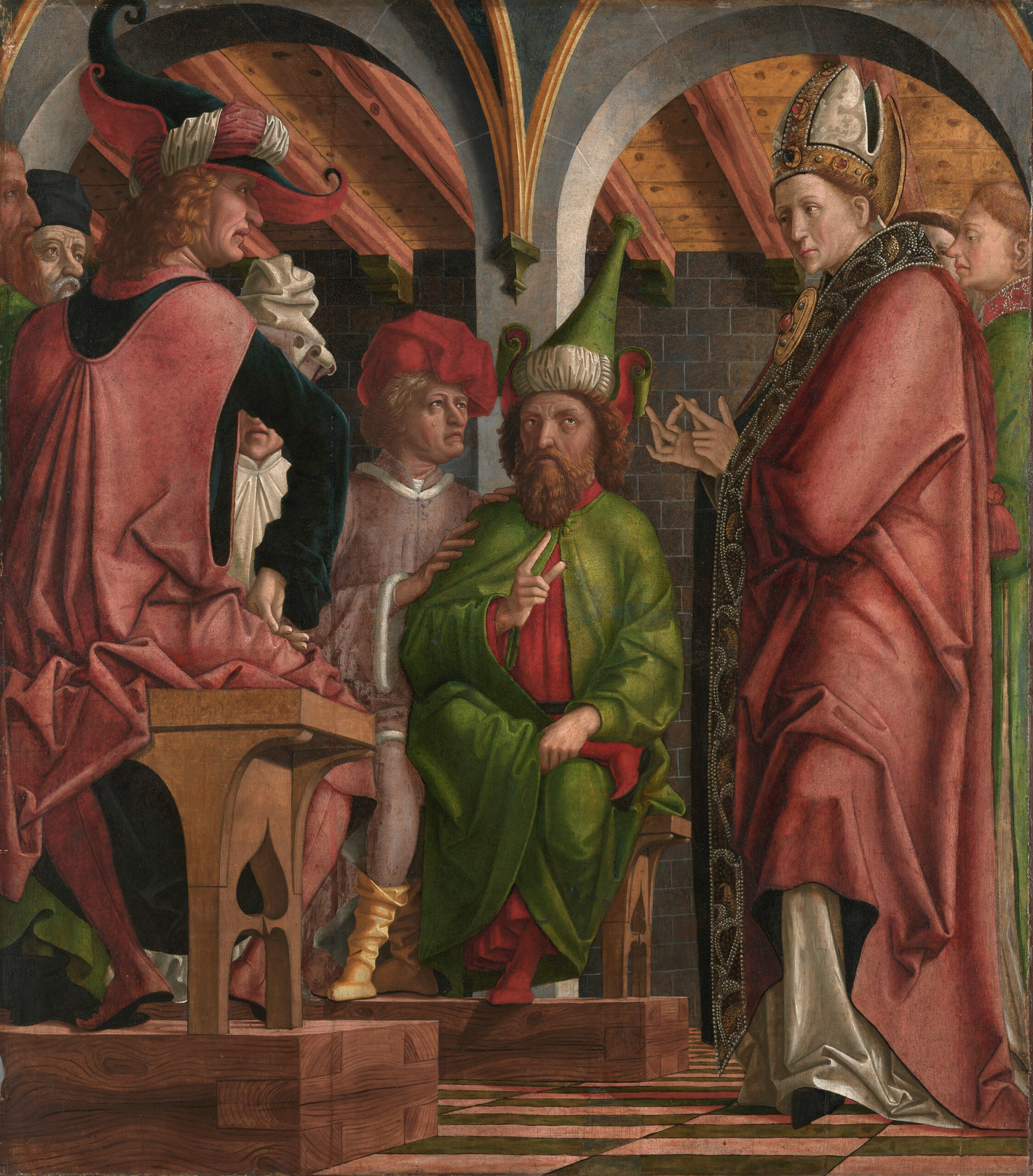
What strikes me first is the panel’s almost square format, which creates a sense of density, as though I were looking through a window opened onto the debate chamber. Pacher did not paint a battle, but an intellectual joust, and he translates this into the very composition: figures press close, gazes clash, the space is saturated with presences.
What held my attention most were the costumes. The broad-brimmed hats, the bold colours, the carefully rendered drapery: Pacher clothes his heretics with as much painterly care as his Doctors of the Church. This is not a neutral choice. In the medieval iconographic tradition, the doctrinal adversary is typically caricatured, visually diminished. Here, nothing of the sort. Augustine’s opponents carry themselves with authority and dignity. Their defeat will be intellectual, not humiliating. Augustine himself embodies this tone: learned and patient, he does not triumph, he explains. His gesture is that of a teacher, not an inquisitor. Pacher seems to suggest that truth has no need to crush; it persuades. This, perhaps, is what makes the scene so compelling five centuries after its creation: in a world accustomed to Manichaean representations of good against evil, this painter from the Tyrol chose nuance.
Why paint one’s adversaries as finely as one’s saints?
What Pacher refuses to do. This is not a scene of condemnation. Or rather, it is, but one would never know it. Look at the heretics on the left. Their garments are sumptuous: vivid rose, deep green, hats with curling feathers. Pacher grants them the same precision of brush as he does to Augustine. The panel, oil on wood, 103 x 91 cm, is dense to the point of discomfort. The nearly square format compresses the figures. The round arches, Gothic in their profile yet Italian in their rigour, structure the space without relieving it. We are inside the dispute, not observing it from a distance.
Around 1480, in the Tyrol
Michael Pacher was working in Bruneck, a crossroads between Gothic Germany and Renaissance Italy. He had absorbed Mantegna’s lesson: perspective as a dramatic instrument. Here, the chequered floor, the carved wooden bench, the falling draperies construct a depth that is almost theatrical. The panel forms the upper section of the outer face of the left wing of the Altarpiece of the Church Fathers, commissioned for the Augustinian monastery of Neustift near Bressanone. Pacher renders Augustine as a composed orator, fingers raised in logical demonstration. It is not faith that speaks here. It is reason. The tension holds: a devotional panel that exalts argument over miracle.
Born around 1435 and dying in Salzburg in 1498, Michael Pacher was both sculptor and painter. His work bridges Late Gothic and the Northern Renaissance.
On view in Munich: the Alte Pinakothek explores the art of pictorial narrative
The Alte Pinakothek presents, until 5 July 2026, the exhibition How Pictures Tell Stories. From Albrecht Altdorfer to Peter Paul Rubens. The Altarpiece of the Church Fathers features among the works illustrating how early painting constructed narrative. Pacher’s Disputation stands as one of its most compelling examples.
Source: pinakothek.de/en/how-pictures-tell-stories
A question for you
💭 What if Pacher’s true break with the Gothic lay not in his mastery of perspective, but in the way he chose to look at his adversaries?
About this work
- Altarpiece of the Church Fathers, outer face of the left wing (upper panel): The Disputation of Saint Augustine with the Heretics
- Michael Pacher
- c. 1480
- Oil on wood
- 103 x 91 cm
- Bavarian State Painting Collections, Alte Pinakothek, Munich
- https://www.sammlung.pinakothek.de/de/artwork/5RGQJK14z3/michael-pacher/kirchenvaeteraltar-aussenseite-des-linken-fluegels-oben-disputation-des-hl-augustinus-mit-den-haeretikern