Key facts
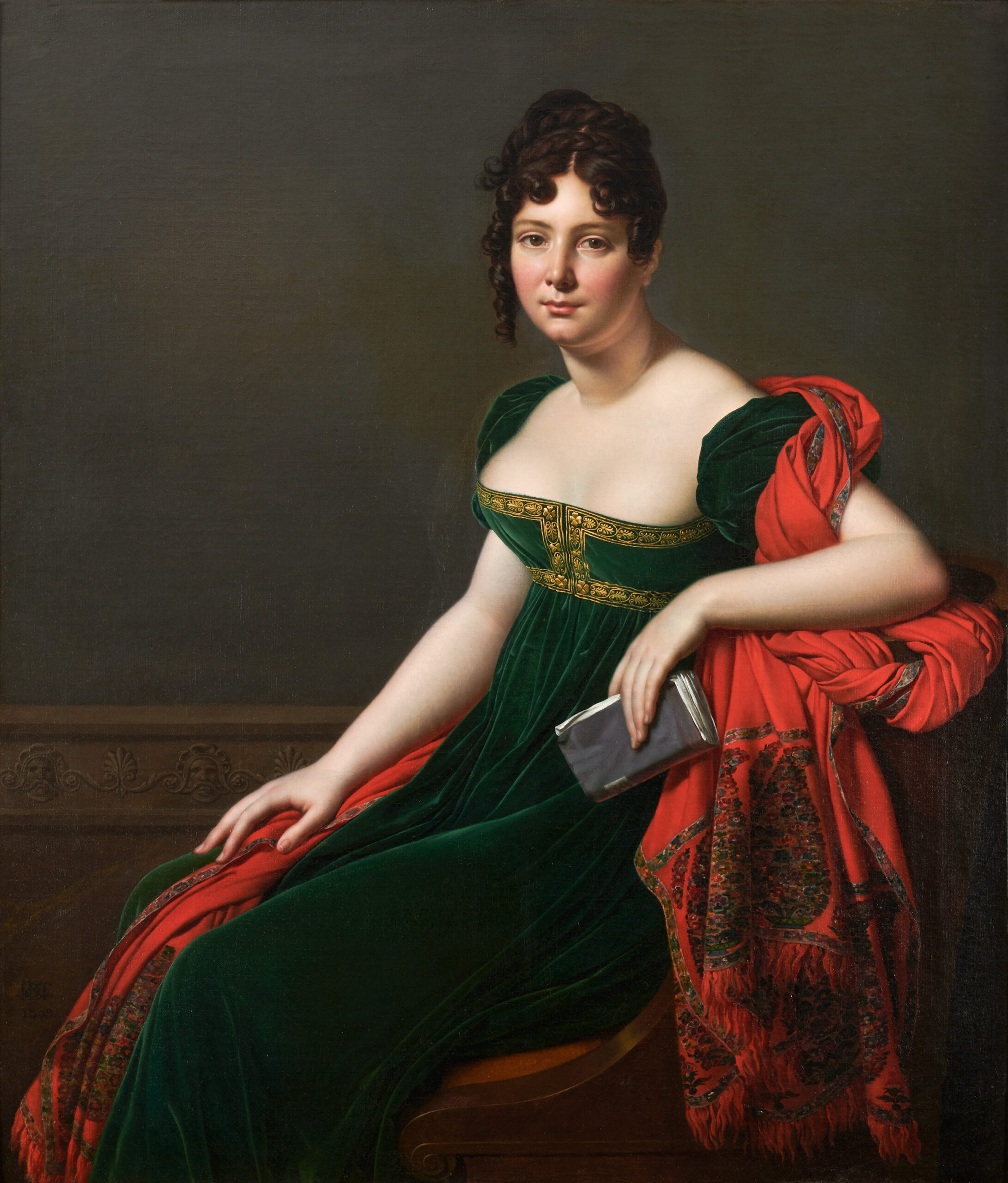
The Portrait of Augustine Bertin de Vaux, née Bocquet is an oil on canvas painted in 1809 by Anne-Louis Girodet de Roussy-Trioson (1767–1824), a pupil of Jacques-Louis David. The sitter is the wife of Louis-François Bertin de Vaux, who ran the Journal des débats with his brother. Painted a year after the success of The Burial of Atala at the Salon of 1808, the picture belongs to Empire Neoclassicism while hinting at the painter’s pre-Romantic sensibility. It shows his skill as a society portraitist: the rendering of velvet, of the cashmere shawl, and of the modelling of the flesh. The painting entered the Clark Art Institute in Williamstown, Massachusetts, in 2025, as a gift from the Aso O. Tavitian Foundation.
Girodet is a Neoclassical painter, a pupil of David, who left his mark on the early 19th century. Yet he soon set himself apart from his master through a taste for mystery and emotion that already heralds Romanticism. I have a special memory connected with him. At the end of the first Covid-19 lockdown, my very first trip outside Paris was to Montargis, his hometown, to visit the Musée Girodet. It was a real breath of fresh air after weeks shut in at home, working remotely. Ever since, I have looked at his paintings with a particular fondness. This portrait is held at the Clark Art Institute in Williamstown, Massachusetts. Painted in 1809, a year after the success of The Burial of Atala at the Salon, it is typical of Girodet’s art as a portraitist. The sitter is Augustine Bocquet, wife of Louis-François Bertin de Vaux, one of the founders of the Journal des débats. Her brother-in-law, Louis-François Bertin, known as Bertin the Elder, would be immortalized by Ingres in 1832 in a famous portrait. The young woman, from Parisian high society, is dressed in the Empire fashion. She wears a gown that seems to me to be embroidered green velvet, and she is loosely wrapped in a large red shawl with a multicolored cashmere border. This interplay of complementary colors gives the composition great brilliance. Her delicate face is rendered with great precision, with the smooth modelling and porcelain skin that Girodet had mastered perfectly. She is seated on an Empire-style chair, another marker of the period. The neutral background does not distract the eye and sets off the figure fully. That is what I love about Girodet: behind the rigor inherited from David, you sense an almost intimate attention to the sitter.
You are standing before a hand. It holds a small gray book, closed on its pages. The other hand rests flat on the velvet, without pressing. Come closer. These two gestures sum up the portrait: reading suspended, composure maintained.
What the Portrait of Augustine Bertin de Vaux tells us
Look at the green first. The velvet drinks in the light, then gives it back in every fold, from bottle green to near black. Gold embroidery marks the high waist, a hallmark of Empire fashion. Velvet is a challenge for a painter, because its color shifts with the angle. Girodet handles it in dark expanses and bright ridges, with no sharp outline. Against this green, the red of the shawl blazes. It is a fringed cashmere, scattered with tiny flowers, painted motif by motif. Girodet lays the paint down in thin, blended layers. On the skin, you find almost no trace of the brush. The modelling glides from the pink of the cheeks to the pearly white of the throat. The brown curls, by contrast, are worked one by one. Look at the hands: long, pale, set down with the same slowness as everything else. The eyes do not look away. They seek you out, calmly. Finally, observe the background. It is not entirely bare: a carved frieze of masks and palmettes runs behind the seat. At the lower left, the painter left his monogram and the date, 1809.
What Girodet’s era tells us
Augustine Bocquet is the wife of Louis-François Bertin de Vaux. With his elder brother, he runs the Journal des débats, a major Parisian newspaper. Girodet knows his sitter well. In 1806, he had already painted her bust-length, on a much smaller canvas now in San Francisco. Three years later, he changes scale. The canvas is nearly 1.20 meters (about 4 feet) high. Augustine appears seated, almost full-length, surrounded by precious fabrics. At the time, the cashmere shawl ranks among the most coveted luxuries of fashionable Parisian women.
Look at the pose: the arm bent over the chair back, the torso in three-quarter view, the gaze straight at you. It recalls Madame de Verninac, painted by David in 1799 and held at the Louvre. The pupil quotes the master. For David, a white dress and a bare wall are enough. Girodet, for his part, piles up textures: velvet, cashmere, carved wood, paper. Luxury becomes a language. The portrait appears at the Salon under mere initials: “Mad. D.V***”. Shown to all, Augustine remains half anonymous. And the book in her hand keeps its title to itself.
The canvas joined the Clark Art Institute in 2025, as a gift from the Aso O. Tavitian Foundation.
Born in Montargis in 1767, Anne-Louis Girodet de Roussy-Trioson trained under David. He broke away through a taste for chiaroscuro and reverie. The Burial of Atala triumphs at the Salon of 1808. Around the same time, the portraitist also paints Chateaubriand. He dies in Paris in 1824, leaving a body of work divided between rigor and reverie.
At the Clark, another way of looking
In May 2026, the Clark Art Institute awarded its Prize for Excellence in Arts Writing to Georgina Kleege. An essayist and Professor Emerita at the University of California, Berkeley, she has been legally blind since childhood. Her books, from Sight Unseen (1999) to More Than Meets the Eye: What Blindness Brings to Art (2018), have changed how we think about blindness and visual culture, and have pushed museums to rethink the accessibility of their collections. The prize carries a $30,000 honorarium and an award designed by Tadao Ando. Past recipients include Linda Nochlin and, in 2024, the French art historian Bénédicte Savoy. The award ceremony is scheduled for autumn 2026.
Source: Clark Art Institute.
A question for you
Does this portrait feel closer to David’s rigor or to the Romantic dream?
About this work
- Portrait of Augustine Bertin de Vaux, née Bocquet
- Anne-Louis Girodet de Roussy-Trioson
- 1809
- Oil on canvas
- 46 3/4 × 39 in. (118.7 × 99.1 cm)
- Clark Art Institute, Williamstown, Massachusetts
- Gift of the Aso O. Tavitian Foundation, 2025 (acc. no. 2025.1.237)