Key facts
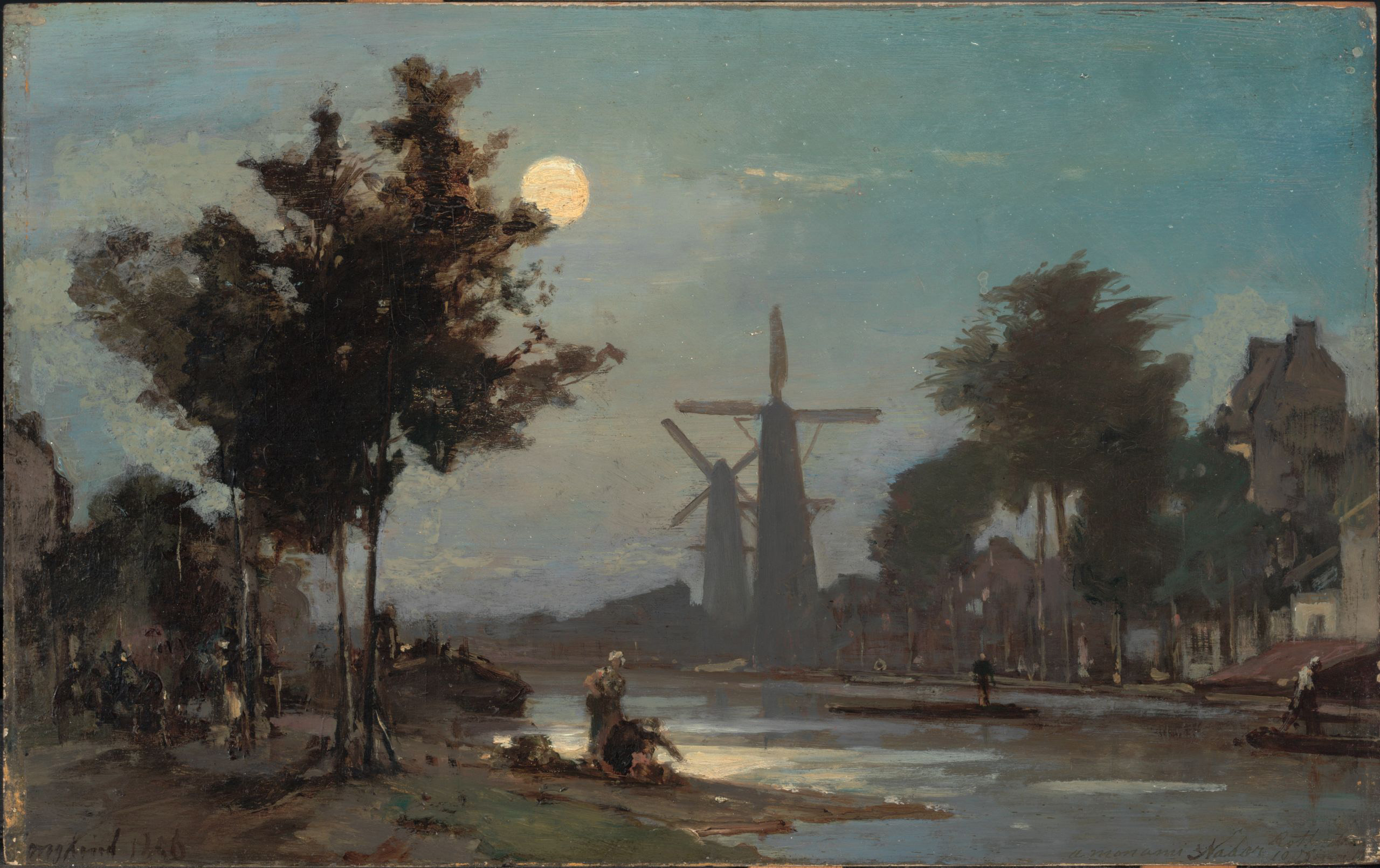
Painted in 1856 by Johan Barthold Jongkind, Moonlight on the Canal is a small Dutch nocturne in oil on wood panel. The Dutch artist made it during his stay in Rotterdam, between 1855 and 1860, and dedicated it to the photographer Félix Nadar. The scene shows a canal, two windmills and a few figures beneath a full moon. Jongkind is regarded as a forerunner of Impressionism: his light effects and quick brushwork left their mark on the young Claude Monet. Once part of George A. Lucas’s collection, the painting has been in the Baltimore Museum of Art since 1996.
It’s another moonlit scene I’m sharing with you today, after Jongkind’s Mill by a River and Notre-Dame de Paris. The painter returned to this nocturnal motif again and again, and each canvas shows me a new side of his talent. This one, Moonlight on the Canal, is more detailed and more colourful than the previous ones, with a bluish sky that wraps around the whole scene. The moon is full and reflects powerfully in the water of the canal: it organises the painting and draws the eye at once. Then you notice the life in the scene. A few figures go about their business on the bank, while others cross the canal by boat. In the centre, two windmills anchor the landscape and remind us that we are in Holland. In 1856, Jongkind had in fact just left Paris to return to his native country, and this work belongs to the tradition of 17th-century Dutch nocturnes, whose great master was Aert van der Neer. We are still far from Impressionism: the composition remains structured, the details carefully rendered. But the artist is already handling light with a brilliance I particularly admire here, in the subtle shift from the glow of the moon to the shadows of the banks. A few years later, Monet would say that Jongkind had taught him how to see. Standing before this small wooden panel, I understand what he meant.
Look at the moon first. It is a disc of thick, almost creamy paint, set in the upper left. The last branches of a tree bite into its edge. Then your eye moves down. It follows a pale trail across the water to the two figures on the bank. The whole painting lies in that path. Only then does the scene open up. A standing woman in a white cap stands beside a seated companion. In the middle of the canal, a man stands upright on a flat boat. On the right, another pushes his boat along with a pole. Behind him, a pale façade catches the last of the light. On the left, other passers-by melt into the shadow of the trees.
Night in Thick Paint
The support matters here. Jongkind paints on a small wooden panel. This smooth, rigid wood takes a quick stroke without soaking up the colour. Notice the contrasts in handling. The moon is built up in relief, in impasto. The foliage, by contrast, is rubbed, scratched, frayed against the sky. On the canal, the light is held in a few horizontal strokes of off-white. The two windmills stand out as flat shadows, with no detail at all. The sky is not black. It stays a milky blue-green, as if night were hesitating to fall. Here lies the paradox of the panel: a nocturne in which almost everything is visible. At the lower right, an inscription in black paint reads “a mon ami Nadar 1856/Rotterdam” (“to my friend Nadar”). Jongkind gives his night to the photographer Félix Nadar. One captures light with a brush, the other with a lens.
Rotterdam, Between Two Parises
In 1856, Johan Barthold Jongkind is living in Rotterdam. He stays there from 1855 to 1860. His Paris years have left him disappointed, without the success he hoped for at the Salon. In the Netherlands, he mostly paints views of his homeland: windmills, harbours, canals. This moonlit scene belongs to that Dutch interlude. The museum’s label stresses the point: the moon fascinated Jongkind all his life. He returns to it in Holland, then in France. His small, spontaneously painted works leave their mark on the next generation. Jongkind moves back to Paris in 1860. In 1862, in Le Havre, he meets the young Claude Monet. He encourages him to paint outdoors. Look at the brushwork on this panel, brief and laid down without retouching. You can already see the lesson passed on to Monet: catch an effect of light before it changes.
The panel has travelled too. After Nadar, it turns up in Paris, in the collection of George A. Lucas. Henry Walters bequeathed it in 1909 to the Maryland Institute College of Art in Baltimore. As early as 1911, it appears in the catalogue of an exhibition at the school. In 1976, it was included in the exhibition Jongkind and the Pre-Impressionists, at Smith College and then at the Clark Art Institute. The title sums up the place given to the painter at the time: that of a forerunner of Impressionism. In 1986, Peter C. Sutton listed it in his guide to Dutch art in America. Although trained in Paris under Isabey, Jongkind was still counted among the Dutch. The Baltimore Museum of Art acquired it in 1996. It showed the work again in 2006, in the exhibition A View Toward Paris.
News: Matisse and Martinique in Baltimore
The Baltimore Museum of Art, home to Moonlight on the Canal, holds the largest public collection of works by Matisse in the world. Until November 29, 2026, it is presenting Matisse and Martinique: Portraits and Poetry in the Jay McKean Fisher Gallery of its Ruth R. Marder Center for Matisse Studies. The exhibition brings together the 28 lithographic portraits Matisse made between 1946 and 1953 for Poésies Antillaises, a collection of poems by John-Antoine Nau. The book was not published until 1972, after the artist’s death, and remains one of his least-known illustrated books. The portraits were inspired by Matisse’s brief stay in Martinique in 1930 and by his work with Caribbean and international models. The exhibition sets them alongside works by Germaine Casse and Serge Hélénon, artists from Martinique and Guadeloupe respectively. In doing so, it sheds light on the transatlantic artistic circles of the late French colonial period. The exhibition is curated by Denise Murrell, curator at The Metropolitan Museum of Art and the first Fellow of the Ruth R. Marder Center for Matisse Studies (2022–2025). Only a few days remain to see it. The museum is also presenting Flashback: Two Centuries of Baltimore Photography until February 21, 2027.
Source: Baltimore Museum of Art.
A Question for You
In this 1856 painting, do you already see Impressionism, or still classical Dutch painting?
About This Work
- Moonlight on the Canal
- Johan Barthold Jongkind
- 1856
- Oil on wood panel
- 21.9 × 34.9 cm (8 5/8 × 13 3/4 in.)
- Baltimore Museum of Art, Baltimore (acc. no. 1996.45.152)
- https://artbma.org/artwork/moonlight-on-the-canal-2/