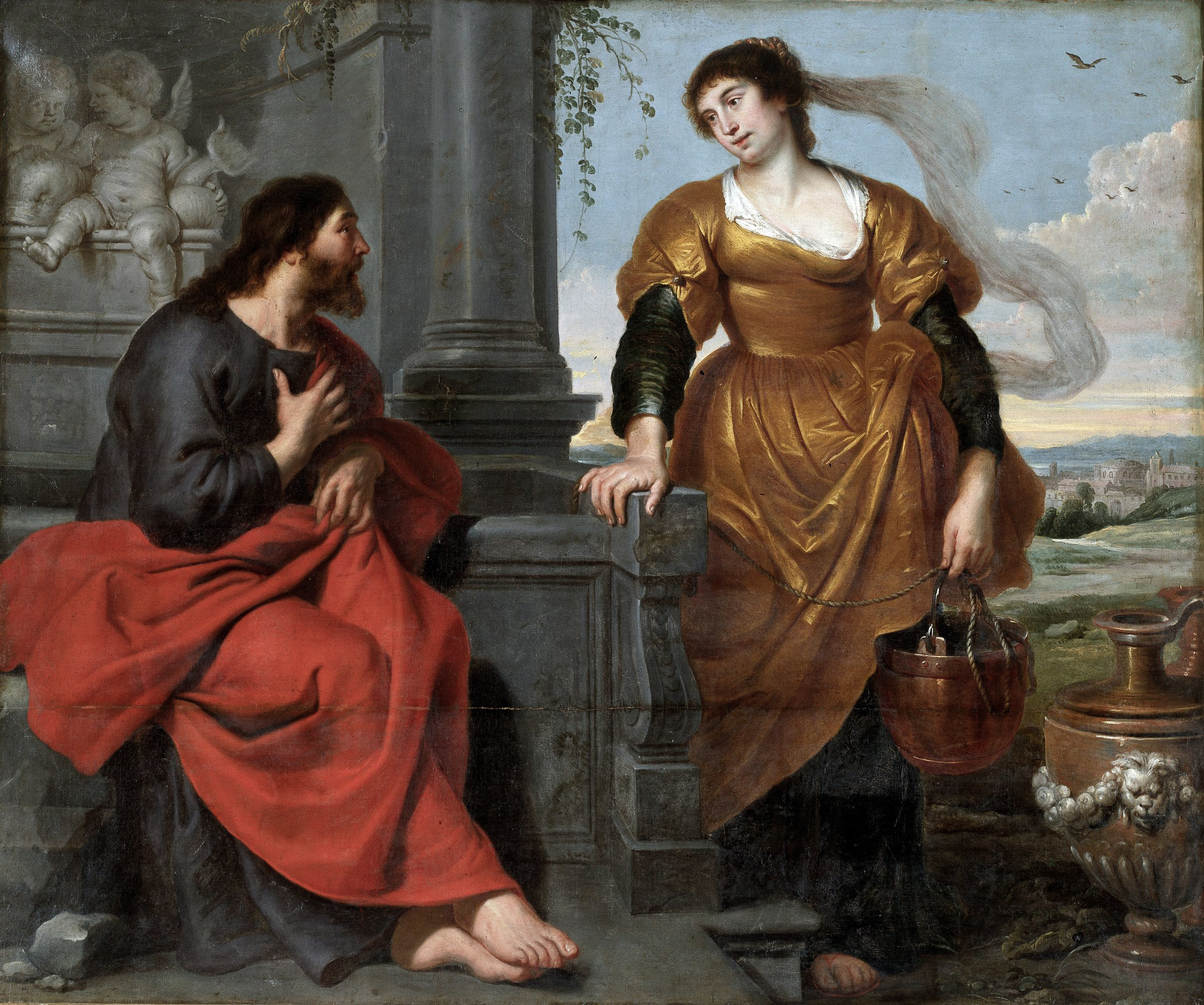
What strikes me in this interpretation by Cornelis de Vos is the contrast between the homeliness of the figures and the solemnity of the setting. Christ and the Samaritan woman are treated with an almost domestic warmth, in natural, conversational poses that recall Flemish genre painting. Yet this naturalism is immediately contradicted by the setting itself: a massive baroque architecture, ample drapery, a monumental staging that evokes a princely court rather than the well at Samaria.
This deliberate disjunction, between the intimacy of the biblical exchange and the grandeur of the décor, seems to me characteristic of Antwerp history painting in the second third of the seventeenth century: the sacred is updated by clothing it in the visual codes of contemporary power and prestige, rather than by seeking to restore its original context.
Why should a simple encounter at a well require the columns of a palace?
The setting
One would expect a modest well, a rough stone rim. It is nothing of the kind. Cornelis de Vos sets the scene before a carved balustrade, between massive columns. Christ, seated, draped in red and dark blue, rests one hand on his chest. The Samaritan woman stands, in a saffron dress, a copper pail at her wrist, her veil lifted by the wind. Here the painter deploys his warm palette and refined rendering of fabrics, two constants of his manner. In the background, a Flemish landscape opens onto hills and a shifting sky. The sacred sits alongside the everyday without ever fully dissolving into it.
Historical context
The subject, drawn from the Gospel of John, became widely diffused in painting from the sixteenth century onward, sustained by its baptismal resonance around the theme of living water. Cornelis de Vos takes up this tradition while introducing more ambiguous signs of his own: discreet putti, a Bacchus mask on the water jug, a low-cut bodice. These are allusions to a worldly life that the biblical narrative does not in fact describe. For the figure of Christ, the painter draws on the repertoire of Peter Paul Rubens, his fellow Antwerp painter and friend, whose early work was circulating in the city’s workshops at the time.
Cornelis de Vos
An Antwerp painter active in Rubens’s circle, Cornelis de Vos (1584-1651) excelled equally in portraiture and religious painting. Christ and the Samaritan Woman, c. 1630-1635, illustrates this dual mastery.
News from the MSK
The MSK Ghent remains an active presence on the museum scene: in spring 2026, the museum presents Unforgettable, an exhibition devoted to women artists of the former Netherlands, organised in collaboration with the National Museum of Women in the Arts in Washington. The exhibition runs from 7 March to 31 May 2026. The museum also continues to host the ongoing, publicly visible restoration of the Van Eyck brothers’ Ghent Altarpiece. Together, these two initiatives, research into women’s contribution to Flemish art history, and live conservation work, reflect the MSK’s continuing scholarly activity as custodian of works such as Cornelis de Vos’s Christ and the Samaritan Woman.
Source: www.meer.com/fr/84634-restauration-de-lagneau-mystique
A question for you
💭 Had Cornelis de Vos received a commission for an ordinary genre scene rather than a biblical subject, what would he have changed in this canvas?
About this work
- Christ and the Samaritan Woman
- Cornelis de Vos
- c. 1630-1635
- Oil on canvas
- 167 x 203.5 cm
- Museum of Fine Arts Ghent (MSK)
- https://www.mskgent.be/en/collection/1900-a