Key facts
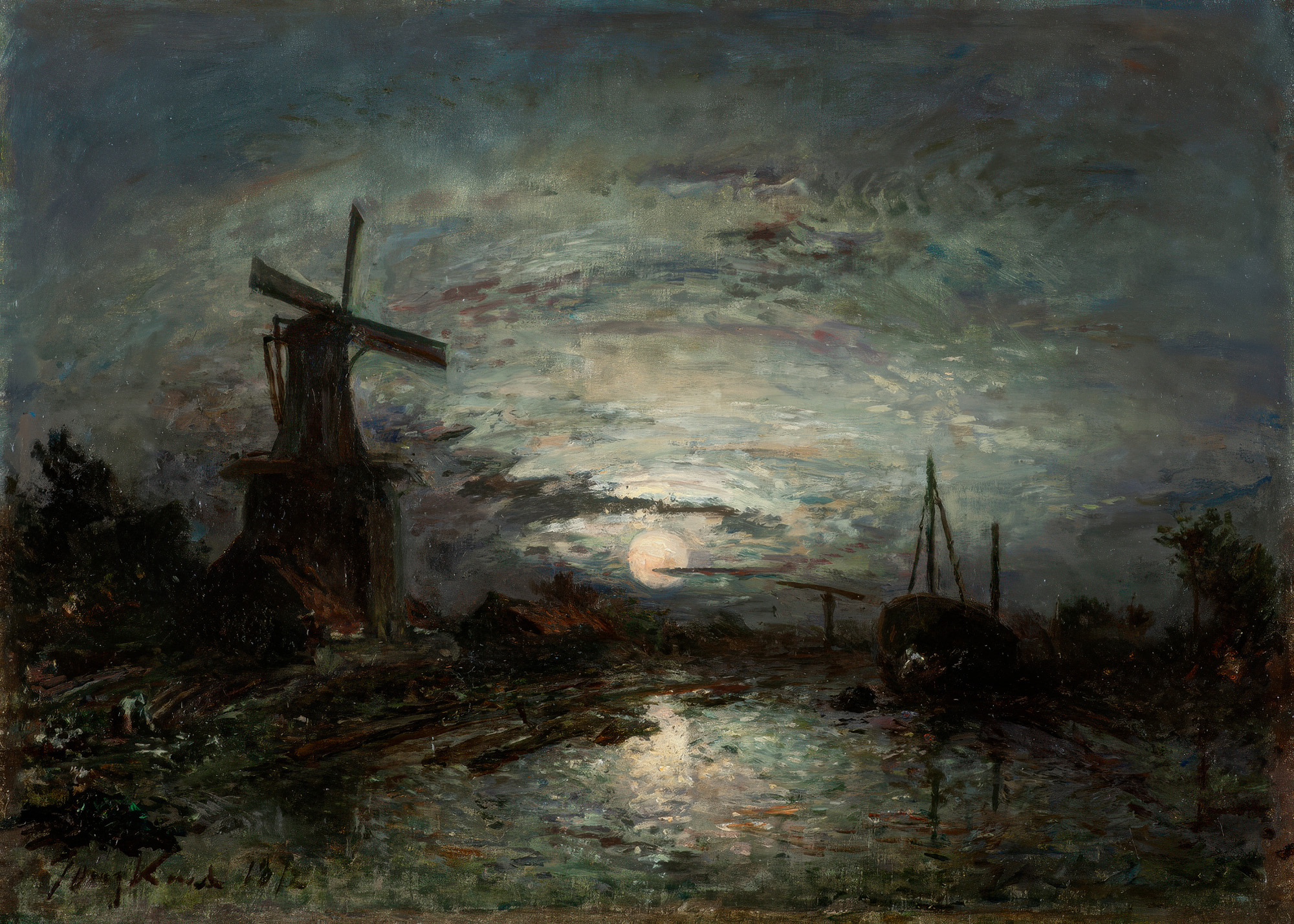
Painted in 1872 by the Dutch artist Johan Barthold Jongkind (1819–1891), Mill by a River, Moonlight depicts a nocturnal river landscape: a windmill silhouetted against the sky, a boat at anchor and a full moon breaking through the clouds. Held at the Musée d’arts de Nantes, this oil on canvas combines the legacy of 17th-century Dutch landscape painters with a free, rapid brushstroke. Jongkind composed his oils in the studio, working from sketches and watercolours made outdoors. Claude Monet, whom he met in 1862, credited him with the “definitive education” of his eye. The painting thus illustrates Jongkind’s role as a forerunner of Impressionism, two years before the group’s first exhibition.
Here is a forerunner of Impressionism whose influence Monet himself acknowledged: he claimed to owe him “the definitive education of his eye”. What I love here is the play of moonlight, a motif Jongkind returned to throughout his career, in the tradition of the great 17th-century Dutch nocturnes such as those by Aert van der Neer. A riverside landscape, with the mill standing proudly on the left, surrounded by a few houses, and the boat on the right balancing the composition. The moon lights up the sky and the water in a rounded halo, and its reflection traces a luminous path that draws the eye to the heart of the painting. The clouds shape the sky and still seem to be moving. The atmosphere is damp yet clear, the tones sharply contrasted: the full moon floods the scene with light, between shadow-play silhouettes and brown tones. What strikes me most is how Jongkind captures a fleeting impression, the precise moment the moon breaks through the clouds, with a free, rapid touch that already heralds the explorations of the Impressionists. In 1872, two years before the first Impressionist exhibition, this small canvas already says a great deal about what was to come.
Rest your eye on this small disc, just left of centre. The moon is not white. It is cream-coloured, almost warm. A thin band of dark cloud cuts across it sharply. Beneath it, the water sends back a column of broken light. You feel the dampness of the air before you even notice the mill.
A night rebuilt in the studio
Step closer to the canvas. The sky is not blended. It is laid down in short, horizontal strokes, heavy with paint. Grey-green, slate blue, then suddenly flashes of pink and wine-red along the edges of the clouds. Around the moon, the paint thickens into a swirling halo. The reflection is built up from small broken strokes, like water rippling in the breeze. In the centre, a footbridge stands out against the light. The signature and date, 1872, are inscribed in the dark paint of the foreground.
Here lies the paradox. Jongkind does not paint his oils in front of the motif. He composes them in the studio, from sketches and watercolours made outdoors. This night, which seems caught from life, is in fact a night rebuilt from memory. The brushwork, however, keeps the speed of a first glance.
Jongkind and his time
Born in the Netherlands in 1819, Johan Barthold Jongkind trained in The Hague under Andreas Schelfhout. He continued his training in Paris with Eugène Isabey, then settled permanently in France from 1860. In Normandy, he met the young Claude Monet in 1862. His mill carries the memory of the Dutch landscape painters. His brushwork already looks ahead to Impressionism. He died in 1891 and is buried in La Côte-Saint-André, in the Isère region.
News: the Musée d’arts de Nantes
Held at the Musée d’arts de Nantes, Mill by a River, Moonlight belongs to a major collection: the museum’s holdings number more than 14,000 works, nearly half of them modern and contemporary art. The institution recently devoted a major exhibition to atmospheric effects in painting: « Sous la pluie. Peindre, vivre et rêver » (Under the Rain: Painting, Living and Dreaming), shown from 7 November 2025 to 1 March 2026, brought together nearly 150 works by Turner, Caillebotte, Brassaï and Courbet, a theme that echoes Jongkind’s explorations of light and changing skies. Until 3 January 2027, visitors can discover “Plants and People” as well as “Neurone Miroir” by Eva Taulois.
Source: Musée d’arts de Nantes.
A question for you
Jongkind paints a moon breaking through the clouds; Monet would later sign, in Le Havre, a sun breaking through the mist in Impression, Sunrise. Were the master and the pupil painting the same moment after all, one by night, the other at dawn, and what difference would give birth to Impressionism?
📌 About this work
- Mill by a River, Moonlight
- Johan Barthold Jongkind
- 1872
- Oil on canvas
- 34 x 47 cm
- Musée d’arts de Nantes