Key Takeaways
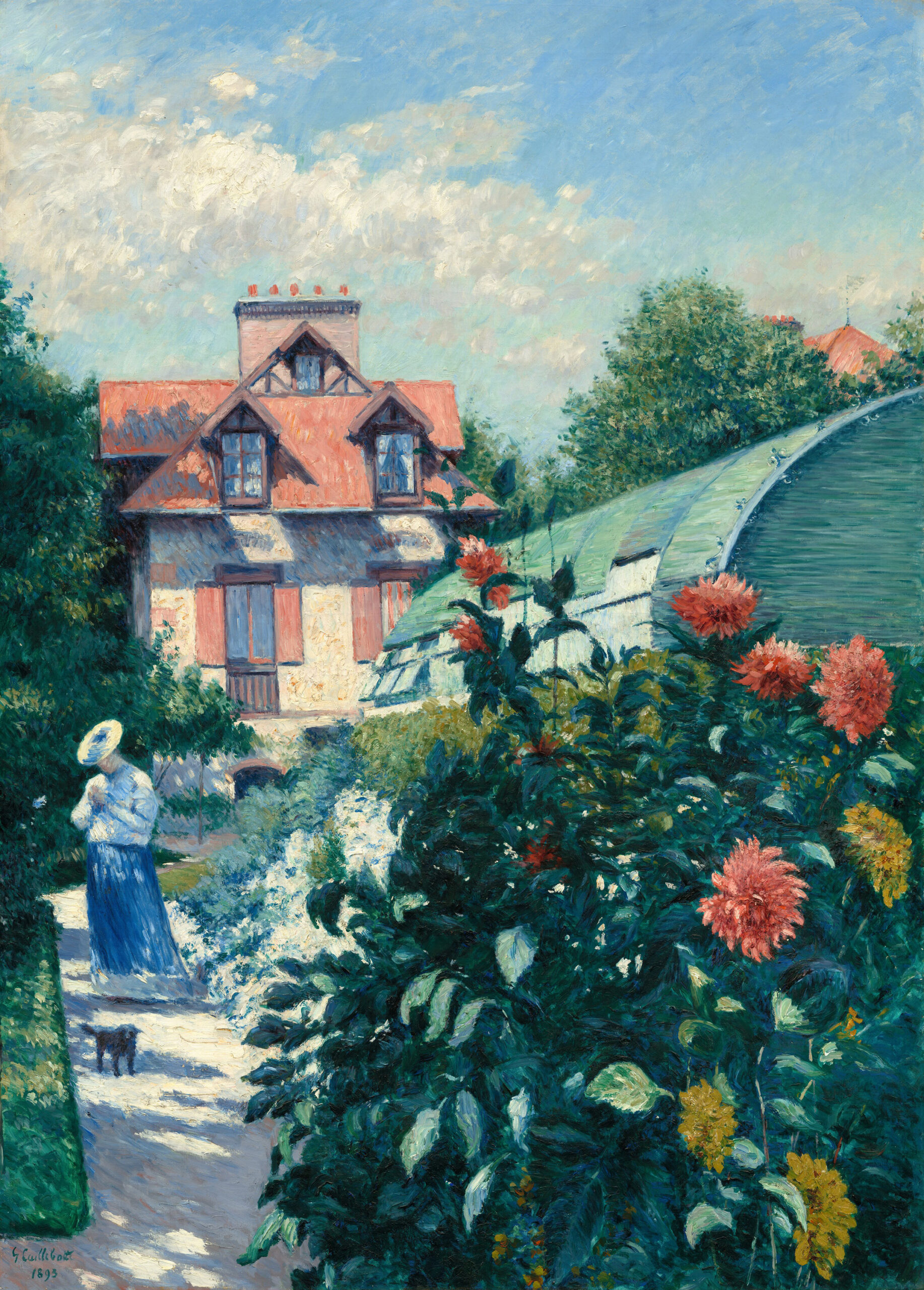
Painted in 1893 by Gustave Caillebotte, Dahlias, Garden at Petit-Gennevilliers depicts the garden the artist cultivated on his riverside property, facing Argenteuil across the Seine. A leading figure of Impressionism who exhibited alongside Monet, Renoir, and Degas between 1876 and 1882, Caillebotte devoted his final years to painting his garden, weaving together the greenhouse, flower beds, and the discreet presence of a female figure. Completed a year before the painter’s death in 1894, this canvas illustrates the shift in his late work toward the domestic landscape as a subject in its own right. It is now held at the National Gallery of Art in Washington, a gift of the Scharffenberger family.
Standing before this scene, I find myself immersed in the stillness of a summer afternoon in Caillebotte’s garden at Petit-Gennevilliers. The flowers in the foreground draw me in at once, rendered in an almost photographic close-up; the rest of the canvas, the house, the distant figure, serves merely as a pretext for this celebration of dahlias. An avid gardener as much as a painter, Caillebotte tended his own flower beds on this riverside property, and that intimate knowledge of plant life comes through in the dense, contrasting brushwork, almost fleshy in its texture. One senses that he is not painting a decorative motif but recording an object of daily, patient, almost horticultural observation.
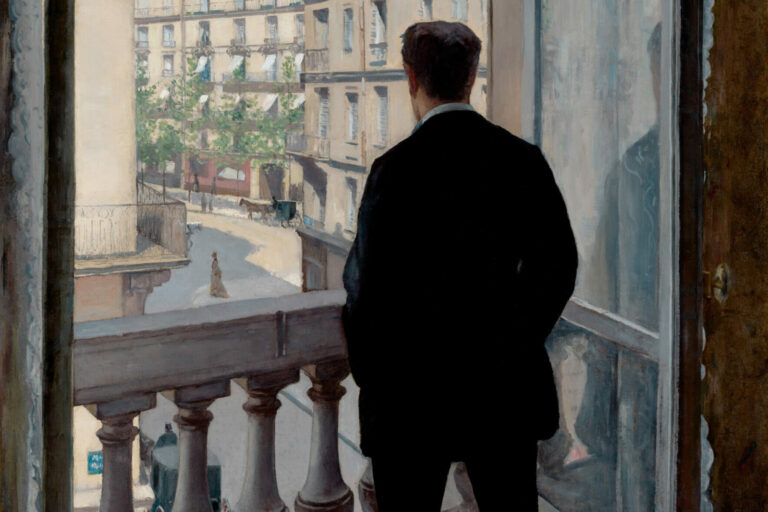
What I particularly admire here is the quiet stillness that settles over the composition, and the touch of humanity brought by the female figure, barely revealed at the edge of the canvas, likely one of the women in his circle, a discreet presence that lends the painting scale and breathing room without ever competing with the brilliance of the flowers. This tight framing, a legacy of his interest in photography, is characteristic of his late period, when the garden becomes a subject in its own right rather than a mere backdrop for the human figure. These distinctive framing choices recur in works such as Skiffs (Périssoires sur l’Yerres) and Young Man at His Window.
Look first at the small black dog, almost invisible against the pale gravel. It fixes its gaze on the painter, motionless, while the dahlias erupt in color around it. This contrast between botanical exuberance and animal stillness organizes the entire composition.
What Lies Beneath the Surface
Under the afternoon light, Caillebotte builds his dahlias with dense, almost sculptural impasto, while the sky remains fluid and light. A glass greenhouse closes off the composition in the background, a reminder of the property’s horticultural purpose. Here he paints his estate at Petit-Gennevilliers, acquired with his brother Martial in 1881. The receding perspective of the path, inherited from his Parisian street scenes, structures this garden like a city street transposed to the countryside.
The Artist and His Era
A major figure of Impressionism, Caillebotte exhibited alongside Monet, Renoir, and Degas between 1876 and 1882. A man of independent means, he financially supported his fellow painters. From the 1880s onward, he turned away from Paris in favor of gardening, sailing, and plein-air painting, until his premature death in 1894.
News: Caillebotte’s Love of Nature, Celebrated at Yerres
In the garden of the Caillebotte family estate at Yerres, now the Maison Caillebotte, the painter first developed his taste for plein-air painting. Through October 18, 2026, the site presents “Nature Is Not a Backdrop,” bringing together Monet and contemporary artists.
Source: Maison Caillebotte
A Question for You
💭 What if Caillebotte did for the garden what Monet did for light, a variable to be painted and repainted until the motif is exhausted?
About This Work
- Dahlias, Garden at Petit-Gennevilliers
- Gustave Caillebotte
- 1893
- Oil on canvas
- 157 x 114 cm (61 3/4 x 44 7/8 in.)
- National Gallery of Art, Washington, D.C.
- https://www.nga.gov/artworks/110067-dahlias-garden-petit-gennevilliers