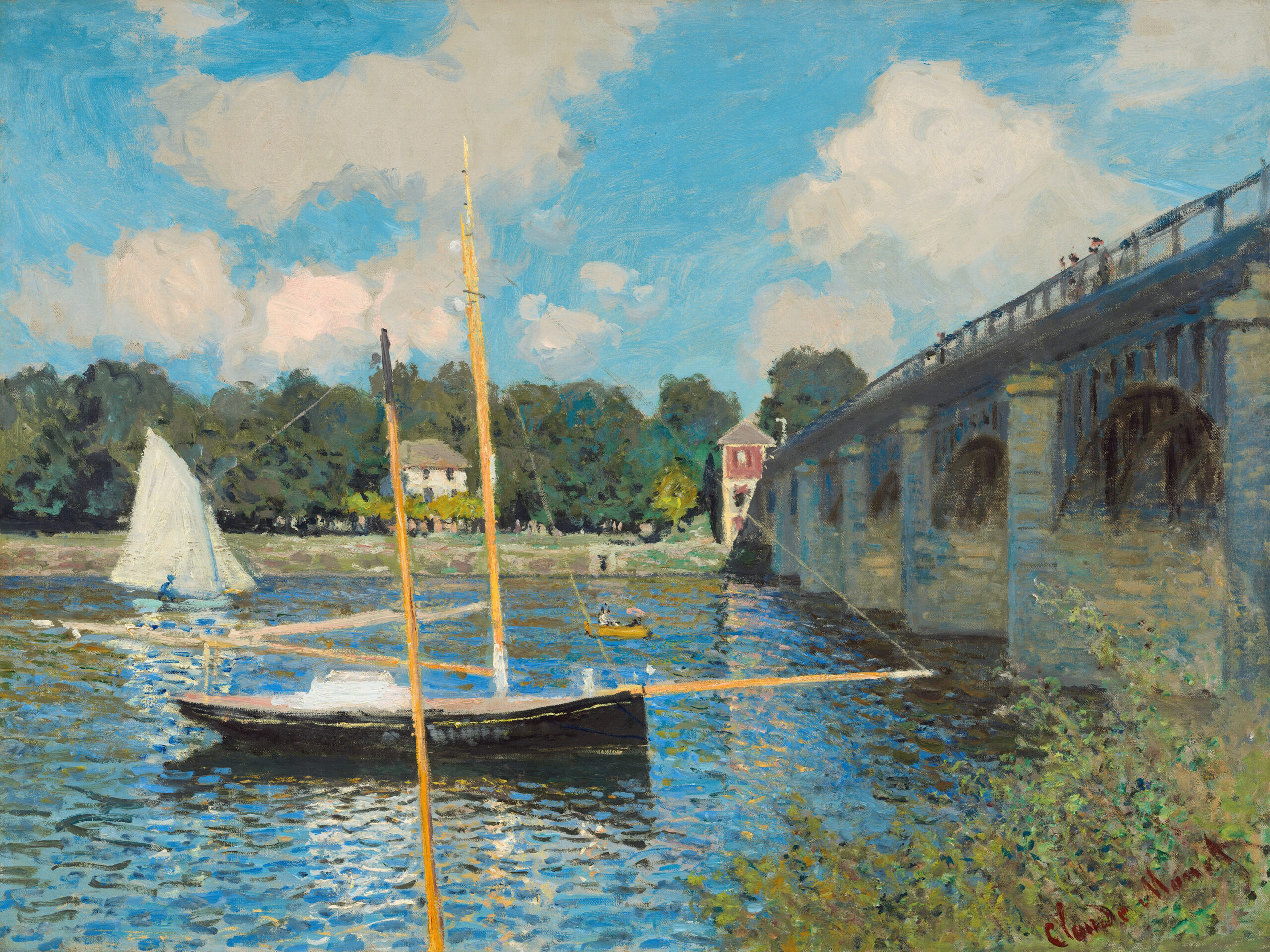
What strikes me first in this painting is the light, the way Monet sets the surface of the water vibrating, dissolving reflections into color without ever fixing them in place. We are in 1874, the very year of the first Impressionist exhibition, and one senses in this canvas the full ambition of a nascent movement: not to reproduce a scene, but to restore its living impression.
Monet works on the motif, standing before the Seine, before the bridge. The scene is real, verifiable and yet the painting deliberately moves away from it. Nothing here is photographic: brushstrokes layer over one another, colors answer each other, the sky flows into the water. This is a vision of the world rather than a record of it.
That is precisely what I find most precious here: the feeling that the painter truly lived this moment, passed through it with every sense alert, and offers us something irreplaceable, an afternoon light over Argenteuil that will never exist again, yet which one still perceives, with undiminished joy.
See
A yellow mast divides the sky in two. It leads nowhere. Below, the Seine is blue, a dense, almost physical blue, shot through with flecks of green and gold. The reflections move. Not metaphorically: the paint itself trembles. Monet’s brushstrokes are rapid, fluid across the water’s surface, shorter and denser in the trees. The figure in the sailboat is barely blue. The people rowing nearby are no more than a summary notation. The bridge, by contrast, is solid, mineral, impassive. Everything around it stirs. It remains.
Understand
Argenteuil, 1874. Monet had settled in this riverside town two years earlier. He paints outdoors, on the motif, in all weathers. This is the year of the first Impressionist exhibition, on the rue des Capucines in Paris. The group formed by Monet, Renoir, Sisley, Degas, Pissarro and a handful of others refuses the codes of academic painting. Their ambition: to capture the effect, not the form. Monet himself told the American painter Lilla Cabot Perry to forget the objects before her and see only a small square of blue, a pink rectangle, a streak of yellow — to paint the spontaneous impression. From three metres away, the scene is convincing. Up close, it dissolves into mosaic. That is intentional. Therein lies the tension: the canvas is at once an image of the world and its undoing.
Feel
Look at the water again. Those brushstrokes do not imitate the lapping of the current. They are the lapping of the current. Monet does not describe the afternoon light on the Seine. He reconstitutes it through matter, through the speed of the gesture, through color set down pure and unmixed. The National Gallery of Art holds this canvas in Washington, D.C. It is far from Argenteuil. And yet something resists the distance, resists a century and a half of separation. A summer afternoon. Water in motion.
Monet in 2026: a centenary year
The Bridge at Argenteuil carries particular resonance in 2026. Claude Monet is the subject of a major national tribute marking the centenary of his death. The Musée d’Orsay presented Monet. Le paysage en question (musee-orsay.fr). The Musée de l’Orangerie offers Monet, peindre le temps, accompanied by a virtual reality experience from Argenteuil to Giverny (musee-orangerie.fr). The Festival Normandie Impressionniste runs from 29 May to 27 September 2026 (normandie-tourisme.fr).
A question for you
💭 A canvas that falls apart as you approach and reassembles as you step back: is it still a painting, or has it become something else entirely?
About this work
- The Bridge at Argenteuil
- Claude Monet
- 1874
- Oil on canvas
- 60 x 79.7 cm
- National Gallery of Art, Washington, D.C.
- https://www.nga.gov/artworks/61374-bridge-argenteuil