Key Facts
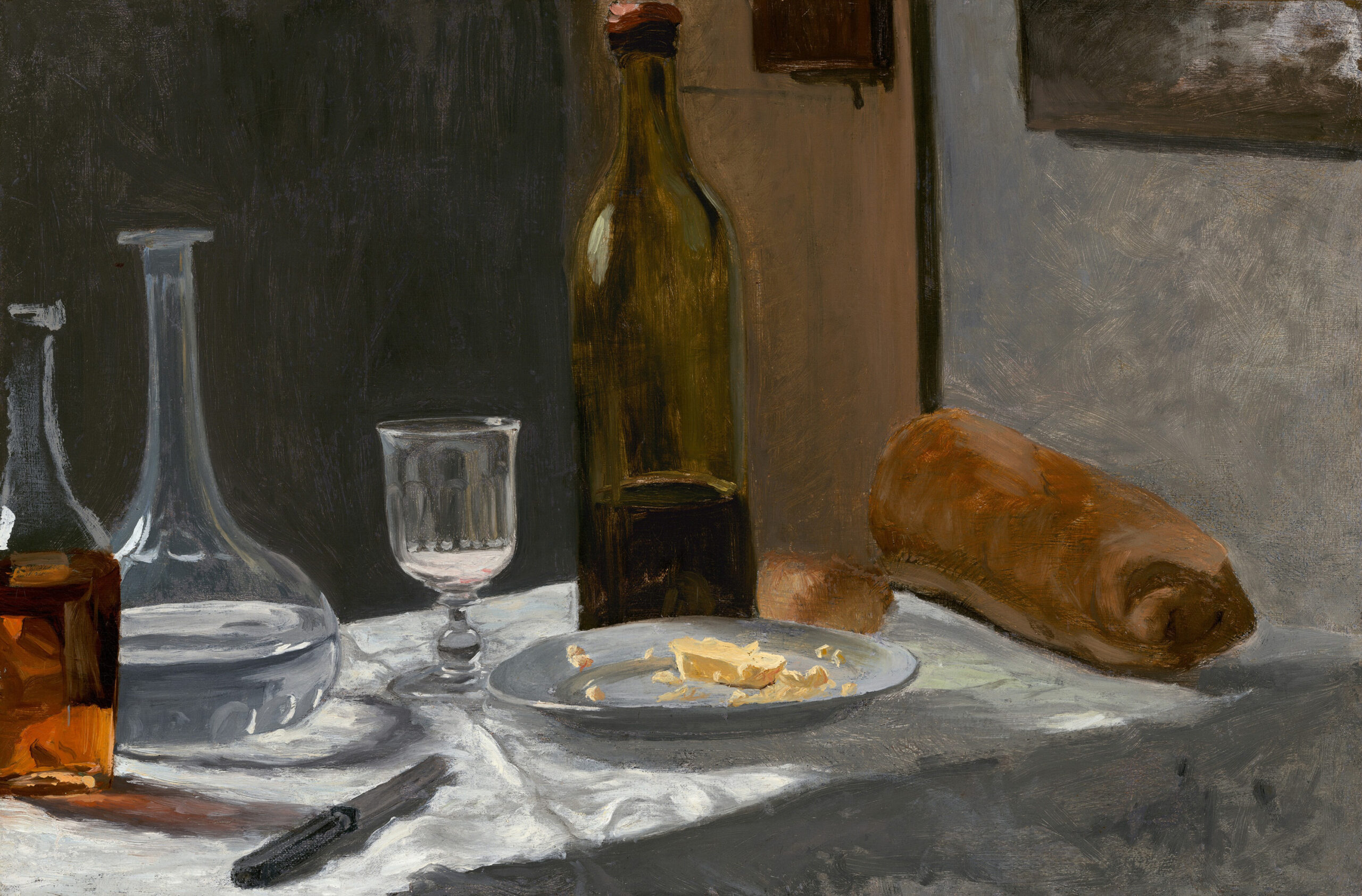
Painted around 1862–1863, Still Life with Bottle, Carafe, Bread, and Wine is one of the earliest known works by Claude Monet (1840–1926). The young painter, then a student in Charles Gleyre’s studio in Paris, depicts a table set with simple objects: a bottle of wine, a carafe of water, a glass, bread, butter and a knife. Painted before Impressionism, this oil on canvas already shows his attention to the way light falls on different materials, such as glass, linen and bread crust. It points toward the explorations that would lead to his great series and to the Water Lilies. The painting is held by the National Gallery of Art in Washington, in the Collection of Mr. and Mrs. Paul Mellon.
Here is an early work by Claude Monet, painted when he was barely 22 or 23 years old. It is rare to be given the chance to contemplate such a work, so readily do we associate Monet with the Water Lilies, the Haystacks or the Rouen Cathedrals. In this year marking the centenary of his death, it seems all the more worthwhile to return to his beginnings, to the time when he was attending Charles Gleyre’s studio in Paris and still searching for his own path.
Although this is an early work, we can already see his ability to work with light: the reflections on the glass of the carafe and the bottle, the golden crust of the bread, the white tablecloth catching the brightness. We can also sense his skill at capturing the objects he depicts in just a few brushstrokes, without lingering over detail. The still-dark palette and sober composition recall the legacy of Chardin and the influence of Courbet, but the brushwork, freer and quicker, already heralds the painter he would become.
I love this work for its freshness, and I would even say its innocence. We sense a young painter who is practising, observing and taking pleasure in painting simple, everyday objects. I particularly love the knife set at an angle: it gives the eye an anchor, creates depth and draws us into the scene. It is a classic still-life device, which Monet makes his own here with great ease.
For me, this is a fascinating work in many respects. It reminds us that the great master of Impressionism was not born with his Water Lilies: he first learned, observed and copied, before revolutionising the way light is painted. Looking at this small still life is a little like witnessing the birth of a way of seeing.
Looking at This Still Life
At the bottom of the glass, a pink trace. Almost nothing: a drop of leftover wine where the light comes to rest. Now look at the plate. The butter has been cut into, and yellow crumbs are scattered along the rim. The bread rolls to the right, plump, baked through, still warm, one might think. On the left, a square bottle runs out of the frame. Its amber liquid glows against the tablecloth. The water carafe beside it barely exists. A few white strokes, a grey belly, and the glass appears. In the centre, the green bottle stands tall and dark, a third full. The knife, laid at an angle on the linen, leads the eye toward the plate. The greys of the background are laid down in broad brushstrokes, visible and unhidden. On the wall, a dark rectangle catches the eye. A painting, a mirror, a window? The canvas does not say.
Claude Monet and His Work
Claude Monet paints this still life around 1862–1863. He is just over twenty. In Paris, he attends the studio of the Swiss painter Charles Gleyre. There he meets Renoir, Bazille and Sisley, his future companions in Impressionism. At the time, still life is still a training exercise, inherited from the Old Masters. Monet follows the rules, but in his own way. Look at the framing. The table runs diagonally from the lower left. The amber bottle slips off the edge of the canvas, cut off sharply. This tight framing breaks with the closed, centred compositions of classical still life. The painter seems to catch the table in passing, between two gestures.
Look at the brushwork. It changes with each material. The glass is not painted so much as seen through. The dark background shows through the carafe, and a few white highlights trace its edges. The paint layer there seems thin, almost transparent itself. The bread, by contrast, receives a thick impasto, brushed in the direction of the crust. The butter is modelled in rich, oily touches that hold the light. A single oil on canvas, three thicknesses, three ways of touching reality. Here the young painter learns what light does to each surface. This lesson will stay with him all the way to the Haystacks and the Cathedrals.
The canvas now belongs to the National Gallery of Art in Washington, in the Collection of Mr. and Mrs. Paul Mellon.
Monet Before the Water Lilies
The title promises wine. The glass holds only a memory of it. The butter has been cut into; crumbs are left lying about. Someone has just left the table, or is about to sit down. There is no way of knowing. The light comes from the left. It whitens the linen, sets the amber aglow, barely brushes the background. Come closer to the tablecloth. Its whiteness is made of greys, cool blues and a few raw flashes of light. It creases under the painter’s hand as it would under a diner’s. The silence of the room becomes almost audible. No rare fruit, no silverware, no game. Only the bread, water and wine of an ordinary meal. Claude Monet gives this little his full attention. Before the Water Lilies, there was this corner of a table.
The Monet Centenary at the Musée de l’Orangerie
Claude Monet died in Giverny on 5 December 1926. A century later, his early still life held in Washington takes on particular significance, as more than a hundred events are being organised across Paris and Normandy to celebrate his legacy. In Paris, the Musée de l’Orangerie is presenting, from 30 September 2026 to 25 January 2027, an exhibition devoted to the relationship between his work and time, entitled Monet, peindre le temps (Monet: Painting Time). Around forty paintings trace his great series, from the Cathedrals to the Haystacks and the Poplars, lent mainly by the Musée d’Orsay and the Musée Marmottan Monet, alongside works from French and international collections. The Musée Marmottan Monet, which holds the largest collection of Monet’s works in the world, is showing Histoires du paysage (Stories of Landscape) until 31 January 2027, an exhibition on the painter’s lasting influence on artists of the 20th and 21st centuries. These exhibitions shed light on the path Monet travelled, from this modest still life of 1862–1863 to his great series and the Water Lilies.
Source: Musée de l’Orangerie.
A Question for You
Where and how do you already see the future painter of the Water Lilies in this early work by Monet?
About this work
- Still Life with Bottle, Carafe, Bread, and Wine
- Claude Monet
- c. 1862–1863
- Oil on canvas
- 39.69 × 59.85 cm (15 5/8 × 23 9/16 in.)
- National Gallery of Art, Washington, D.C.
- https://www.nga.gov/artworks/164942-still-life-bottle-carafe-bread-and-wine