Key Facts
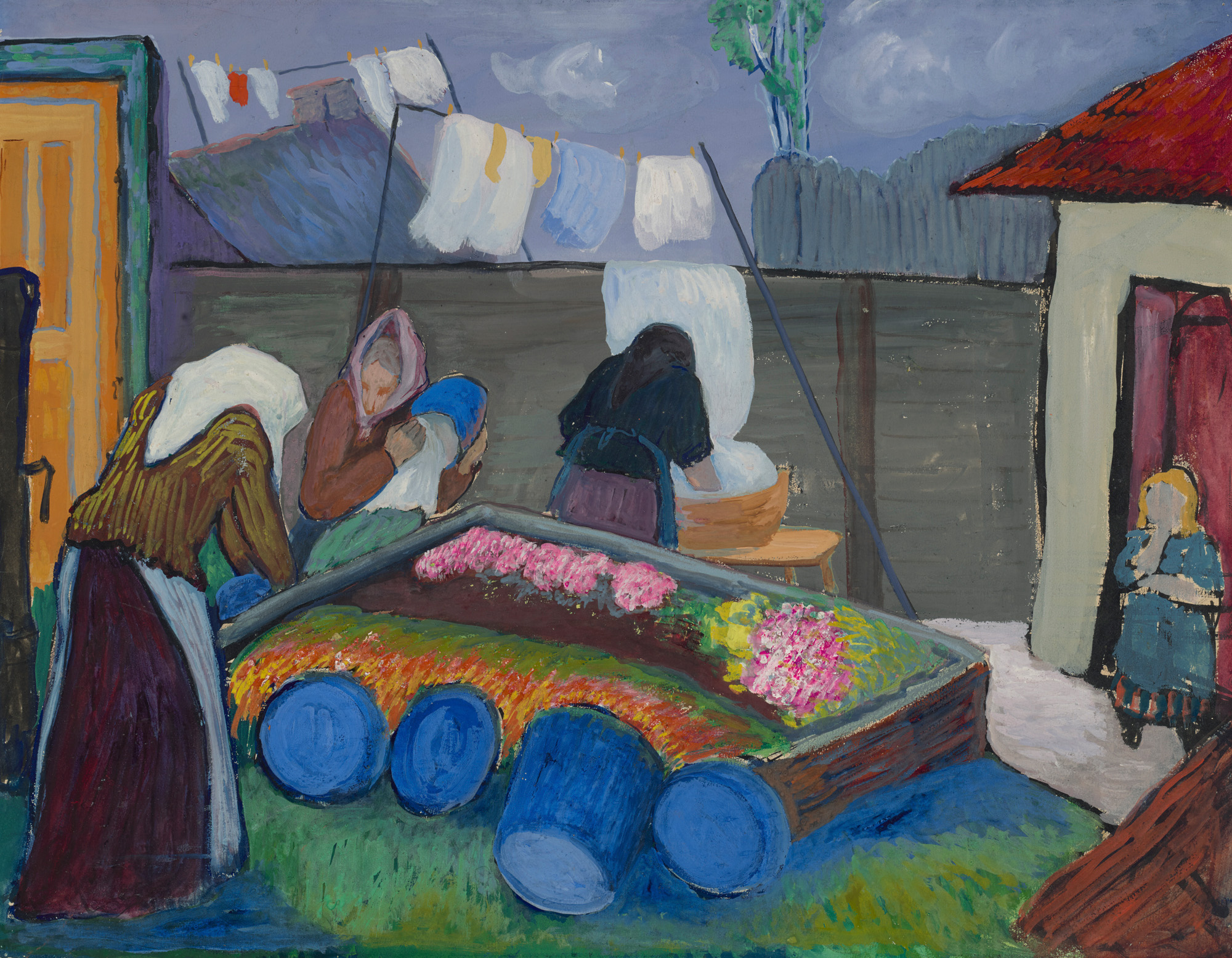
Washerwomen is a painting created around 1909 by Marianne von Werefkin, a Russian-born artist active in Munich within the founding circle of Der Blaue Reiter. Executed in tempera on paper laid down on board, the work is held at the Städtische Galerie im Lenbachhaus und Kunstbau, Munich. Unlike her close associates Kandinsky, Jawlensky, and Münter, who moved toward abstraction, Werefkin remained committed to a figurative, symbolist idiom shaped by Gauguin, the Nabis, and Edvard Munch. This laundry scene, structured by repeated poses and a circulating blue, reflects the singularity of an artist long overshadowed by her male contemporaries and now being rediscovered through several museum exhibitions.
Looking at Marianne von Werefkin’s Washerwomen, I keep returning to Paul Sérusier’s La Ferme du Pouldu, which I featured recently on VMuseum. The same debt to the Nabis and to Gauguin runs through both: broad, contoured fields of colour, forms outlined in black, and a way of capturing ordinary rural labour without reaching for anecdote. Werefkin’s painting stays within that same pictorial register, even as she was, at the very moment, an active member of the Blaue Reiter — a movement already tilting toward abstraction and expressive intensity. What strikes me most is the vivid blue of the washtubs in the foreground, echoed in the grey-blue of the sky and in the little girl’s dress. That circulation of colour gives the composition its unity, carrying it well beyond a simple genre scene.
You are standing before an ordinary courtyard, somewhere in Bavaria, around 1909. Four women wash linen around a wooden tub. A fair-haired girl watches from a doorway beneath a red-tiled roof. Nothing appears to be happening. And yet everything is at stake.
What Washerwomen Tells Us
Marianne von Werefkin worked in tempera, on paper mounted on board. The surface stays matte, opaque, without sheen. The washerwomen’s bodies repeat, all bent forward, all seen from behind. This rhythm is no accident: it organises the gaze, imposing an almost hypnotic cadence. Blue dominates, from the tubs to the low sky to the child’s dress. Then, to the right, a scarlet wall breaks in abruptly. The chromatic contrast unsettles as much as it captivates. A scene of domestic labour becomes, under this treatment, something closer to a vision.
What Werefkin’s Era Tells Us
In 1909, Werefkin gathered Jawlensky, Kandinsky, Münter, and other Munich-based artists in her own salon. The New Artists’ Association of Munich (Neue Künstlervereinigung München) was born there. Around her, close colleagues drifted toward abstraction. Werefkin, by contrast, remained figurative, faithful to a symbolist mode of painting shaped by Van Gogh, Gauguin, the Nabis, and Japanese woodblock prints. Her work has sometimes been described as “painting of the soul,” aligning her with Edvard Munch, whom she admired. Beneath these rural scenes, something else is always at work: a quiet, psychological tension.
The Artist: Marianne von Werefkin
Born in Tula in 1860 and trained under the realist painter Ilya Repin, Werefkin settled in Munich in 1896. She became a central figure in the circle that would give rise to Der Blaue Reiter. She died in Ascona in 1938.
Current Exhibition
Interest in Marianne von Werefkin is gaining new momentum in 2026. From 23 October 2026 to 21 February 2027, Museum Wiesbaden presents Die Blauen Reiterinnen, the first exhibition worldwide devoted to the women artists who gravitated around Der Blaue Reiter, Werefkin foremost among them, alongside Gabriele Münter, Sonia Delaunay-Terk, Natalia Goncharova, and Elisabeth Epstein. The exhibition brings to light a long-overlooked fact: Werefkin, together with Elisabeth Epstein, played a decisive role in shaping the pictorial language that would come to define the movement. It is organised in collaboration with Museum Wiesbaden, the Städtische Galerie im Lenbachhaus und Kunstbau in Munich, the Paula Modersohn-Becker Museum in Bremen, and the Fondazione Marianne Werefkin in Ascona. After opening in Wiesbaden, the exhibition will travel to Bremen and Munich before concluding in Ascona. Such an itinerary across major institutions reflects the growing recognition now given to Werefkin, long eclipsed by her male peers in the Blaue Reiter, and confirms the central role the Lenbachhaus collection continues to play in the rediscovery of her work.
Source: Museum Wiesbaden
A Question for You
Werefkin so admired Munch that critics applied the phrase “painting of the soul” to her work as well. But where does his influence end, and where does her own voice begin?
About This Work
- Washerwomen
- Marianne von Werefkin
- c. 1909
- Tempera on paper laid down on board
- 50.5 × 64.6 cm
- Städtische Galerie im Lenbachhaus und Kunstbau, Munich (Gabriele Münter Foundation, 1957)
- https://www.lenbachhaus.de/en/digital/collection-online/detail/waescherinnen-30012440