Key facts
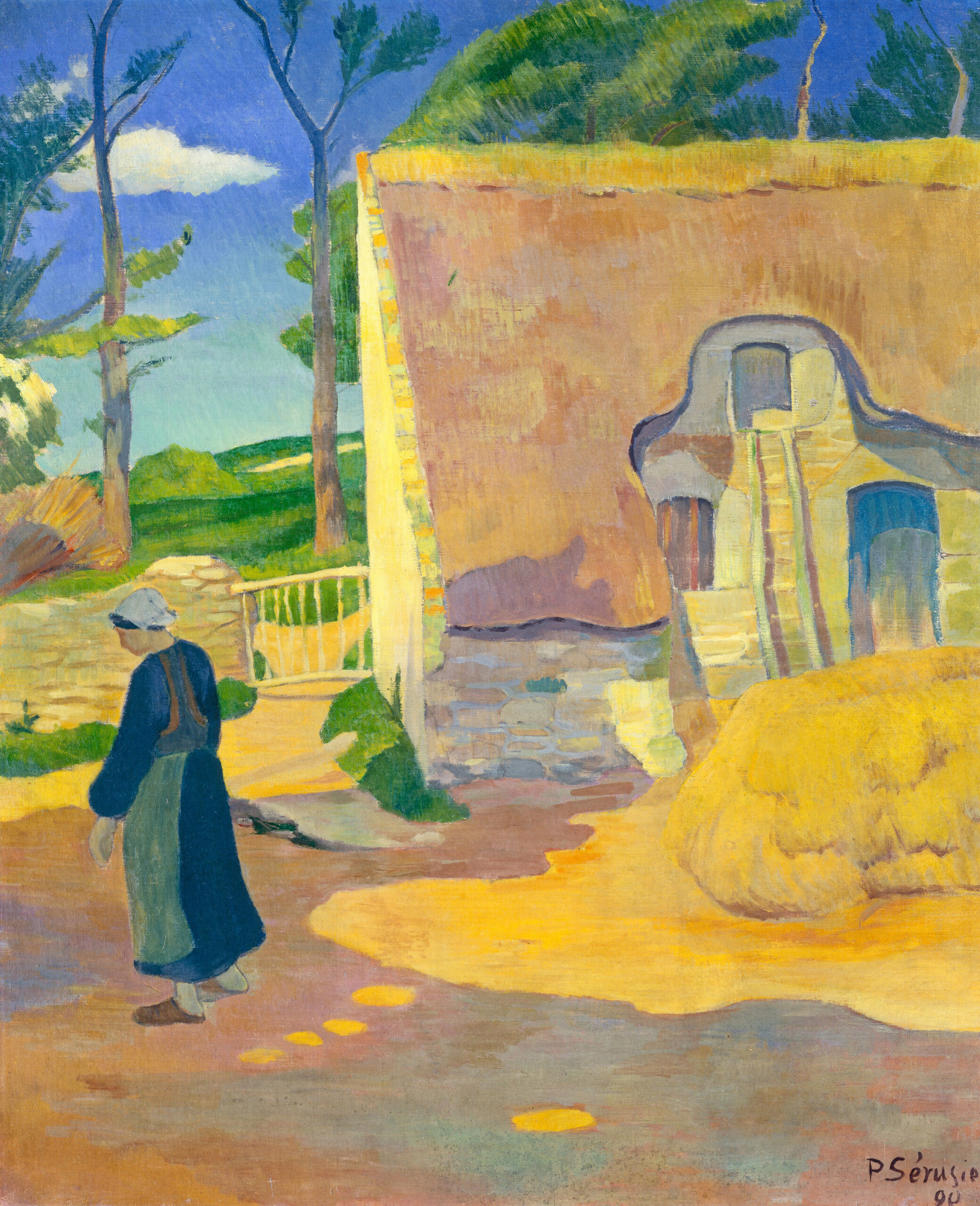
Farmhouse at Le Pouldu belongs to the Breton period of Paul Sérusier, a painter born in Paris in 1864. Painted in 1890, two years after his encounter with Paul Gauguin at Pont-Aven, this oil on canvas illustrates the principles of Synthetism and the Nabis movement, of which Sérusier was one of the founders alongside Maurice Denis, Émile Bernard, Pierre Bonnard, and Édouard Vuillard. The composition simplifies the shapes and colors of a Breton farmyard, favoring the decorative organization of the surface over the imitation of reality. Held at the National Gallery of Art in Washington, the work marks a decisive turning point in the history of modern painting, between Impressionist heritage and Post-Impressionist rupture.
Yet another modern-style painting for its time. Sérusier is one of the founding members of the Nabis group, alongside Bonnard, Maurice Denis, and Vuillard. I discover this work with real interest. It shows a simple rural scene treated with brilliant colors and simplified forms. We are no longer in the realm of faithful representation of reality here: we are in Synthetism, that movement in which color and form convey an emotion, an inner sensation, rather than a faithful copy of the landscape. This is a deliberate, openly claimed act of creation. I find this new approach compelling, driven by a genuine reflection on what painting should be. Isn’t this resolutely modern?
The Farmhouse at Le Pouldu
Look first at this yellow diagonal, almost electric, cutting across the thatched wall. The sun strikes the façade at an angle, carving out a stark, unshaded light. A woman in a white coif crosses the courtyard, tiny in her navy-blue dress. The sky has none of the softness of the Atlantic. It is a sharp, almost hard blue, saturated all the way to the bare branches of the trees. To the right, a haystack spreads out, almost sun-like. The painter signs discreetly in the bottom right corner, far from this chromatic explosion.
Paul Sérusier
Sérusier paints this farmhouse in 1890, two years after a decisive stay in Pont-Aven. At the Pension Gloanec, he meets Paul Gauguin, who gives him a now-famous painting lesson. Gauguin urges him to exaggerate colors, to simplify forms, far from any faithful imitation of nature. During the summer of 1888, he shares this experience with other artists. All are drawn to the rural remoteness of Brittany, its traditional costumes, and its ancient faith. Sérusier trains at the Académie Julian in Paris. He joins Gauguin’s circle, which becomes known as the Nabis, alongside Émile Bernard and Maurice Denis. The word, from Hebrew, means prophet. Denis sums up their ambition in a now-famous statement. A painting, before all else, is a flat surface covered with colors arranged in a certain order. Here, light is no longer modeled through minute shading. It becomes flat color, sharp contour, sinuous linear pattern. The small hatched brushstrokes, visible in the sky and the thatched roof, betray the influence of Cézanne. The Nabis call this approach Synthetism. It is a deliberate pictorial unity, openly claimed, far removed from any faithful copy of the Breton landscape.
Feel
The warmth of this farmyard is almost tangible. The yellow of the haystack vibrates against the deep blue of the sky. Nothing here is soft; everything is sharp, contrasted, almost blunt in its economy of means. One might mistake this for a peaceful scene of rural Brittany, a woman heading home, an ordinary day. Yet Sérusier is not seeking pastoral calm. He builds a tension. On one side, the simplicity of the subject: a farmhouse, a peasant woman, a gate. On the other, the radical nature of the pictorial treatment. This canvas does not really tell a story. It imposes a colored presence, almost abstract for its time. The true subject may not be the farmhouse at Le Pouldu at all. It is the very organization of colors and lines on the canvas, an invented order rather than an observed one.
News: a landmark exhibition at the Musée Sérusier
Since April 2026, the Musée Sérusier in Châteauneuf-du-Faou, in Finistère, has been presenting “Musée Sérusier, The Collection Revealed: A Second Look,” on view through January 10, 2027. It brings together more than 200 works from the museum’s collections, several shown to the public for the first time. Located in the town where Paul Sérusier spent his final years alongside his wife Marguerite, herself a painter, this museum places a work like Farmhouse at Le Pouldu within the broader context of the artist’s Breton period.
Source: Musée Sérusier
A question for you
Cézanne in the brushwork, Gauguin in the color: which of the two truly dominates this canvas?
About this work
- Farmhouse at Le Pouldu
- Paul Sérusier
- 1890
- Oil on canvas
- 72 × 60 cm
- National Gallery of Art, Washington D.C.
- https://www.nga.gov/artworks/116570-farmhouse-le-pouldu