Key facts
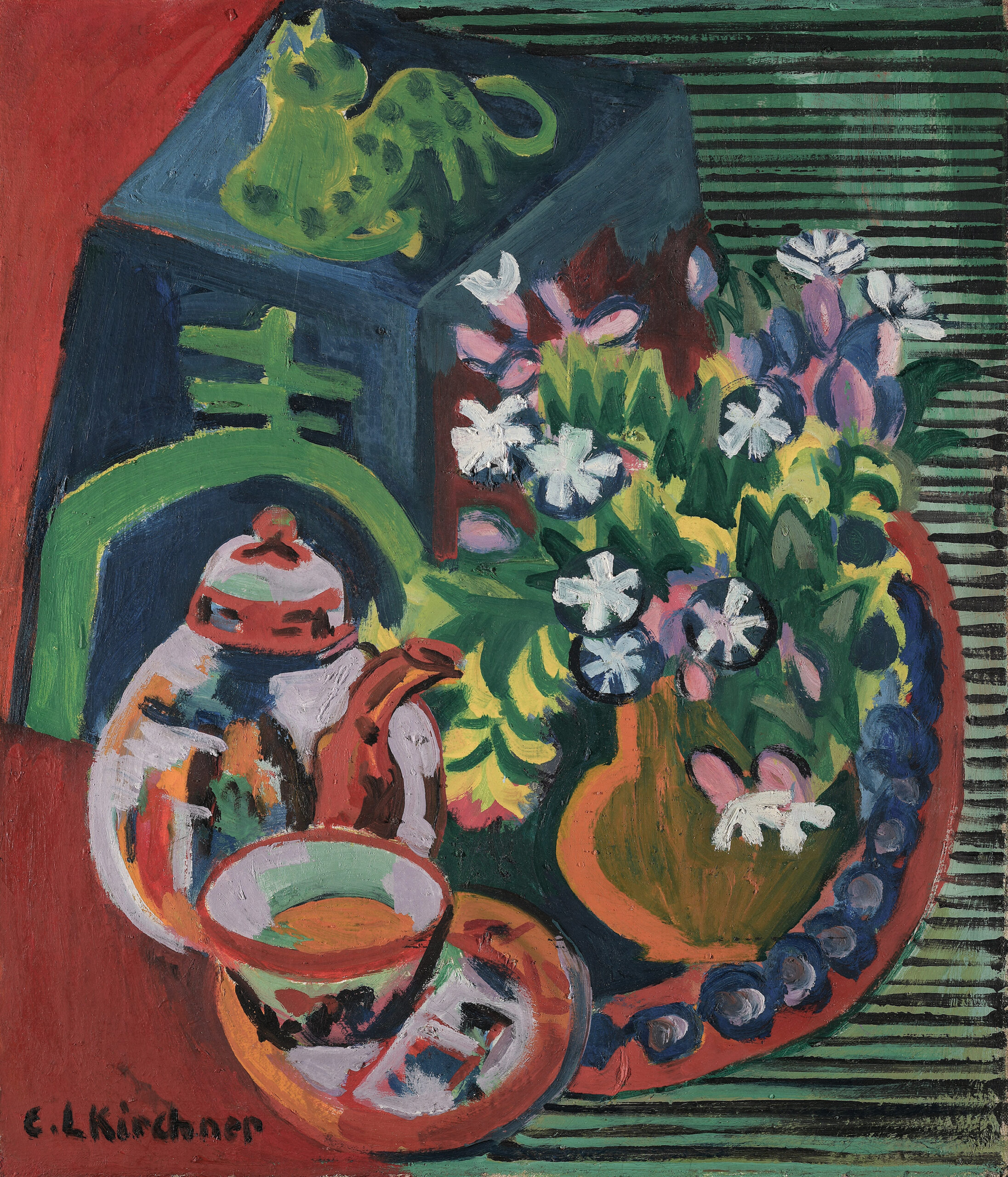
Still Life with Chinese Porcelain is an oil on canvas painted by Ernst Ludwig Kirchner between 1920 and 1938, held at the Neue Nationalgalerie in Berlin. It belongs to the artist’s late period, marked by a calmer style and a composition structured in flat planes, associated with German Expressionism and the Die Brücke group he co-founded in 1905. The painting, reworked by Kirchner shortly before his death, reflects the evolution of his palette and spatial construction during the years spent in Davos, Switzerland, where he settled after the First World War.
This is a rather classical still life that Kirchner offers us here. We’re used to works more marked by his signature style, sharper, more nervous, here the lines are surprisingly soft. I love the way the colors, softer here, still hold onto a fairly wide range, between red and green. The composition is nicely balanced between the flower bouquet and the Chinese porcelain, two motifs that echo each other without competing. The whole thing is drawn tightly against a dense background, almost muted, which gives the scene a more intimate feel than his Berlin or Davos canvases. It’s precisely this contrast with the image we usually have of Kirchner that makes this piece worth lingering on.
Look first at this little green figurine decorating the porcelain, speckled, perched on the dark blue edge of the crate. It catches the eye before it drifts toward the teapot, the bowl set in the foreground, then toward the dense bouquet of white, pink and mauve flowers filling the entire right half of the canvas. The light, matte, catches no reflections: everything is painted in flat planes, without cast shadow.
What Still Life with Chinese Porcelain shows
Kirchner builds this still life like a woven carpet of planes. Since 1920, settled in Davos, his touch grows calmer and his palette gains clarity, heightened by deliberate contrasts between red and green. Here, a tectonic order arranges each object along a grid of horizontal and vertical lines, inherited from the alpine landscapes he paints during the same period. On the left, a uniform red field envelops the teapot and the Chinese porcelain bowl. On the right, repeating stripes structure the background into strict bands, almost textile-like. This tension between smooth surface and rhythmic pattern bears the mark of the “carpet style,” born from his collaboration with the weaver Lise Gujer, for whom he designs large tapestry cartoons. Kirchner reworks the canvas shortly before his death in 1938, further sharpening this deliberate flatness. The Chinese tea set and the small animal figurine speak to his taste for exotic and varied objects, gathered here without apparent hierarchy. These disparate objects sketch out a longing for the universal, far from the borders that history is about to close.
Ernst Ludwig Kirchner and his era
Nothing in this composition hints at the urgency of the preceding years. Ernst Ludwig Kirchner co-founds the Die Brücke group in Dresden in 1905, a driving force behind the emerging German Expressionist movement. His Berlin canvases, nervous and angular, stand in sharp contrast to the scene shown here. The First World War shatters his nervous health. He settles in Davos in 1917 and gradually rebuilds his pictorial gesture, surrounded by porcelain and objects brought back from his travels. This late phase, marked by order and calmed color, comes shortly before his tragic end. Kirchner dies in 1938, the very year several hundred of his works are removed from German museums, branded as degenerate art by the Nazi regime. The serenity of this Chinese porcelain stands in stark contrast to the violence of that context.
Kirchner and “Degenerate Art”
The story of this late Kirchner work resonates strongly with current events at its place of conservation. In 1933, the artist sees his work branded “degenerate art” by the Nazi regime, which confiscates hundreds of his paintings from German museums, an episode that would shape his critical reception until his death in 1938. The Neue Nationalgalerie in Berlin, which holds this still life, will dedicate an exhibition to this dark chapter of modern art history: Schatten Reich. The Other German Art 1933-1945, running from January 29 to May 2, 2027. Curated by Maike Steinkamp and Florian Illies, it will trace the paths of artists such as Willi Baumeister, Jeanne Mammen and Alexej von Jawlensky, who continued or reinvented abstract work despite the regime’s ban on exhibiting, offering a complementary lens on the historical backdrop Kirchner himself lived through.
Source: Neue Nationalgalerie
A question for you
Kirchner co-founds Die Brücke in 1905 to break with academicism. Twenty years later, is this calmed still life still an Expressionist painting, or already something else?
About this work
- Still Life with Chinese Porcelain
- Ernst Ludwig Kirchner
- c. 1920-1938
- Oil on canvas
- 70 x 60 cm
- Neue Nationalgalerie, Berlin
- https://search.smb.museum/object/obj-965425