Davos, 1923. Kirchner turns his gaze toward the Swiss Alps. He is fleeing Berlin, and his demons. In this forced retreat, he discovers a wild and monumental nature. The mountains of Klosters await him, ready to burn on the canvas.
A palette in fusion
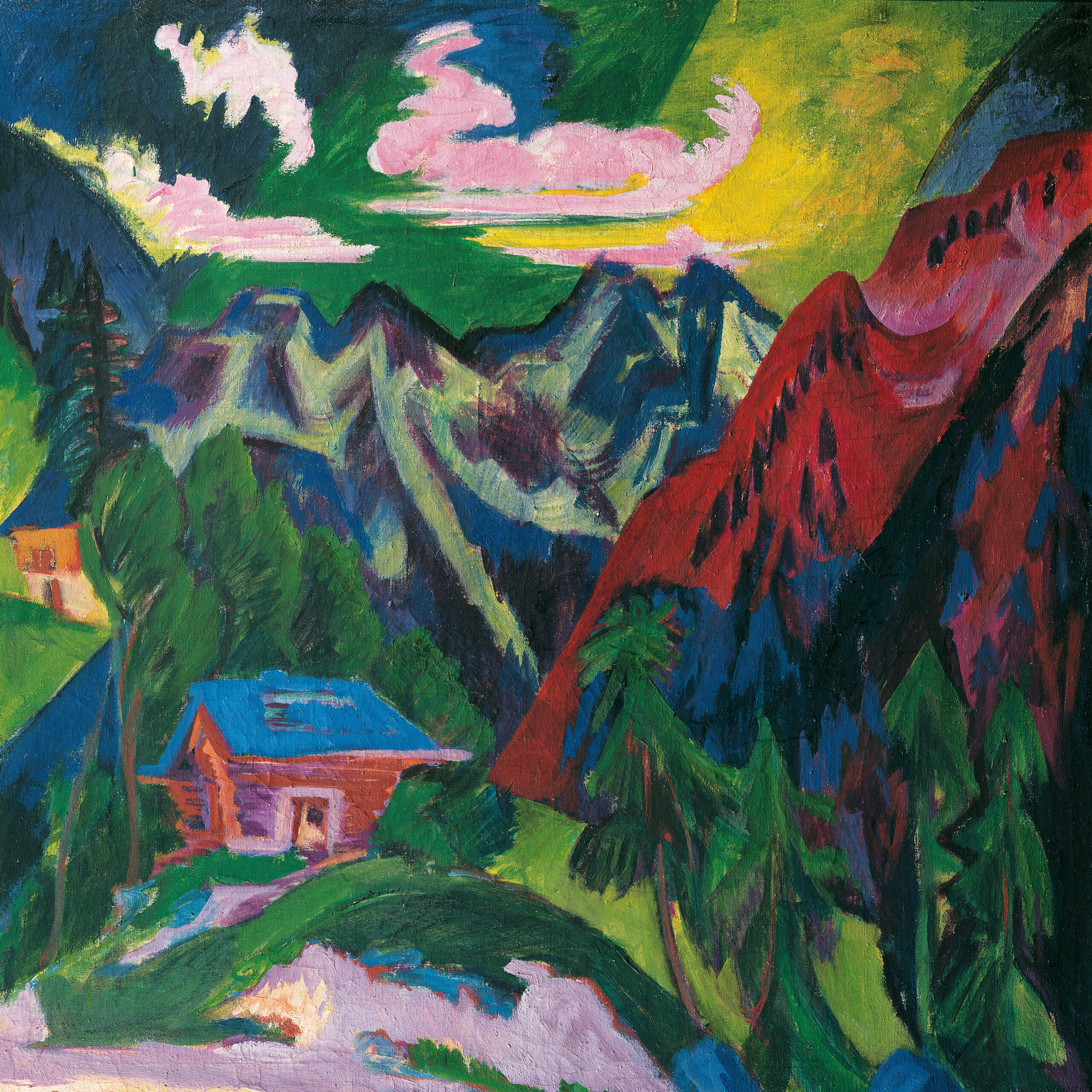
Look at that red setting the right-hand slope ablaze. The cobalt blue of the roof cuts sharply against the acid green of the forests. Kirchner does not imitate nature: he reinvents it. The brushstrokes are rapid, incisive, expressive. The mountains ripple like frozen waves. A chalet nestles at the bottom of the valley, tiny against the summits. Everything vibrates, everything pulses. The shape of the ridgelines echoes in the spruce trees: a visual rhythm that runs through the entire composition.
When the Alps save an artist
In 1917, Kirchner settled in Switzerland following a nervous breakdown. The Great War had broken him. The Alpine panoramas became his new terrain of experimentation. Far from the urban Expressionism of his Berlin years, he now explored the raw power of landscape. This 1923 oil on canvas belongs to that period of creative rebirth. Kirchner transforms each valley into a pictorial manifesto: non-naturalistic colors, nervous contours, dynamic tensions. The work is today held in the collections of the Belvedere Museum in Vienna.
Ernst Ludwig Kirchner
Ernst Ludwig Kirchner (1880–1938) co-founded the group Die Brücke in 1905, the vanguard of German Expressionism. His work constantly interrogates the relationship between human beings and their environment. In Davos, the mountains replace the streets of Berlin. Same urgency. Same intensity.
A question for you
💭 Where Romantic painters sublimated the mountain, Kirchner sets it ablaze with unreal color. Does this rupture mark the end of an ideal — or the birth of a new way of seeing landscape?
About this work
- The Klosters Mountains
- Ernst Ludwig Kirchner
- c. 1923
- Oil on canvas
- 120.5 × 120.5 cm
- Belvedere Museum, Vienna
- https://sammlung.belvedere.at/objects/8275/die-klosterser-berge