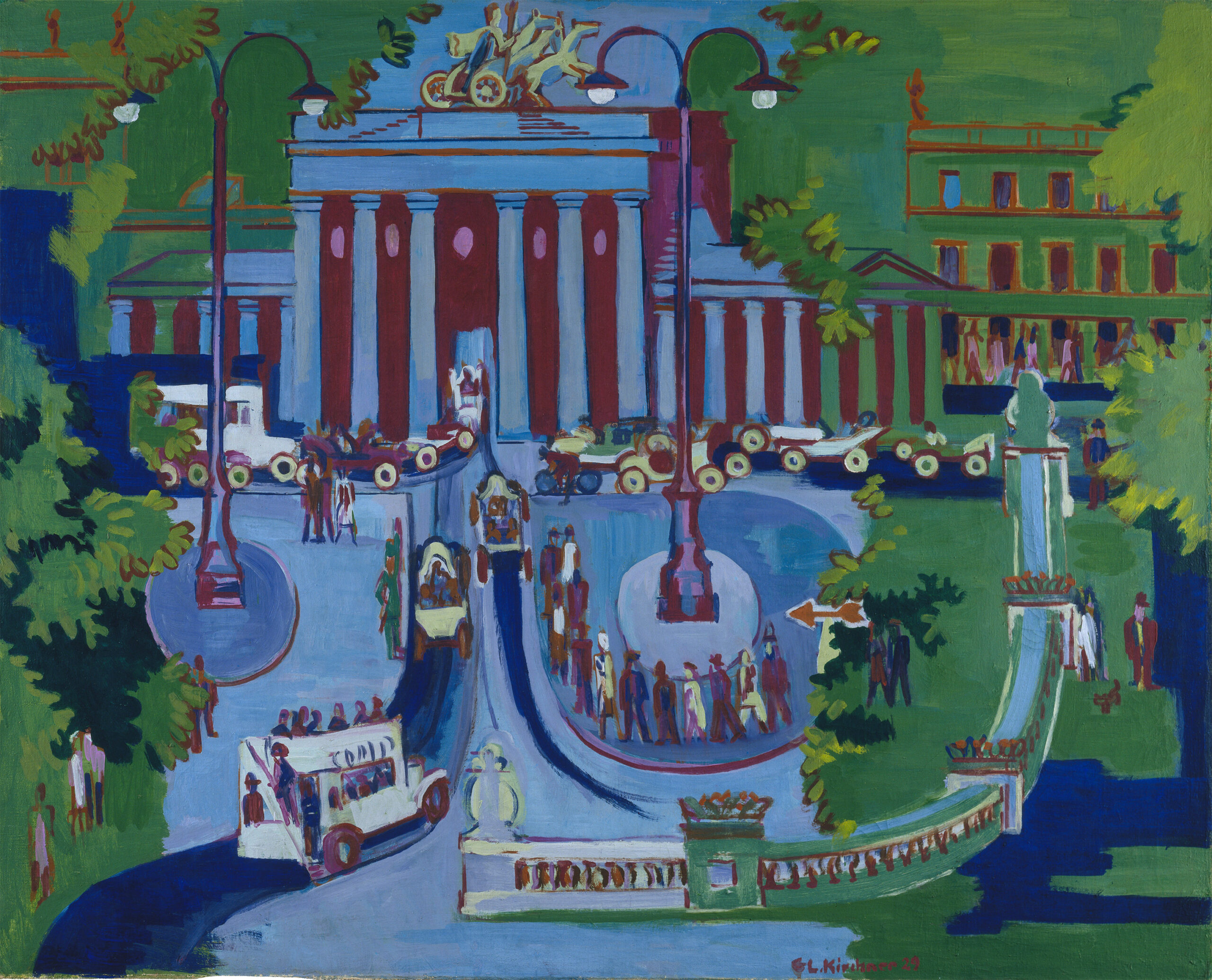
I still remember the emotion I felt when I first encountered the Brandenburg Gate in Berlin. The emotion of standing before a monument that occupies such a singular place in the city’s history : a symbol of the fall of the Wall in 1989, and of the founding moment of European reunification. The emotion, too, of the monument itself: restored after the devastation of the Second World War, like so many other remnants of a district that had to rebuild itself stone by stone. This is precisely what makes Kirchner’s canvas so arresting. Painted in 1929, it restores to us the life that already animated this storied place before the fracas of history: the silhouettes, the movement, the colour of a vibrant, unsuspecting Berlin, only a few years from the abyss. A rare pictorial testament to what the Gate once was, before it became a symbol of modernity.
The blue commands the eye. A dense, almost electric blue that floods the roadway and the columns of the Brandenburg Gate. Around it, green erupts in bold, unmodulated patches. Automobiles, figures, a white double-decker bus, Berlin is in motion.
Berlin in Colour, Before the Silence
Kirchner painted this oil on canvas in 1929, from an elevated vantage point overlooking the Tiergarten. Observe the composition: the perspective drives deep toward the Gate, drawing the eye through the crowd and the traffic. The brushwork is rapid, tense. The palette, blues, greens, deep reds, is that of German Expressionism at full maturity. Kirchner is not seeking photographic fidelity. He captures the energy of a modern city, dense and alive. The Berlin of the Roaring Twenties, cosmopolitan and carefree, standing only four years from the Nazi seizure of power.
Kirchner and the City as Experimental Ground
Ernst Ludwig Kirchner (1880–1938) co-founded Die Brücke in Dresden in 1905. The movement transformed German painting: acid colours, distorted forms, a persistent tension between the individual and urban modernity. Kirchner settled in Berlin in 1911, and the city became his defining subject. By 1929, he was living in seclusion in Switzerland, this canvas is a distanced gaze, almost elegiac, cast toward a metropolis he no longer frequented. The work is held today in the collection of the Städel Museum, Frankfurt am Main.
Kirchner in Berlin, Still Present
The Brandenburg Gate remains one of the most represented landmarks in Berlin. Until 21 June 2026, the Brücke-Museum is dedicating its exhibition Kunst Hand Werk Brücke to this legacy, an unprecedented exploration of the applied arts of Kirchner and his fellow founders: furniture, jewellery, textiles, with over 170 works shedding light on a lesser-known dimension of their practice.
Source : www.bruecke-museum.de
A question for you
💭 What do you see first in this canvas: the monument, or the crowd that surrounds it?
About this work
- Brandenburg Gate
- Ernst Ludwig Kirchner
- 1929
- Oil on canvas
- 121 × 149.5 cm
- Städel Museum, Frankfurt am Main