Berlin, 1917. Arnold Topp, a teacher in Brandenburg, prepares a revolutionary canvas for the Der Sturm gallery. A blue house is about to soar into infinite space.
Shards of Color in Dialogue
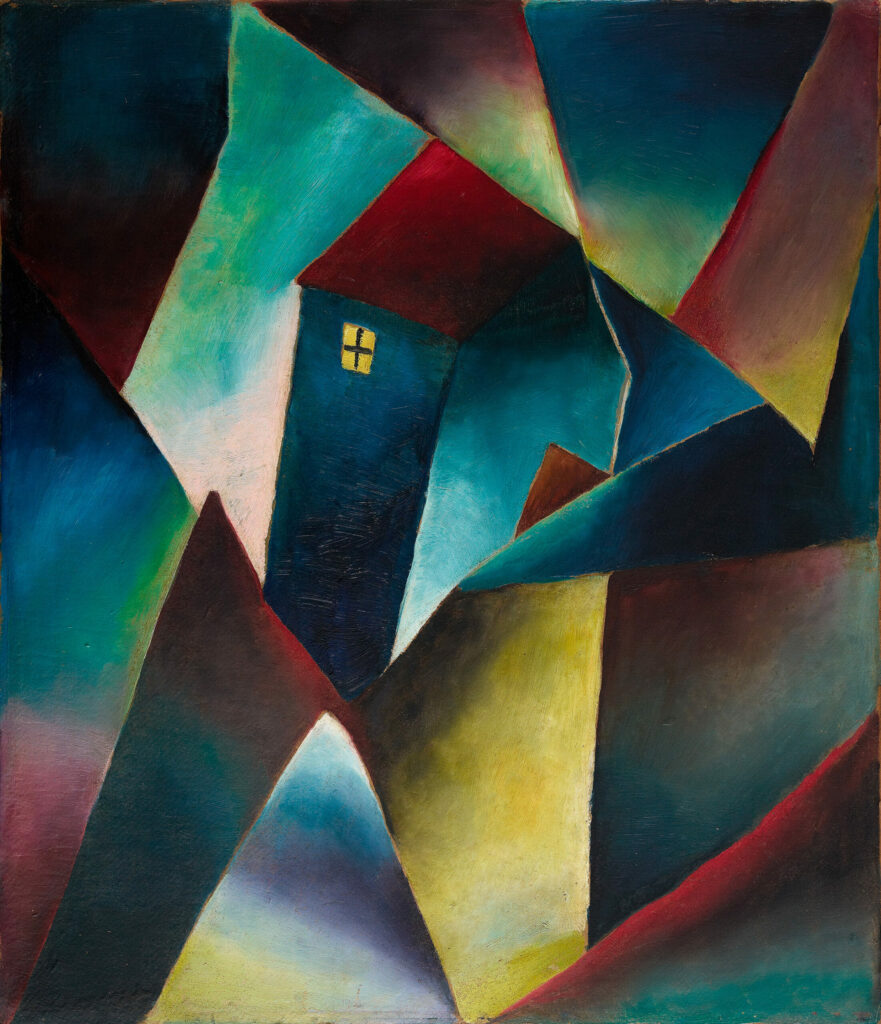
Observe these chromatic surfaces converging to a point. The blue of the house dialogues with yellow, red, and green fragments. A golden window shines like a beacon. Topp applies oil to cardboard in successive layers. The contours undulate, curve, refuse Cubist rigidity.
These forms evoke broken stained glass reorganizing itself in space. The composition unfolds its colored wings in a fan. Each surface reflects the others in a subtle chromatic play.
The Influence of Franz Marc and Der Blaue Reiter
This work emerges in the wake of German Expressionism. Arnold Topp associated with Franz Marc and Heinrich Campendonk, whose influence is evident in these organic curves. In 1918, critic Adolf Behne praised this “absolute painting” where color becomes a “vehicle of architectural sensibility.”
Topp exhibited this painting at the Der Sturm gallery, temple of the Berlin avant-garde, in May 1918. The work embodies the Expressionist quest for a spiritual reality beyond appearances. Forms dissolve to reveal the emotional essence of the landscape.
Arnold Topp
Arnold Topp (1887-1945) developed a unique pictorial vocabulary from 1913 onward. This drawing and gymnastics teacher became an “absolute painter.” He created uncompromisingly from pure color. His style synthesizes Expressionism and nascent abstraction.
Think about it
💭 If this blue house were a fragment of your own inner universe, what color would dominate your intimate landscape?
About This Work
- Image with Blue House
- Arnold Topp
- circa 1917
- Oil on cardboard
- 58.5 × 50.5 cm
- Staatliche Museen zu Berlin, Neue Nationalgalerie (Andres Kilger, Public Domain)
- https://recherche.smb.museum/detail/963877/bild-mit-blauem-haus
Der Sturm: The Gallery That Launched Topp
Between 1917 and 1926, Arnold Topp exhibited regularly at Herwarth Walden’s Der Sturm gallery in Berlin, one of the most influential platforms for the European avant-garde of the period. It was in this setting that the present work was shown in May 1918, where critic Adolf Behne described it as “absolute painting,” praising colour as a “vehicle of architectural sensibility.” Walden had made his gallery an essential staging post for Expressionists, Cubists and Futurists alike: to exhibit there was a consecration. Topp showed alongside figures such as Bruno Taut and Georg Muche, and his works travelled as far as the United States, the Soviet Union, Japan and France.
A Life Broken by History
The fate of Arnold Topp (1887-1945) stands as a testament to the tragedy of an entire generation of German artists. Wounded at the Battle of Verdun in 1915, he nevertheless continued his creative work and his teaching career, becoming a senior lecturer in 1927. In 1945, he was called up to the Volkssturm, the last-resort militia of the Third Reich. He disappeared, most likely as a prisoner of the Red Army. His death was not declared officially until 1961, leaving the circumstances of his final days unresolved. His work then fell into oblivion until the publication of a biography in 2006.
An Abstraction Between Expressionism and Architecture
Trained at the Düsseldorf school of applied arts from 1910, Topp developed a pictorial language grounded in pure colour, in which the blue house at the centre of this composition is not a subject but a structure. The architectural form becomes a pretext for chromatic relationships: blue, yellow, red and green are arranged in a visual tension that owes everything to chromatic intuition and nothing to realism. This approach places him at the crossroads of German Expressionism and the emerging tendencies that would lead toward geometric abstraction.