Key facts
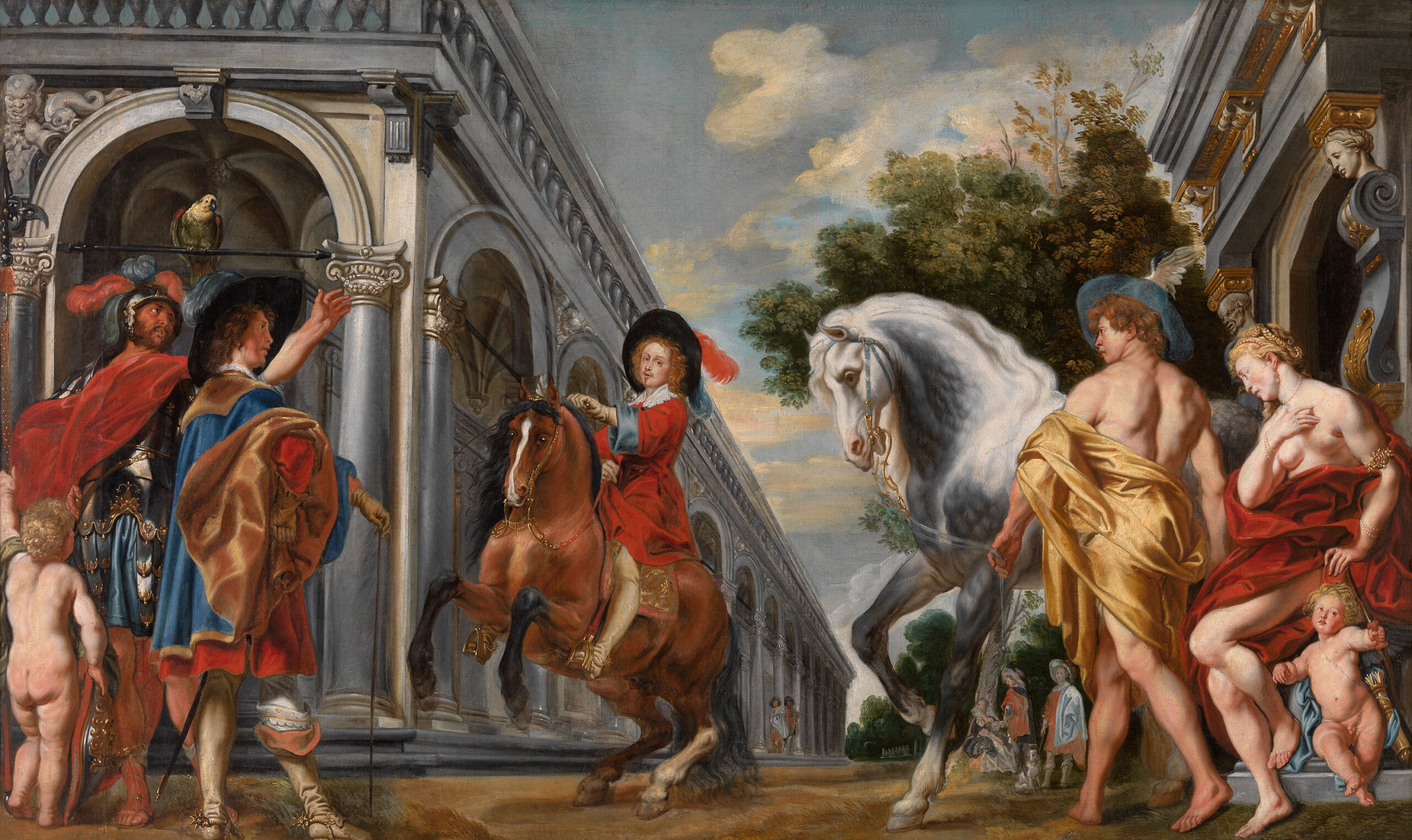
Levade is an oil on canvas by the Flemish painter Jacob Jordaens (1593-1678), painted in the 17th century and held at the KMSKA, the Royal Museum of Fine Arts Antwerp. A young rider performs a levade, a haute école movement in which the horse rises onto its haunches. The scene takes place in front of a classical loggia, in the presence of mythological figures such as Mercury. The subject echoes that of a tapestry series on horsemanship woven in Brussels after designs by Jordaens, around 1640-1650. A closely related version is held at the National Gallery of Canada, in Ottawa. A leading figure of Flemish Baroque, Jordaens shows a disciplined side here, far from his popular genre scenes.
I find Jordaens’s verve here, though somewhat tempered in this history painting. In a composition built entirely on perspective, we see at the centre a noble rider whose horse performs a levade, the haute école movement in which the animal rises onto its haunches in perfect control. Around him, figures in colourful clothing bring the scene to life and lead the eye towards the rider. What strikes me here is the Renaissance-inspired work, with its constructed perspective and classical feel, from a painter best known for his boisterous scenes, such as The King Drinks or his peasant feasts full of laughter and noise. Yet Jordaens’s temperament has not disappeared: it lives on in the flesh of the colours, in the power of the animal, in this contained energy that seems ready to burst out. For me, this contrast is what makes the work so endearing: it shows a Jordaens capable of discipline, like the horse he paints, without giving up his vitality.
Under the left-hand arch, a green parrot sits on a perch. It looks at no one. Everyone else, however, is looking at the rider. Observe this young man in red, wearing a black hat with a feather. He holds his bay horse upright, motionless. The gesture looks simple, but it takes years of training. At the KMSKA, the museum’s entry remains sparse: no precise date, no subject.
A riding lesson among the gods
Now look at the edges of the canvas. On the left, a warrior in helmet and armour, draped in red, stands beside a gentleman in a blue cloak. On the right, Mercury, recognisable by his winged hat, holds a grey horse on a lead. Beside him, a woman draped in red, accompanied by a Cupid with his quiver, lowers her eyes. Reality and myth share the same courtyard. This blend has a precise origin. Around 1640-1650, Jacob Jordaens designed the models for a tapestry series on the art of riding, woven in Brussels. The riders follow the engravings of Crispijn de Passe the Younger, which illustrated the lessons of the riding master Antoine de Pluvinel. Jordaens replaced the riding master with the god Mars. A very similar version, dated around 1645, belongs to the National Gallery of Canada, in Ottawa. The museum considers it a model for a tapestry, entirely by the painter’s own hand. Jordaens even added a statue of Neptune, creator of the horse, at a later stage. Is the Antwerp canvas a stage, a variant, a later version? The museum records do not say.
Jacob Jordaens and his time
Jacob Jordaens (1593-1678) spent his whole life in Antwerp. A pupil of Adam van Noort, like Rubens, he never made the journey to Italy. Yet he became the leading figure in Antwerp after the deaths of Rubens and Van Dyck in the early 1640s. Italy came to him through books and engravings. Observe the loggia on the left: its arches recede towards a very low point, almost at the centre. Ionic columns, balusters and grotesque masks form a classical stage set. In this oil on canvas, the cool greys of the stone answer the vivid reds of the fabrics. The architecture is learned; the colour remains Flemish. Everything here speaks of control: the horse, the perspective, the gestures. And yet the draperies overflow, and the flesh glows pink.
At the KMSKA this autumn
If you would like to see Levade in Antwerp, autumn is a good time to visit the KMSKA. The museum is coming off a record year: for the third year running, it broke its attendance record, with nearly 570,000 visitors in 2025. Its end-of-year programme focuses on sculpture. Since 3 October, the Philip Aguirre y Otegui exhibition (until 17 January 2027) explores the tension between inside and outside, security and uncertainty. The KMSKA will then close 2026 with a major tribute to Ossip Zadkine (1888–1967), from 31 October 2026 to 18 April 2027. The museum owns nine of his works, including The Misery of Job, donated by Zadkine himself. Jordaens is also in the spotlight outside Belgium. In Berlin, the Kupferstichkabinett is presenting an exhibition on Flemish drawing, where sketches, studies and designs offer a rare insight into the creative process of Rubens, Jordaens, van Dyck and their circle.
Sources: Focus on Belgium and KMSKA.
A question for you
Jordaens never travelled to Italy: where can you still see Italy in this painting?
About this work
- Levade
- Jacob Jordaens
- 17th century
- Oil on canvas
- 96.9 × 162.6 cm
- KMSKA, Royal Museum of Fine Arts Antwerp
- https://kmska.be/en/masterpiece/levade