Key facts
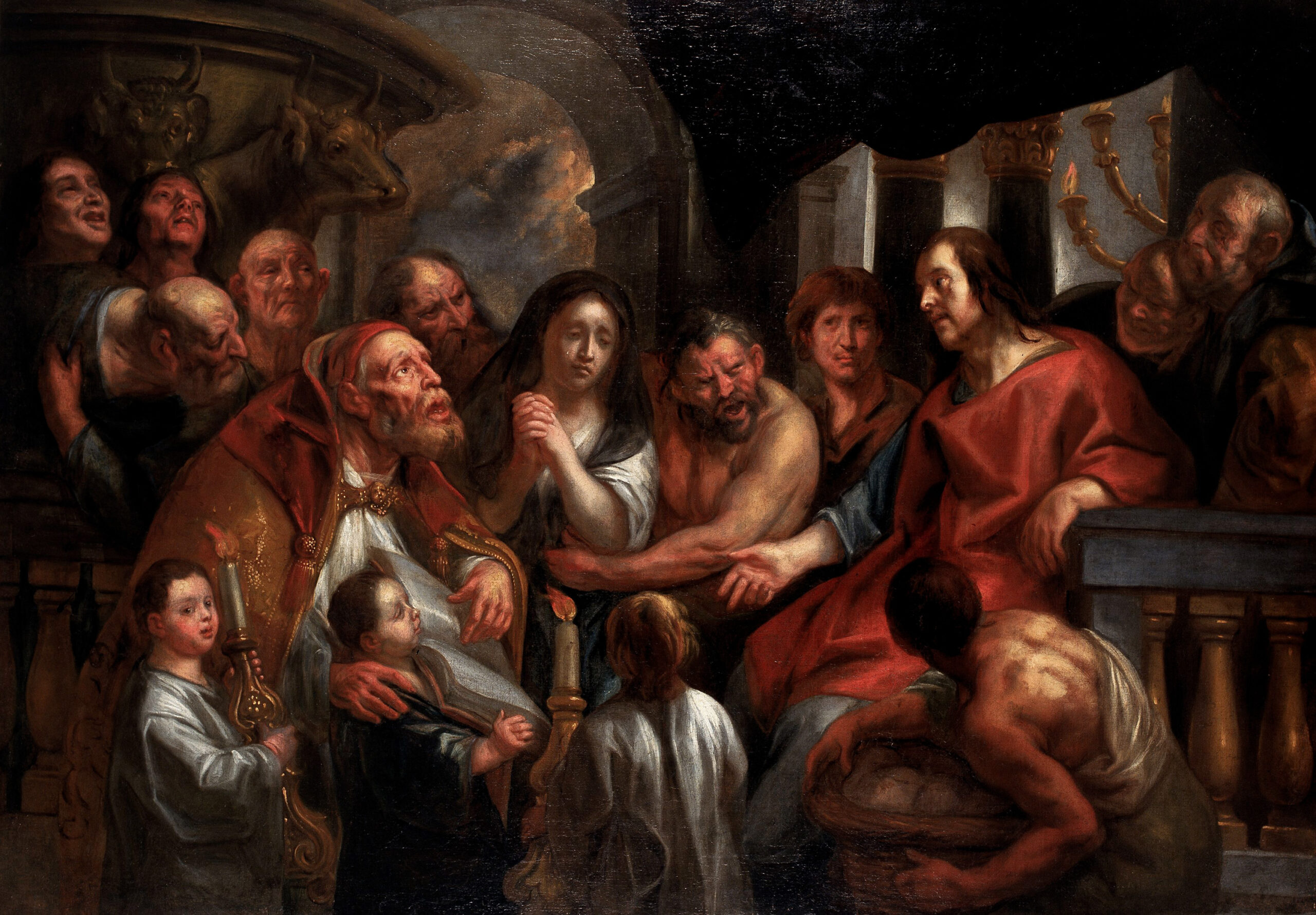
The Adulterous Woman Brought Before Christ is an oil on canvas painted around 1670 by Jacob Jordaens, a leading figure of Flemish Baroque painting alongside Rubens and Van Dyck. Held at the Museum of Fine Arts Ghent (MSK), the work comes from the Abbey of Saint Peter in Ghent and illustrates an episode from the Gospel of John in which Christ refuses to condemn a woman accused of adultery. Largely executed by Jordaens’s workshop, with the master’s own hand visible in certain figures, the painting reflects how Antwerp’s picture production was organised after 1640, when commissions to Jordaens multiplied following Rubens’s death. Jordaens returned to this same religious subject several times over the course of his career.
A classic subject of the period, treated here by Jordaens. This is most likely a workshop production in which he took part, painting a few passages with his own hand, a common practice for him after Rubens’s death, when commissions poured in. What strikes me here is the restrained, dark colour range, built around browns and ochres, characteristic of his output in the 1660s and 1670s. Another thing that strikes me is how the faces are handled, at times bordering on the grotesque, conveying the assembly’s feelings toward the adulterous woman. She is, in fact, the only woman in the picture, as though morality concerned men alone. I also note the look of astonishment on many faces, struck as they are by Christ’s new message in the face of sin. The painting commands attention through the intensity of its expressions and the tightly held palette of muted tones.
Look first at that wrist. A man’s hand, calloused, grips a woman’s arm at the centre of the canvas. Around her, a dozen faces crowd in: toothless elders, round-cheeked children, a bare-chested man bent over a basket. No one looks her in the eye.
The Adulterous Woman Brought Before Christ
Jordaens sets the scene in the Temple of Jerusalem, between a seven-branched candelabrum and a carved sacrificial bull’s head. On the right, Christ, draped in red, addresses the crowd. No stone has been thrown yet; the basket stays closed. The composition likely comes, for the most part, from Jordaens’s workshop: the painter draws it, his collaborators transfer it to canvas, and he then reworks certain heads himself, those of the figures in the foreground. The canvas comes from the Abbey of Saint Peter in Ghent. The palette stays dark, brown, ochre-toned, the brushwork looser, a signature of his manner after 1660. Christ does not judge, says the Gospel of John. The faces around him do, insistently: the scene shows a forgiveness that, aside from Christ, no one present yet seems to grasp.
Jacob Jordaens and his time
After Rubens’s death in 1640, Jacob Jordaens became the leading name in Antwerp Baroque painting. Commissions poured in, the workshop grew, production became standardised. Jordaens painted several versions of the Adulterous Woman Brought Before Christ over his career: another canvas on the subject is held at the Louvre, another at the KMSKA in Antwerp. Same subject, same tension between Mosaic law and Christian forgiveness, revisited each time through the resources of a thriving workshop rather than a single hand.
Currently at the Museum of Fine Arts Ghent
The Museum of Fine Arts Ghent (MSK) is showing, until 31 December 2026, an exhibition devoted to Van Eyck’s celebrated Ghent Altarpiece, held a short walk away at Saint Bavo’s Cathedral. From 10 October 2026, the MSK will open a retrospective on the Ghent painter Jenny Montigny, an opportunity to look beyond old masters such as Jordaens and rediscover the breadth of its collection.
Source: Museum of Fine Arts Ghent (MSK)
A question for you
If you had to single out one face painted by Jordaens’s own hand, which one in this crowd would you choose?
About this work
- The Adulterous Woman Brought Before Christ
- Jacob Jordaens
- circa 1670
- Oil on canvas
- 177.5 x 243 cm
- Museum of Fine Arts Ghent (MSK)
- https://www.mskgent.be/fr/collection/s-6