Key facts
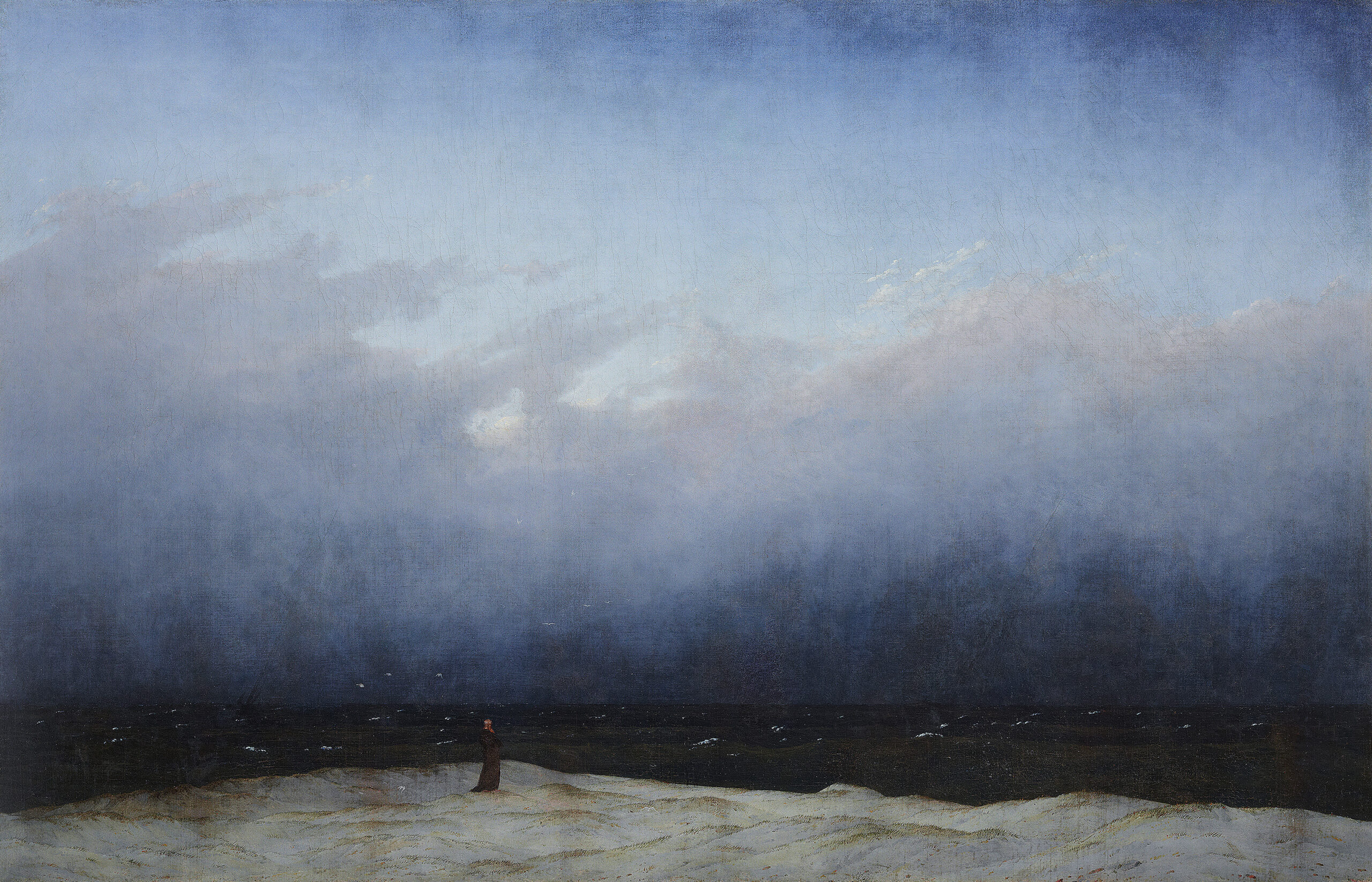
Painted by Caspar David Friedrich in Dresden between 1808 and 1810, Monk by the Sea is one of the major works of German Romanticism. The painter reduces the landscape to three horizontal bands, sand, sea and sky, before which stands the tiny figure of a monk. Infrared examination has shown that Friedrich first depicted ships, then painted over them. Exhibited in 1810 at the Berlin Academy of Arts alongside its companion piece, The Abbey in the Oakwood, the painting was acquired by King Frederick William III and established the artist’s early reputation. Restored between 2013 and 2016, it is held at the Alte Nationalgalerie in Berlin.
When I visited Berlin in 2020, Friedrich’s Monk by the Sea was one of the two paintings that moved and affected me the most. I remember that encounter very clearly: the canvas hung at the far end of a gallery in the Alte Nationalgalerie, alone on its wall, and it gripped me instantly. At more than 1.70 m wide, it fills your entire field of vision. And yet there is almost nothing on it: a tiny figure facing the vastness of the sea and sky. The tones are soft, rather dark, with nothing to catch the eye, and it is precisely this emptiness that fascinates. I was struck by the painting’s power to hold one’s attention and to stir a deep emotion. I spent long minutes in front of it.
I later learned that Friedrich had first painted ships on the sea, before covering them over to leave only this stripped-back landscape. The restoration carried out between 2013 and 2016 confirmed it. This radical choice no doubt explains the painting’s force, and the unease it provoked as soon as it was shown in 1810: an article published in Berlin at the time compared its effect to having one’s eyelids cut off. More than two centuries later, I understand what he meant.
This painting alone is worth the trip to Berlin. Its reproduction on screen really doesn’t do the work justice; nothing beats the experience of seeing it in person. The second painting that struck me that day was Courbet’s The Wave, held in the same museum. It is also a seascape, but in an entirely different spirit: where Friedrich invites silent contemplation, Courbet paints the raw force of the elements. Seeing both on the same day is a fine lesson in what landscape painting can express. If you’re passing through Berlin, don’t hesitate to step inside the Alte Nationalgalerie and see them for yourself!
A tiny figure on the left. Around it, three horizontal bands. Sand, sea, sky. Caspar David Friedrich paints this oil on canvas in Dresden, between 1808 and 1810.
A landscape painted by subtraction
Look at the sky. It takes up nearly two thirds of the canvas. Below it, the sea is a leaden black, flecked with white crests. This bareness looks like a starting point. It is an end point. Infrared reflectography reveals a completely different underdrawing: ships, fishing-net stakes, and a monk first seen in profile. Friedrich covers it all. The 2013–2016 restoration in turn removes old fillings and overpainting, applied over marks left by a pressing iron. According to the Berlin State Museums, the painting had not looked this close to its original state for a century. The emptiness gains in clarity. The fragility remains.
Emptiness crowned by a king
Friedrich all but gives up on a subject. Yet the success is resounding. In 1810, the theologian Friedrich Schleiermacher suggests showing the canvas at the Berlin Academy of Arts. It is displayed there with its companion piece, The Abbey in the Oakwood. Frederick William III buys both paintings. The Academy elects Friedrich a member that same year. Brentano and Arnim see in it a longing for the infinite. Kleist reworks their text for the Berliner Abendblätter of 13 October. He projects onto it apocalypse and solitude. One image, two opposing readings. A monk, a man of prayer, facing a sky that does not answer.
Born in 1774 in Greifswald and trained in Copenhagen, Caspar David Friedrich works in Dresden. He dies in 1840. Long forgotten, now a central figure of German Romanticism, he is rediscovered in the early twentieth century, thanks in part to the Nationalgalerie.
News: the Alte Nationalgalerie celebrates its 150th anniversary
In 2026, the Alte Nationalgalerie, home to Monk by the Sea, celebrated the 150th anniversary of its building, inaugurated in 1876 on Museum Island. To mark the occasion, the museum presented the exhibition “Cassirer and the Breakthrough of Impressionism” from 22 May to 27 September 2026. It was devoted to the art dealer Paul Cassirer, who died a hundred years ago, and brought together more than a hundred works by Degas, Manet, Monet and Cézanne, among others. From October 2026, the presentation “Across Epochs: Gursky, Lucas, Miró, Warhol and the Art of the Long 19th Century” will set the nineteenth-century collections in dialogue with works by twentieth- and twenty-first-century artists, until 28 February 2027. In 2027, the museum will devote a major retrospective to Arnold Böcklin, from 19 March to 1 August, marking the bicentenary of his birth. It will bring together all four versions of Isle of the Dead for the first time. That painting is a direct heir to the Romantic landscape pioneered by Friedrich.
Source: Alte Nationalgalerie.
A question for you
Two centuries before abstraction, Friedrich reduces a landscape to three bands of colour. Should we see this painting as a forerunner of Mark Rothko’s great canvases?
About this work
- Monk by the Sea
- Caspar David Friedrich
- 1808–1810
- Oil on canvas
- 110 x 171.5 cm
- Alte Nationalgalerie, Berlin
- https://search.smb.museum/object/obj-965511