Key facts
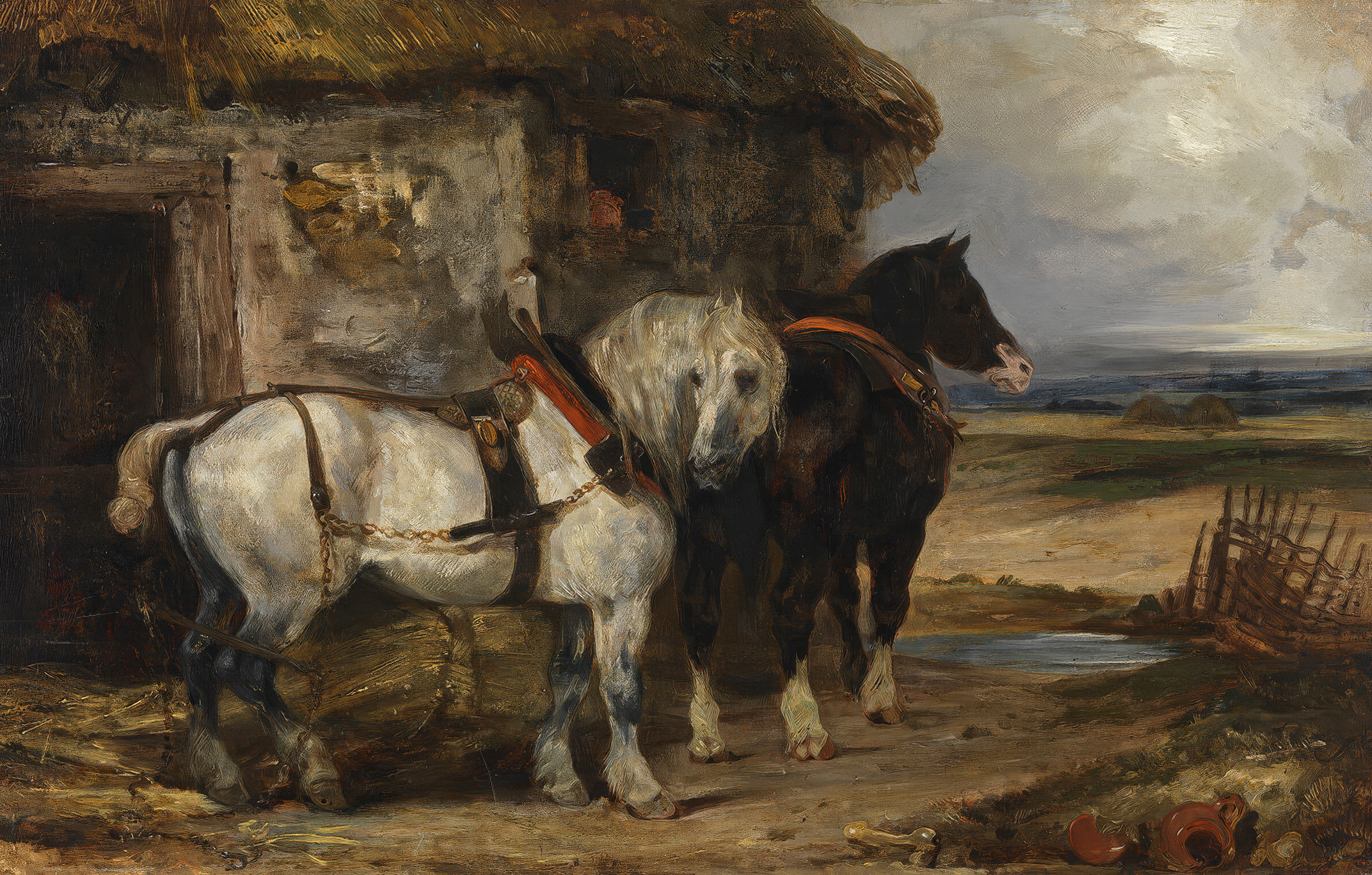
Two Horses in Front of a Stable is an oil on panel by Eugène Delacroix (1798–1863), painted around 1825–1827. It depicts two harnessed draught horses returning from the fields, standing in front of a thatched stable. The painting belongs to the artist’s early Romantic period, and Delacroix may have painted this panel during his stay in London in 1825. There he associated with Richard Parkes Bonington and David Wilkie. Close to the art of Théodore Géricault and to English painting, the work was exhibited at the Paris Salon of 1827–1828. It belongs to the collections of the Neue Pinakothek in Munich and remains on view at the Alte Pinakothek while the museum is being renovated.
Delacroix’s animal world interests me because it is rich and varied: Arabian horses, lions, tigers, battle mounts… Here, there is no fury and no combat. The painter depicted everyday horses, draught animals returning to the stable after a day in the fields. This choice of a humble subject moves me, because Delacroix gives these working beasts the same attention as his noblest chargers. We find his characteristic handling, with a lively, forceful line and a brushstroke that makes the horses’ coats and the light of the landscape vibrate. And yet the whole scene conveys a sense of peace, that of well-earned rest after effort. For me, this is one of the most endearing aspects of the painting: a more intimate Delacroix, close to Géricault and the English painters he admired, far from the grand Romantic scenes that made him famous.
Look first at the lower right corner. A red earthenware jug lies broken in the dust. Then the light catches you. It strikes the grey horse’s hindquarters, raw, almost white. Behind it, a brown horse turns its head towards the plain. Above them, the thatched roof frays.
A texture you can almost touch
Look at the grey horse’s coat. The paint is thick, laid down in short strokes that follow the muscle. You can almost feel the dried sweat under the collar. The sky, by contrast, is brushed in thin, fluid layers. On this small panel, an oil on wood, Delacroix alternates scumbling and impasto. We move from breath to weight. The reds travel from one point to another: the collar, the saddle pad, the shards. This thread of colour holds the whole composition together.
Nothing here of a noble mount. Two draught horses return from the fields, still caught in their harness and chains. The Neue Pinakothek’s catalogue entry links the painting to Géricault and to English painting. The eye confirms it. In his lithographs of horses, Géricault also depicts working animals. Le Cheval du plâtrier (The Plasterer’s Horse) shows a harnessed horse in front of a wall with flaking plaster. In Delacroix we find the same worn wall, the same weariness, the same refusal of heroism.
The grey horse looks back, head lowered. The brown one gazes at the horizon, where the sky is darkening. One seems to have arrived. The other, not yet.
Eugène Delacroix and his time
Eugène Delacroix (1798–1863) is twenty-seven in 1825. He crosses the Channel and discovers London. There he associates with Richard Parkes Bonington and David Wilkie. Géricault, his elder, had died the year before. The young painter is still finding his way within an emerging Romanticism. This panel may have been painted in England. It is later shown at the Paris Salon of 1827–1828. Delacroix’s Romanticism also finds expression in this humility of subject.
News: Delacroix’s horses in Paris
From 12 September 2026 to 18 April 2027, the Musée national Eugène-Delacroix in Paris presents a new display devoted to the painter’s animal world. It is organised to mark the acquisition of two recently restored horse studies. These two studies of stallions, one chestnut and one golden chestnut, are shown at the museum for the first time and reflect Delacroix’s enduring interest in the horse and its depiction. Horses, lions and tigers were for him both a subject of study and a motif he staged throughout his career, in his paintings, lithographs and decorative schemes. These studies were not intended for exhibition or sale: they served him as reference material and a source of inspiration. The display thus focuses on the artist’s creative process, a perspective that also sheds light on Two Horses in Front of a Stable.
Source: Musée national Eugène-Delacroix.
A question for you
Before the peasants of Millet and Courbet, doesn’t this panel already bring rural labour into the realm of high art?
About this work
- Two Horses in Front of a Stable
- Eugène Delacroix
- c. 1825–1827
- Oil on panel
- 40.5 × 63.5 cm
- Bayerische Staatsgemäldesammlungen, Neue Pinakothek, Munich
- https://www.sammlung.pinakothek.de/de/artwork/QKGBlOnxBb/eugene-delacroix/zwei-pferde-vor-einem-stall