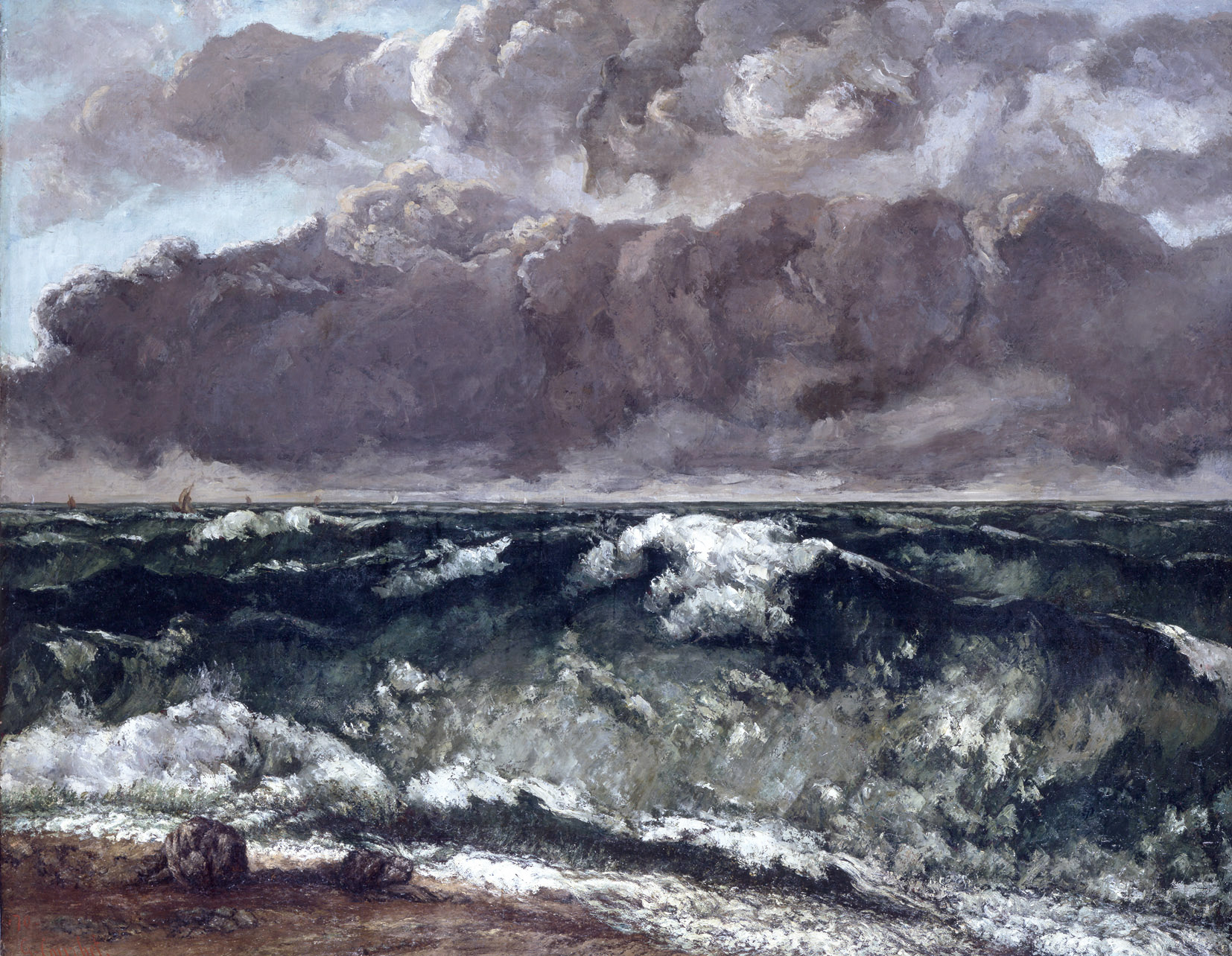
Étretat, 1869. Gustave Courbet observes from his studio the Norman waves crashing beneath his window. He wants to capture their raw power, their untamed violence. He takes his palette knife and trowel to freeze the instant when water breaks.
The first time I saw this painting at the Alte Nationalgalerie in Berlin, I felt the sea spray whip my face, heard the crash of the waves, smelled the salt air. It was hanging there, just past a doorway, and suddenly you found yourself face to face with this evocative landscape. The full force of Courbet’s realism is concentrated in it. It left a profound mark on me.
Matter Sculpting Movement
Look at this dark green mass of water rising up. White foam bursts in chaotic plumes. The torn sky weighs upon the horizon. Courbet applies paint in thick layers, worked with a trowel. He spreads broadly with the palette knife.
This technique gives the liquid element an almost mineral solidity. The colors are “dirty,” deliberately non-idealized: venomous green, earthy orange. Each knife stroke sculpts the pictorial matter as one would sculpt stone. The result? A wave that seems ready to engulf you.
A Fragment of Infinity
Courbet created this series between 1869 and 1870, a period of republican unrest in France. Several versions quickly circulated in modern European museums. Berlin, Bremen, Frankfurt: all wanted their “Wave.”
The work condenses transience and permanence. Baudelaire understood this: Courbet captures “the temporary, the fleeting” while touching “the eternal.” Collectors also saw in it the influence of Hokusai’s Japanese prints. Some critics read a political message: the image of the people’s power.
Courbet’s Radical Realism
Leader of Realism, Gustave Courbet (1819-1877) refuses all superficial idealization. He paints the world as he sees it. With “The Wave,” he revolutionizes marine painting through his bold material technique.
Think about it
💭 Facing this petrified wave, do you feel the eternal power of the ocean or the fragility of the suspended moment?
About This Work
- The Wave
- Gustave Courbet
- 1869-1870
- Oil on canvas
- 112 × 144 cm
- Alte Nationalgalerie, Staatliche Museen zu Berlin
- https://recherche.smb.museum/detail/965168/die-welle
A Norman Series, an Unprecedented Pictorial Gesture
The Wave belongs to a series Courbet developed during repeated stays on the Normandy coast in the late 1860s, particularly at Trouville and Etretat. During a single three-month visit to Trouville, he produced dozens of seascapes. This intense rate of production was made possible by a radical technique: Courbet worked with a palette knife rather than a brush, applying paint in successive layers that give the sea an almost mineral consistency. A contemporary critic observed that the tool “confers upon the waves the brilliance, the polish and the solidity of agate.” This is not a seascape in the traditional sense, there is no boat, no human figure, no narrative horizon. What Courbet paints is the sheer matter of water in motion, its mass and force against whatever resists it.
Museums in Berlin, Paris, Lyon and Beyond
The Wave series was quickly distributed across European collections, which attests to significant commercial success. The version held at the Alte Nationalgalerie in Berlin (112 × 144 cm) is one of the largest and most imposing. Other versions are held at the Musée d’Orsay in Paris (117 × 160.5 cm, dated 1870), at the Musée des Beaux-Arts in Lyon, at the Brooklyn Museum, at LACMA in Los Angeles, and at the National Gallery of Victoria in Melbourne. This geographical dispersal is the hallmark of a body of work that succeeded in persuading collectors of very different profiles in several countries simultaneously. Some have detected the influence of Hokusai’s Japanese prints; others have read the paintings as a political metaphor for popular force on the eve of the 1870 war, two readings that the painting’s mute robustness permits without imposing.