Key facts
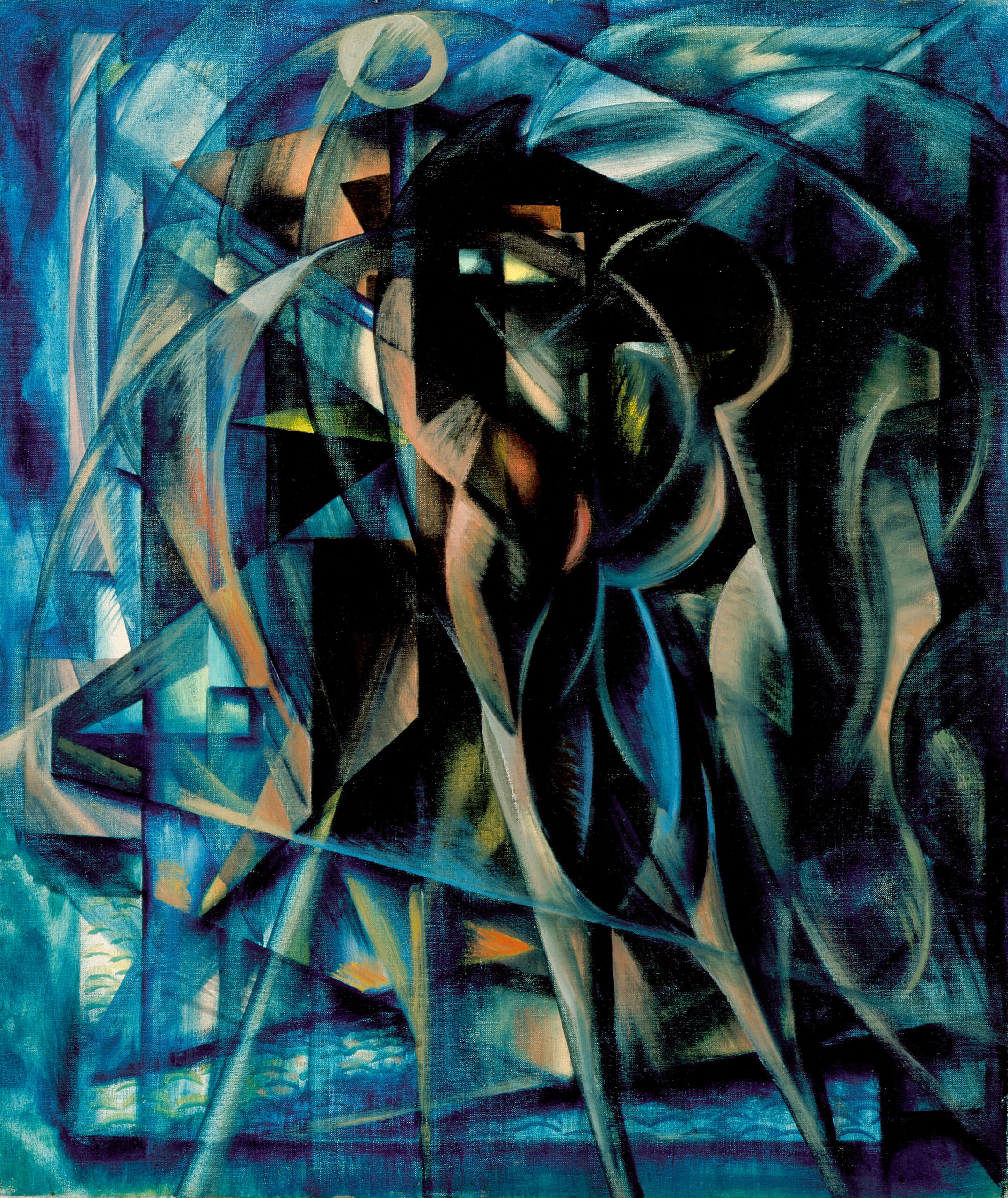
Figures is an oil on canvas painted by Benjamin F. Berlin (1887-1939) in the mid-to-late 1920s. A pioneer of modernism in Los Angeles, the artist took part in the city’s first modernist exhibition in 1923. The painting belongs to a cubist-inspired abstraction: human figures merge into a network of faceted, translucent planes, dominated by dark blue. The museum links it to Marcel Duchamp’s Nude Descending a Staircase (No. 2), which Berlin probably came to know through the collector Walter Arensberg. Considered by his peers to be one of the most gifted abstract painters in Los Angeles, Berlin remains little known today. The work is held at the Los Angeles County Museum of Art.
I see human figures caught in full motion. They merge into the space around them, so much so that you can no longer quite tell where the body ends and the setting begins. We are in Los Angeles, in the mid-1920s, at the heart of an American modernism steeped in cubism. Berlin probably never went to France. Yet he discovered this language through books and through the Californian art scene. How can one not think of Marcel Duchamp’s Nude Descending a Staircase (No. 2) (1912)? LACMA itself sees it as a direct source of inspiration. Berlin may have known the painting through the collector Walter Arensberg, who lived in Hollywood and showed a color reproduction of it. As in Duchamp, the figures are broken down into multiple intersecting planes, seen from different angles. Diagonal lines run across the whole surface. I love the dynamism of these Figures. Everything is rhythm. Midnight blue dominates, dark and deep. Then, here and there, points of yellow and amber light pierce the canvas. I am struck by these flashes. Laid in light touches over the blue planes, they create an effect of transparency, as if light were passing through the bodies. As early as 1924, critics hailed Berlin as one of the first to attempt to paint the “fourth dimension.” Standing before this canvas, I understand why. It is very different from Untitled (Surreal Abstraction) also by Benjamin F. Berlin, painted in 1939, which we have already explored on VMuseum and which is also held at LACMA. Fifteen years separate the two works: here, cubism has given way to surrealism.
Seeing
A small cream ring floats at the top left of the canvas. A head? A halo? Nothing confirms it. Lower down, flesh-colored curves stretch out like walking legs. At the center, an almost black block. A tiny yellow rectangle glows within it, like a lit window. Look at the bottom of the painting: small blue ripples suggest water. Everywhere, the weave of the canvas shows through the oil.
Understanding Benjamin F. Berlin
It may all have begun with a book: Jerome Eddy’s Cubists and Post-Impressionism, published in 1914. Berlin thus paints a European revolution he probably never saw in person. His devices are cubist: faceted planes, ray lines, an all-over composition. Yet his translucent planes look toward Los Angeles. Stanton Macdonald-Wright then dominates the city’s modernist circles. Lorser Feitelson, who settled there in 1927, may also have mattered. In 1923, Berlin shows nineteen pieces at the city’s first modernist exhibition. It is one of the largest groups of works on view. His peers rank him among the most gifted local abstract painters. And yet, LACMA’s catalogue entry admits it today: little is known about him.
Feeling “Figures“
The title promises figures. The canvas refuses to count them. Look for a long time. The bodies emerge, then dissolve into the blue. The black center draws the eye in, and keeps it from entering. The amber flashes warm the scene without ever fully lighting it. This cubism is nocturnal, almost silent. It moves, but we will never know where to.
News: 1920s Los Angeles in the spotlight at LACMA
From November 15, 2026, to May 31, 2027, the museum that holds Figures will present Paul R. Williams: Architect for Living at the Resnick Pavilion. The most prominent Black American architect of his generation, Williams helped shape his native city during its rapid growth, from the 1920s to the early 1970s. It is in this same booming city that Benjamin F. Berlin paints Figures. His peers then considered him one of the most gifted local abstract artists. In 1923, he takes part in the first modernist exhibition held in Los Angeles, at the MacDowell Women’s Club.
Source: LACMA.
A question for you
Berlin discovered cubism through the reproductions in a book, without ever seeing the originals. Can we understand a movement without seeing the works in person?
About this work
- Figures
- Benjamin F. Berlin
- mid-to-late 1920s
- Oil on canvas
- 81.92 × 69.53 cm
- Los Angeles County Museum of Art (LACMA)
- https://collections.lacma.org/object/22060