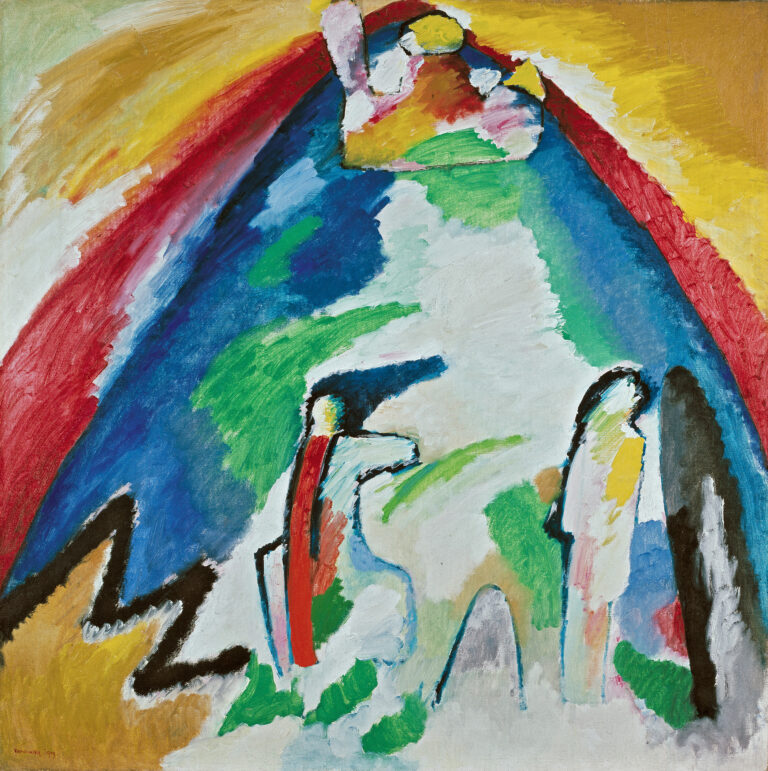

Los Angeles, 1939. Benjamin F. Berlin, an American painter steeped in the avant-gardes, sets his brush to canvas and lets the unconscious speak.
A scene from elsewhere
Look at this central figure, its limbs striped in black and white, one arm reaching toward a blazing solar flower in orange and gold. Above, a face with bulging eyes emerges from a brick wall. Miniature human figures stir and agitate. To the left, a solitary figure walks away. Berlin works in oil with precision. Textures clash: rough brick, smooth flesh, striated metal. The palette oscillates between warm ochres and metallic greys. Each form coexists without apparent logic. Space fragments — at once Cubist and dreamlike.
Surrealism becomes American
European Surrealism crosses the Atlantic. California artists seize it and reinvent it. Berlin does not imitate Dalí or Magritte. He forges an American Surrealism rooted in personal experience. Los Angeles becomes an unlikely crucible of modernity. As early as 1934, Helen Lundeberg and Lorser Feitelson publish the only American Surrealist manifesto, issued from California. Berlin belongs to this ferment. His work probes identity, the double, and the repetition of human forms in a fragmented world.
Benjamin F. Berlin
Active in Los Angeles during the 1930s and 1940s, Berlin (1887–1939) stands as a singular figure within American Surrealism. His style combines formal rigour with unbridled imagination. This canvas, held at LACMA, perfectly illustrates his ability to inhabit the in-between: between dream and reality, between figuration and abstraction.
A question for you
💭 Between Cubist fragmentation and Surrealist dream logic, where would you place Berlin on the chessboard of the 1930s avant-gardes?
About this work
- Untitled (Surreal Abstraction)
- Benjamin F. Berlin
- 1939
- Oil on canvas
- 50.8 × 60.96 cm
- Los Angeles County Museum of Art (LACMA)
- https://collections.lacma.org/node/174393
Los Angeles in the 1930s: A Singular American Surrealism
Untitled (Surreal Abstraction) is one of the last works by Benjamin F. Berlin (Washington D.C., 1887-Los Angeles, 1939), a painter whose trajectory illustrates the recomposition of the American art scene in the interwar years. Born in Washington in 1887, Berlin moved to Los Angeles in 1914 and trained at the Cannon Art School and the University of Southern California. Initially a realist portrait painter, he moved progressively through the 1920s toward Cubism and then abstraction, in the wake of a European Surrealism that was beginning to reach American audiences through magazines, exhibitions, and émigré artists. This 1939 canvas, painted in the year of his death, represents the endpoint of that evolution: its forms are organised according to a dream logic that owes nothing to rational narrative. At the time of his death, Berlin was employed by the WPA (Works Progress Administration), the New Deal federal programme that sustained an entire generation of American painters through the Depression years.
A Visual Grammar of the Dream
A central figure with black-and-white striped limbs stretches toward a solar flower in orange and gold; above it, a face with bulbous eyes emerges from a brick wall, detached from any body; miniaturised human silhouettes occupy improbable positions in the space. Each zone of the canvas presents a different texture, rough brick, smooth flesh, striated metal, and the thermal contrasts between warm ochres and metallic greys prevent the eye from finding any point of equilibrium. This procedure of perceptual destabilisation is characteristic of West Coast American Surrealism, more interested in psychological space than in the automatic writing of Parisian Surrealism. Held in the permanent collection of LACMA, the canvas testifies to a Los Angeles art scene of the 1930s less documented than the New York avant-gardes but equally open to European influence, and ultimately as inventive in what it made of it.