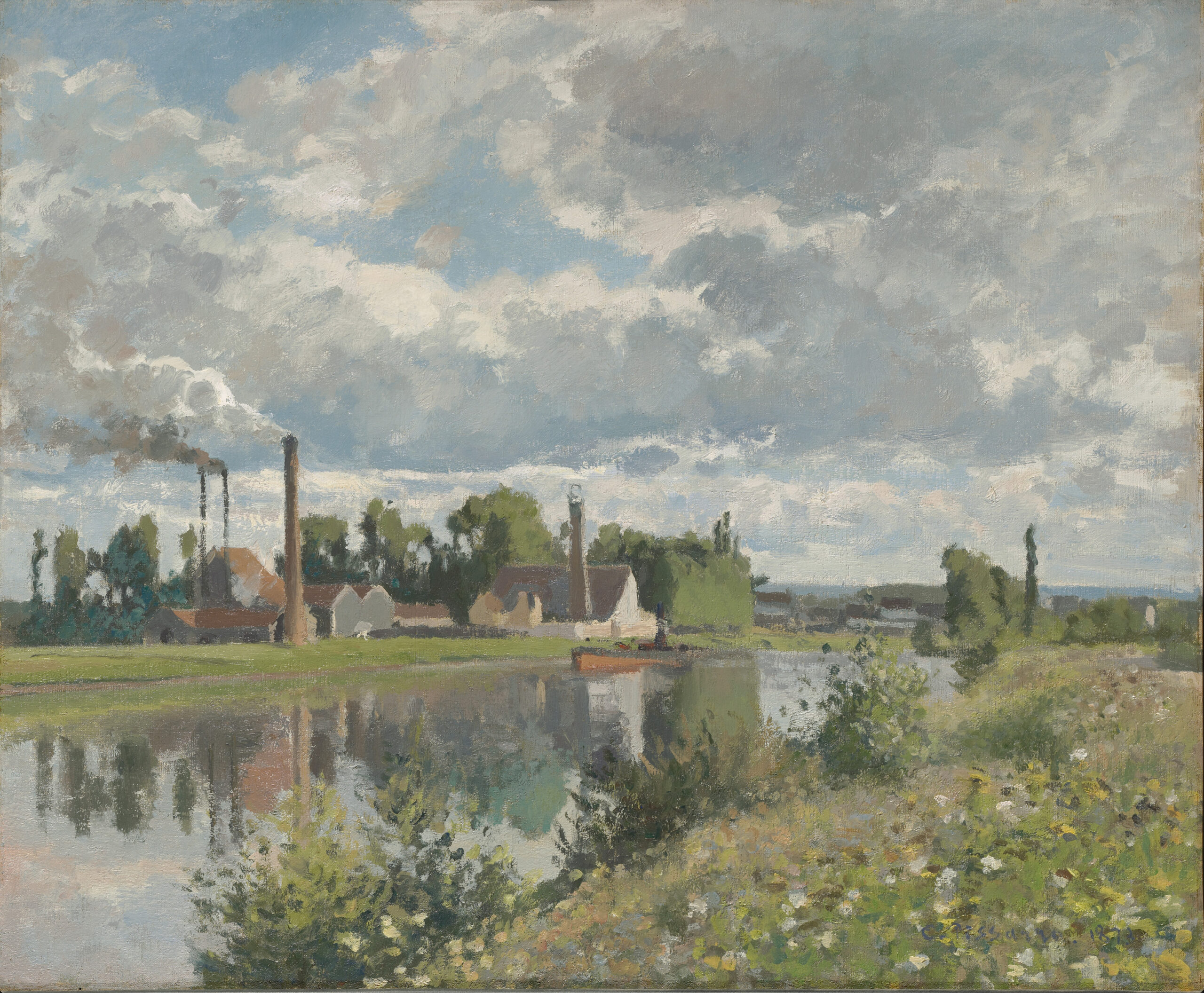
The landscape exactly as he saw it, with nothing left out. Is it not striking that he chose to render reality in its entirety, smoking chimneys included? Other painters would likely have erased them, preserving a purer, more idealized view.
This is precisely what strikes me most in this work by Pissarro: an almost documentary honesty toward his subject, one that excludes neither nature nor the traces of human activity. The light is just as distinctive: you can see it piercing through the clouds, flooding the greenery and the flowers in the foreground. The sky seems to vibrate, and it is this impression of living light that strikes me first when I look at this painting.
You expect a tranquil, untroubled landscape. Pontoise offers something else. Two chimneys send black smoke above the poplars. Pissarro does not look away. In 1873, the factory belongs to the landscape, just as much as the water and the flowers.
What the surface conceals
On the bank opposite his own house, Pissarro sets up his easel facing the factory. The record confirms it: the buildings altered the course of the Oise, shifted its banks, changed the horizon. Yet the painter chooses harmony over indictment. His quick, juxtaposed brushstrokes capture the bright light falling on the clouds and sliding down to the flowers in the foreground. This technique, inherited from the early years of Impressionism, rejects sharp outline in favor of immediate sensation. The orange barge, the trembling reflection on the water, the tall grasses: everything belongs to the same swift, instantaneous gesture. The industrial motif becomes a pretext for painting modernity as it presents itself, without apparent disguise.
The artist and his time
Born in 1830 on the island of Saint Thomas, in the Danish West Indies, Camille Pissarro moved to France to become a painter. He settled in Pontoise in the early 1870s, drawn to its industrial banks as much as its rural ones. The only artist to take part in all eight Impressionist exhibitions, held between 1874 and 1886, he remained a guiding presence for Monet and Cézanne, whom he tirelessly advised. Pontoise gave him a recurring subject: the Oise, its factories, its seasons.
Currently at the Clark Art Institute
The Clark Art Institute, home to this painting by Camille Pissarro, is in a period of change. Since June 2026, the museum has presented a preview of the Aso O. Tavitian collection, ahead of the opening of a new wing designed by Annabelle Selldorf. Through October 12, 2026, the Clark is also hosting the first American exhibition devoted to Giorgio Griffa.
Source: Clark Art Institute
A question for you
💭 What if industrial modernity were not a threat to the landscape, but its very condition for existing?
About this work
- The River Oise near Pontoise
- Camille Pissarro
- 1873
- Oil on canvas
- 46 x 55.7 cm (18 1/8 x 21 7/8 in.)
- Clark Art Institute, Williamstown, Massachusetts
- 1955.554