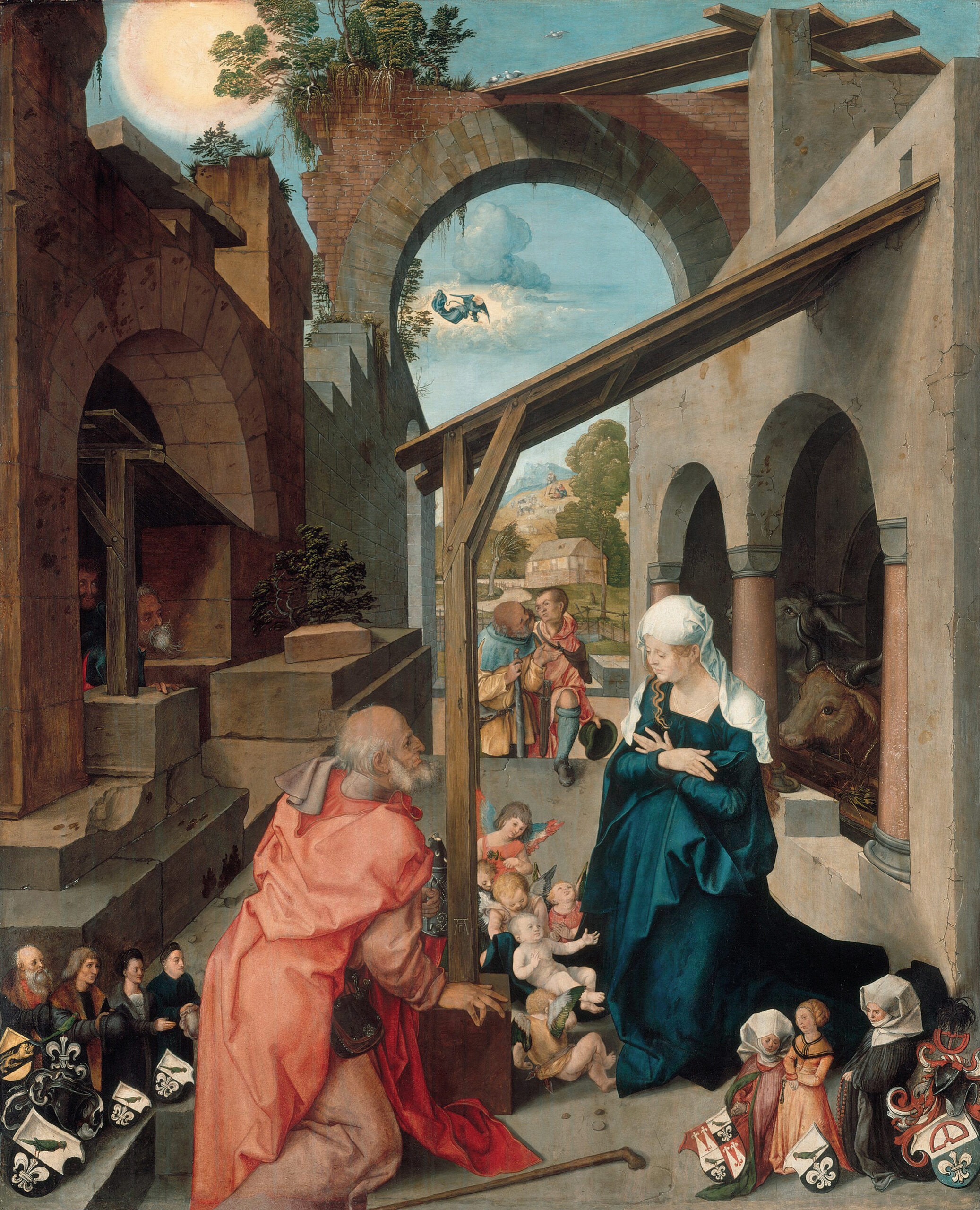
I deeply admire Albrecht Dürer, and this altarpiece has never stopped captivating me. The moment one approaches the central panel, what strikes first is the minute attention to detail so characteristic of Northern painting at the turning point between the Middle Ages and the Renaissance: every fold of fabric, every stone of the ruined architecture serving as a stable, seems rendered with a goldsmith’s patience. What moves me most, though, is the strikingly bold lighting choice for its time: whereas a Nativity is almost always set at night, Dürer opts here for daylight, almost unreal in quality, flooding the scene and nearly dissolving the tiny body of the Christ Child amid a swarm of small angels.
The construction of the gaze is remarkably intelligent: the perspective of the ruin draws the eye toward this luminous centre, where the balance of volumes between the Virgin, the Child and the angels creates a perfect point of visual tension, before the eye wanders toward the modest figures of the Paumgartner family, tucked discreetly at the two edges of the panel. I can stand before this work for long minutes, tracing every face, every angel, every stone, it is this capacity to sustain such a long and attentive gaze that, to me, distinguishes a great painting from a merely beautiful image.
Daylight floods the tiny body of the Child, almost engulfed by a host of angels. Nuremberg, around 1498. The Paumgartner family commissions this altarpiece from Albrecht Dürer for their chapel in the church of the Dominican convent of St. Catherine.
An architecture in collapse, a light that resists
Look at the stone arch dominating the scene. It opens onto a fragment of sky, where the angel announcing the good news to the shepherds floats, minuscule. On the ground, the stable is nothing more than an assemblage of ruins: disjointed beams, cracked stones. These ruins, a traditional setting for the Nativity, also evoke the collapse of an old world. The painting does not settle which one is truly crumbling. Dürer paints in oil on limewood, with precision. Mary, in a deep blue robe, joins her hands before the naked Child, surrounded by colourful putti. To the right, an ox leans its head between two columns. Fleur-de-lis coats of arms border the panel without overwhelming it. Through the arcades on the right, the eye escapes toward a peaceful valley, dotted with a farmhouse. In the upper left, a pale sun illuminates the ruins from above.
A family commission, devotion made visible
The altarpiece follows the Golden Legend, source of the Nativity’s iconography. On the left kneel Lukas and Stephan Paumgartner, with their father Martin, who died in 1478. Hans Schönbach, their mother’s second husband, accompanies them. On the right, Barbara Paumgartner, née Volckamer, prays with her daughters. These donor portraits, common at the time, anchor the sacred scene in a precise social reality. Old documents date the wings to 1498. The central panel, with its more elaborate perspective, appears to be later. The ensemble once stood against the south aisle wall of the church of the Dominican convent of St. Catherine in Nuremberg. It is now held at the Alte Pinakothek in Munich.
Albrecht Dürer is born in Nuremberg in 1471, the son of a goldsmith. He travels to Italy and brings back Italian perspective, without abandoning the Northern minuteness instilled by his workshop training. The Paumgartner Altarpiece belongs to these formative years, between geometric rigour and devotional fervour. He becomes a leading figure of the German Renaissance.
At the Louvre, the shadow of the “fair Martin”
From 8 April to 20 July 2026, the Louvre presents a new exhibition devoted to Martin Schongauer, titled “Martin Schongauer. The Immortal.” Curated by Pantxika Béguerie De Paepe, honorary curator of the Musée Unterlinden, and Hélène Grollemund, curator in the Department of Graphic Arts at the Louvre. This fifteenth-century Alsatian painter and printmaker is no minor name for anyone interested in the Paumgartner Altarpiece: Albrecht Dürer himself nicknamed him “fair Martin,” in tribute to the virtuosity of his burin. The young Dürer trained in part on Schongauer’s models, whose widely circulated engravings shaped an entire generation of German artists before and during the making of his earliest religious works. The exhibition brings together, for the first time, nearly all of Schongauer’s surviving paintings, including the exceptional Madonna of the Rose Bush of 1473, alongside a broad selection of his prints — a rare opportunity to trace the visual sources that nourished Dürer’s generation.
Source: Musée du Louvre
A question for you
💭 The Paumgartners, though the very patrons of this work, painted themselves tiny, at the margins of the panel. Why commission a painting only to appear so small within it?
About this work
- Paumgartner Altarpiece: Nativity
- Albrecht Dürer
- c. 1500
- Oil on limewood panel
- 155 x 126.1 cm
- Alte Pinakothek, Munich (Bavarian State Painting Collections)
- https://www.sammlung.pinakothek.de/de/artwork/anxgBDj4Eq/albrecht-duerer/paumgartner-altar-geburt-christi