In brief
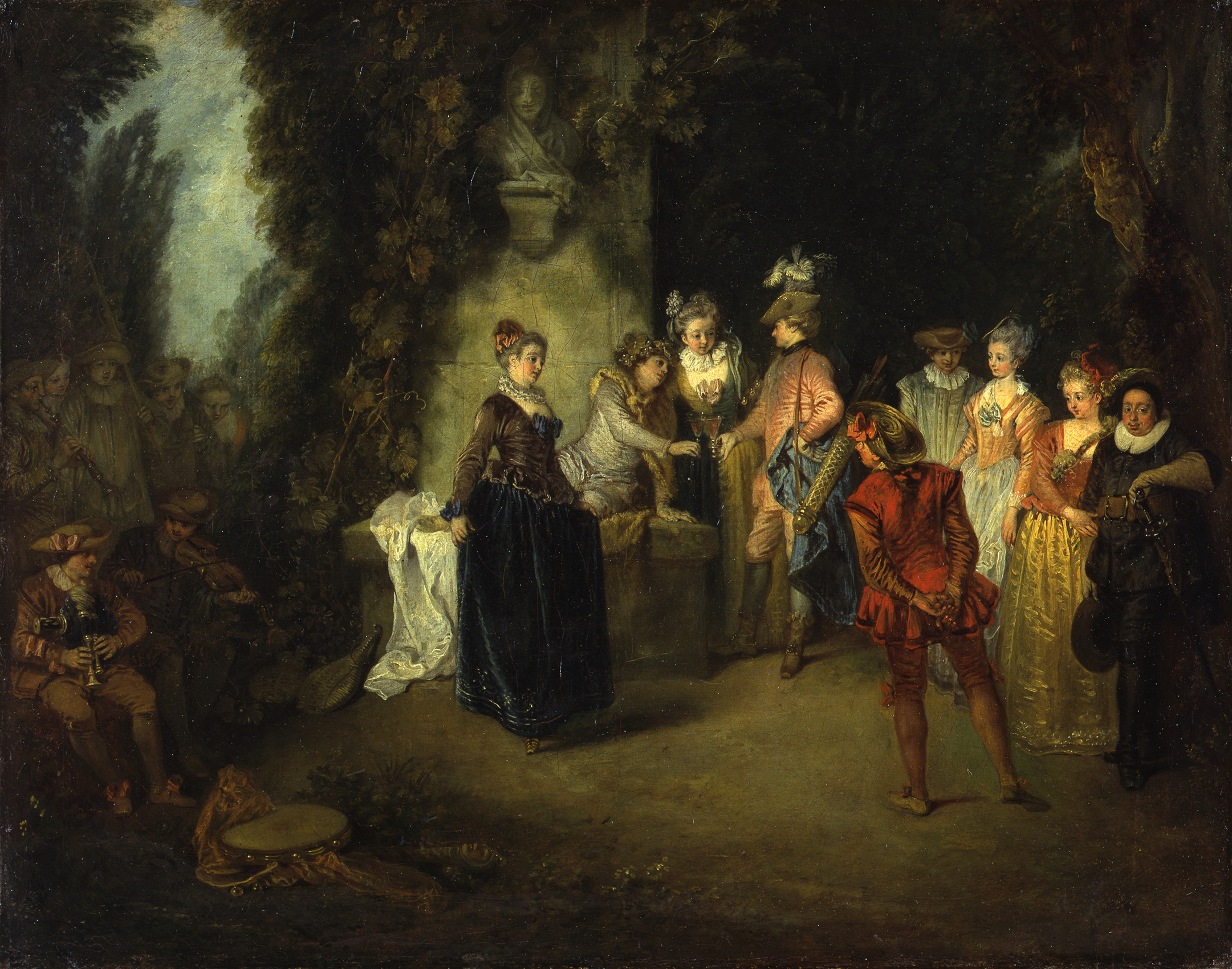
Painted around 1716–1717 by Jean-Antoine Watteau, The French Comedy gathers a company of actors in a park, around two performers costumed as Apollo and Bacchus. It forms a pendant to The Italian Comedy, and owes its title to the reproductive engravings made by Charles-Nicolas Cochin the Elder in 1734. The work belongs to the fête galante, the Rococo genre that Watteau invented and that the Académie Royale formally recognised in 1717. Its state of preservation makes it one of the few reliable witnesses to his manner, so often altered elsewhere. Acquired by Frederick the Great for Sanssouci, the painting entered the Gemäldegalerie in Berlin in 1829.
Watteau never ceases to surprise me. At the height of the Rococo, he stands apart, with a manner all his own: a vivid, luminous naturalism, a surface gaiety beneath which a muted melancholy always stirs : the very paradox of the fête galante, the genre he himself invented. Here we stand in the sunlit clearing of a park, where a company of actors has gathered. To the left, the musicians, among whom we recognise Pierrot and Gilles; at the centre, a couple begins a ceremonial dance while two actors, costumed as Apollo and Bacchus, raise a toast to one another. Everything breathes the air of a fête champêtre, golden light gliding over the fabrics and yet something holds us back. At the lower right, a man dressed in dark clothing, Crispin, is the only figure to meet our gaze: he draws us into the scene even as he keeps us at arm’s length. Above, a veiled herm, generally read as Momus, casts a discreet shadow over all this merriment. This, to my mind, is Watteau’s signature: joy and light, forever doubled by something graver.
One expects a comedy. Nothing here invites laughter. The painting bears the title The French Comedy. Yet there is no stage, no farce. Look instead: a company of actors presses together in a shadowed park, between two masses of trees. A festivity is under way. So too is a gravity. The two hold together within a single frame.
Beneath the surface
The surface appears light. It is not. Watteau paints in oil on canvas, in swift, almost sketch-like touches. This fragile technique has aged poorly across many of his paintings. Here, the state of preservation remains exceptional. Observe the yellow gown: the satin catches the golden light. The midnight-blue gown, by contrast, absorbs it. At the centre, two actors raise a toast, costumed as Apollo and Bacchus. Colombine slips between them, in the guise of La Folie (Folly). On the ground, in the grass, a tambourine lies abandoned. The music has just ceased, or is about to resume. We cannot say. The title announces a comedy; the scene has the bearing of a rite. Above, a veiled herm keeps watch, which the Gemäldegalerie’s catalogue proposes reading as Momus. The gaiety carries its own shadow. It offers no explanation.
Watteau and his age
Jean-Antoine Watteau was born in Valenciennes in 1684. He reached Paris in 1702. The city was emerging from the long reign of Louis XIV. A lighter society was in search of its pleasures. For it, Watteau invented a new genre, the fête galante. The Académie Royale received him in 1717 with the Pilgrimage to Cythera. It then created a category tailored to his art. The painter had frequented the theatre from his earliest days, alongside Claude Gillot. The commedia dell’arte haunts his work: Pierrot, Gilles and Crispin return to it again and again. His career spanned barely fifteen years. Illness carried him off in 1721. That brevity works within his canvases. The revels always seem on the point of ending. Pleasure and loss brush against one another.
Current exhibition : The Gemäldegalerie in Berlin turns the spotlight on the portrait
From 16 October 2026 to 14 March 2027, the Gemäldegalerie is devoting a major exhibition to the genre of the portrait: Portraits! Surprising Encounters from Botticelli to Lempicka. The display sets works spanning five centuries in dialogue, pairing them to reveal striking and sometimes unexpected affinities – Botticelli with Lempicka, Dürer with Giorgione, or Rubens with Gainsborough. Drawing on the museum’s remarkable portrait holdings, enriched by loans from other Berlin institutions, it takes up a question that remains very much alive: how do we see ourselves, and how, from one age to the next, have people wished to be seen? It is a concern that resonates with Watteau’s art, a subtle observer of the roles and social masks of his own time. Source: Gemäldegalerie, Berlin.
A question for you
💭 This painting has a twin, The Italian Comedy, conceived as its pendant. Should we really look at them apart?
About this work
- The French Comedy (La Comédie française)
- Jean-Antoine Watteau
- 1716–1717
- Oil on canvas
- 38.8 × 49.4 cm
- Gemäldegalerie, Berlin
- https://search.smb.museum/object/obj-869368