Key facts
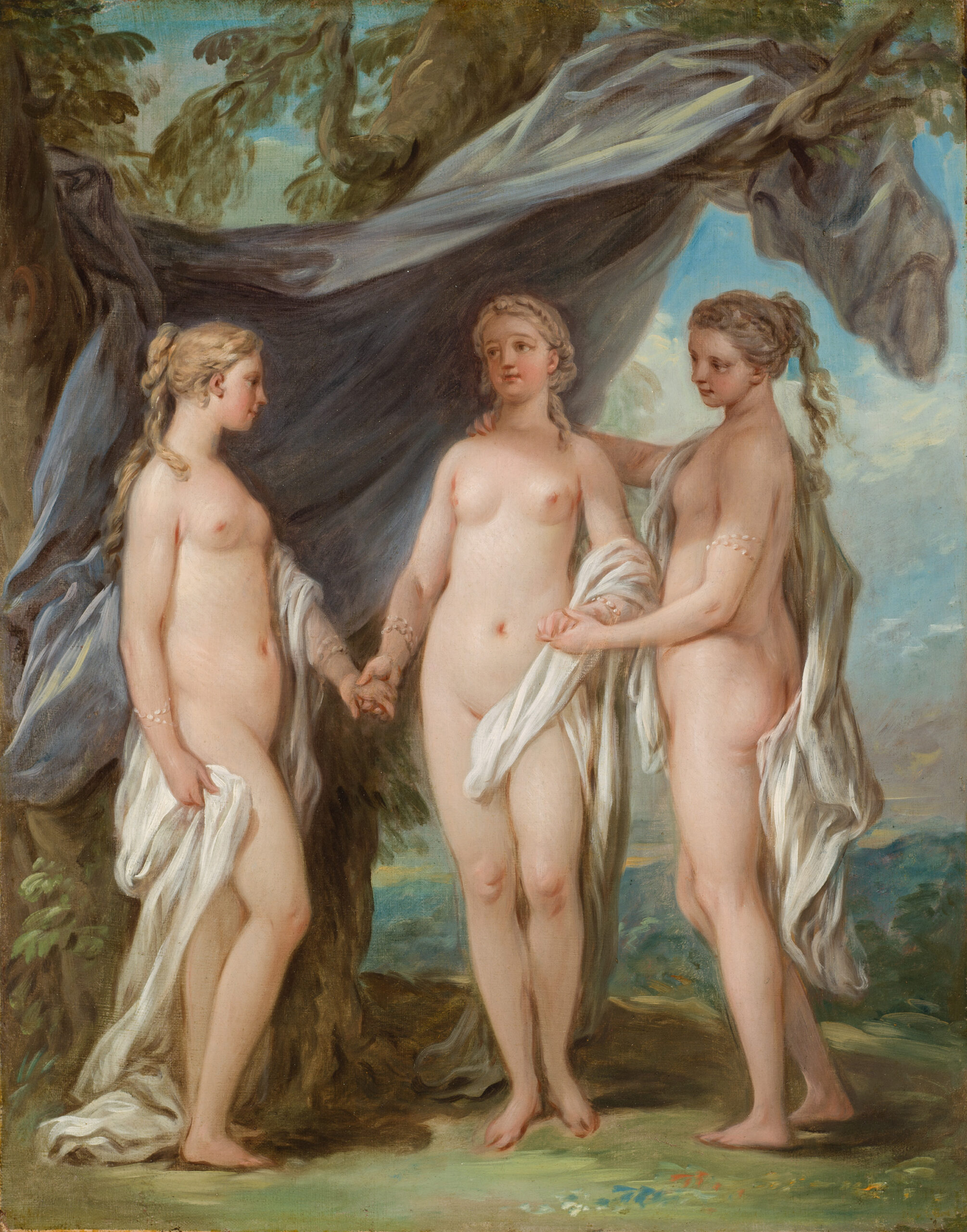
The Three Graces is an oil sketch on canvas by Charles-André Van Loo, known as Carle Van Loo, born in Nice in 1705 and died in Paris in 1765. It dates from around 1763. First Painter to the King under Louis XV, the artist is a major figure of French Rococo. The painting depicts the Charites of Greek mythology, associated with beauty, charm and the joy of life. It belongs to Van Loo’s long engagement with this subject: a first version, criticized at the Salon of 1763, followed by a second, now held at the Château de Chenonceau. The sketch belonged to the Chevalier de Damery, then to the Ciechanowiecki collection. It entered the Los Angeles County Museum of Art in 2000.
The Three Graces have been a recurring subject in art history since Antiquity. Many depictions are known, such as Cranach’s (The Nelson-Atkins Museum of Art, Kansas City) and Raphael’s (Musée Condé, Château de Chantilly), or later those of Rubens and Canova, and many others. I was curious about the symbolism of these three figures, and I discovered that they are the Charites. They are three minor deities of Greek mythology, daughters of Zeus and the Oceanid Eurynome, linked to beauty, charm and the joy of life: Aglaea (splendor), Euphrosyne (joy) and Thalia (abundance). Seneca, in his treatise On Benefits, sees in them the cycle of generosity: giving, receiving and returning. That is why they hold hands, for a kindness passes from hand to hand and returns to the one who gave it.
The LACMA painting is a small oil sketch, closely related to the large canvas at the Château de Chenonceau (250 × 204 cm). Van Loo’s history with this subject was eventful. A first version, Les Grâces enchaînées par l’Amour (The Graces Bound by Love), shown at the Salon of 1763, was harshly criticized: Diderot found these Graces far too heavy. The painter then went back to work for the Salon of 1765, but he died that same year, before it opened. This second version is the one we admire today at Chenonceau. Whatever the case, I find this sketch full of grace, steeped in the 18th-century style, and wonderfully light: the brushwork is free and quick, and the pale flesh tones stand out against the landscape and the drapery hung in the tree. I love this playful style, and this simpler, more spontaneous version than the one at Chenonceau, where you can feel the painter’s hand at work.
A string of pearls encircles the arm of the Grace on the right. First, rest your eyes on this tiny pearly touch. Then follow the light. It slides over the shoulders, blushes the knees, fades into the white linen. You can almost feel the coolness of the shade beneath the tree.
The substance of a sketch of the Three Graces
Come closer. Along the edges, the weave of the canvas still shows through. Here, Carle Van Loo works fast, in thin layers. The flesh emerges from a fluid paint, warmed with pink at the cheeks and joints. The white linen, by contrast, receives a thick paste, laid down in nervous, comma-like strokes. This impasto catches the real light of the room. Stretched between the branches, the slate-blue drapery acts as a theater curtain. It pushes the pale bodies toward you. An oil sketch serves to set the balance of masses and values, not the finish. Now look at the hands. The first two Graces hold each other’s hand. The third rests hers on a neighbor’s shoulder. The chain does exist. Yet the three bodies remain aligned, facing forward, as in a frieze. Seneca’s round dance becomes a row.
Carle Van Loo, First Painter to the King
Charles-André Van Loo, known as Carle Van Loo, is born in Nice in 1705 and dies in Paris in 1765. He holds the title of First Painter to the King under Louis XV. His Graces thus sit at the heart of official Rococo taste. The sketch belongs to the Chevalier de Damery by 1769. It then passes into the collection of Andrew Ciechanowiecki in London. It enters LACMA in 2000, through the Ahmanson Foundation.
News: autumn at LACMA
The museum that holds The Three Graces offers a rich program this autumn. On the graphic arts side, the exhibition Danse Macabre: Death in Print from Dürer to Dix explores the theme of the dance of death through December 6, 2026. This allegory of life’s fragility, shown as dancing skeletons, spread through woodcuts as early as the 14th century. It is presented on the same level as Pablo Picasso-Portraits in Disguise, on view for the same dates. On October 18, The Brockman Gallery: Los Angeles, 1967–1990 opens. It is the first major exhibition devoted to the brothers Alonzo and Dale Brockman Davis and their historic South L.A. gallery, with more than 60 works and extensive archival material. Design is also in the spotlight: two exhibitions explore design as a driver of social, political and economic change in modern domestic life, including Home of the Future, 1925–1985, at the Resnick Pavilion through March 14, 2027.
Source: LACMA.
A question for you
Since Antiquity, the Graces have held hands. What gesture would you choose today to express generosity?
About this work
- The Three Graces
- Charles-André Van Loo
- circa 1763
- Oil on canvas
- 58.42 × 46.04 cm
- Los Angeles County Museum of Art (LACMA)
- https://collections.lacma.org/object/103861