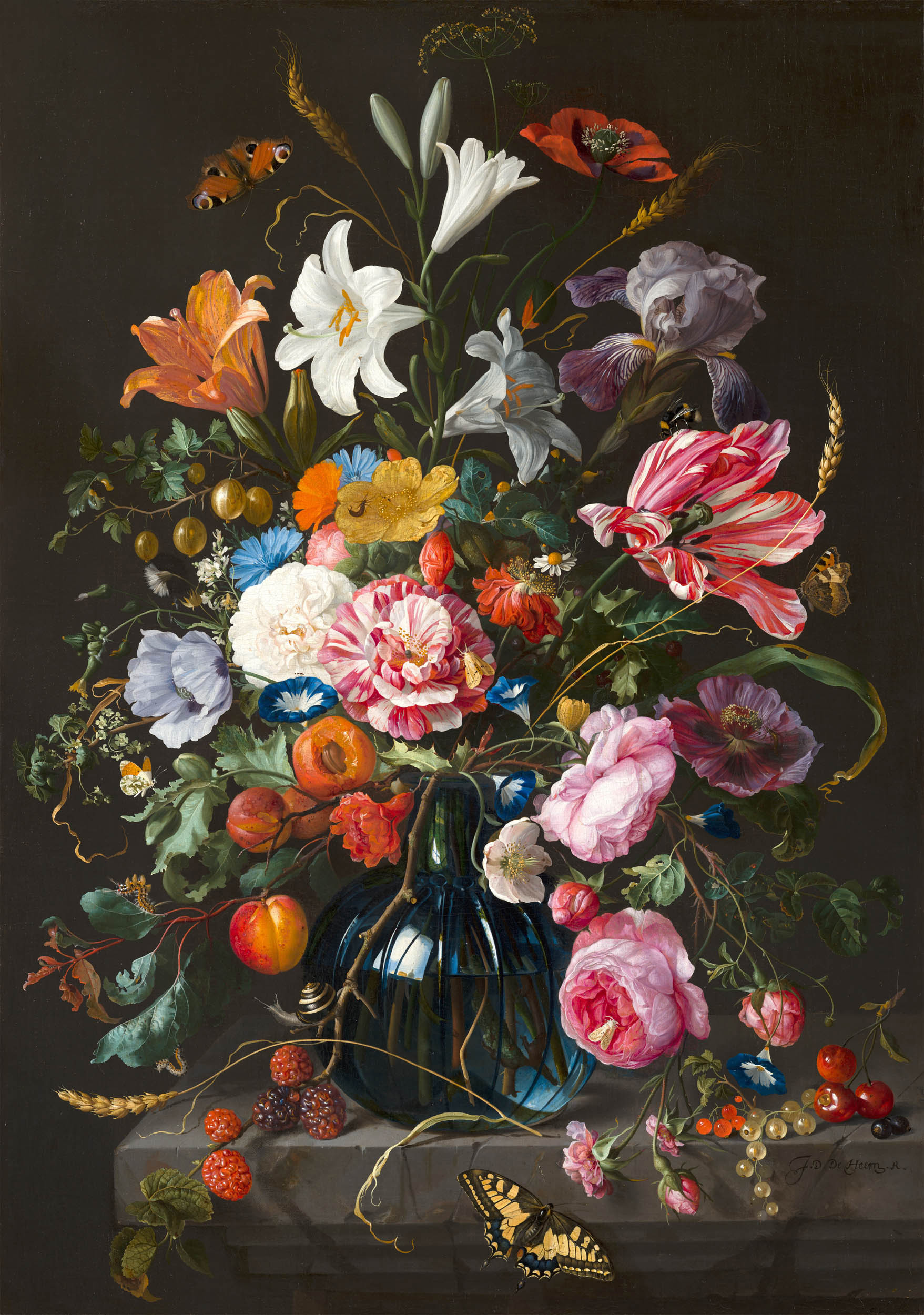
What strikes me first is the chromatic intensity of the bouquet: the blood-red of the poppies against the pearlescent white of the lilies, the vivid energy of the striped tulips. De Heem does not paint flowers in decline, he arrests a moment of absolute perfection. Among all the floral arrangements in the history of art, those of seventeenth-century Dutch painting possess a particular vitality, a way of spilling beyond the frame and seeming almost breathable. This one is no exception.
Yet it is a quiet detail that holds my attention longest: the reflection in the glass vase. There, barely legible, one makes out a studio window open onto a cloudy sky, and a few objects resting on the sill. De Heem slips his own presence into the canvas, not as a signature, but as a confession. This small mirror shatters the illusion of the still life and reminds us that behind this so carefully composed abundance, there is a painter, a quality of light, a specific morning.
Look first at the vase. Dark, almost opaque, it catches the studio light and returns it as bluish reflections across the blown glass.
Beneath the surface
Set upon a cold stone ledge, the glass vase holds a light of its own. Jan Davidsz de Heem lodges within it a cloudy sky, a half-open window, a few objects on the sill. The still life breathes. Around it, flowers overflow without restraint: white lilies rising upward, tulips striped in red and cream, full-bodied roses, violet irises, scarlet poppies. Butterflies alight on petals. Cherries roll across the stone. De Heem works in layered glazes, coat upon coat, until the illusion of the damp petal is complete. Oil on canvas. One would swear it were alive.
The artist and his century
Born in Utrecht in 1606, Jan Davidsz de Heem moves through the Dutch Golden Age between two worlds. He settles in Antwerp in 1636 and absorbs the baroque exuberance of the South. He becomes the most influential flower painter of his era. His compositions exceed mere ornament: they speak of vanity, of passing time, of commercial wealth. This bouquet of c. 1670 is their late culmination. Perfect. And yet, everything here is destined to perish.
Jan Davidsz de Heem in the museum spotlight
From 3 December 2024 to 13 April 2025, the Fitzwilliam Museum in Cambridge brought together four monumental still lifes by the artist. The exhibition Picturing Excess examined the pronkstilleven in light of Dutch colonial trade. X-ray fluorescence analysis traced the global origins of the pigments De Heem used.
Source: fitzmuseum.cam.ac.uk
A question for you
💭 If you were to choose a single flower from this bouquet to encapsulate what seventeenth-century Dutch painting contributed to Western art, which would it be?
About this work
- Vase of Flowers
- Jan Davidsz de Heem
- c. 1670
- Oil on canvas
- 74.2 × 52.6 cm
- Mauritshuis, The Hague
- https://www.mauritshuis.nl/fr/decouvrir-la-collection/oeuvres-d-art/1099-vase-of-flowers