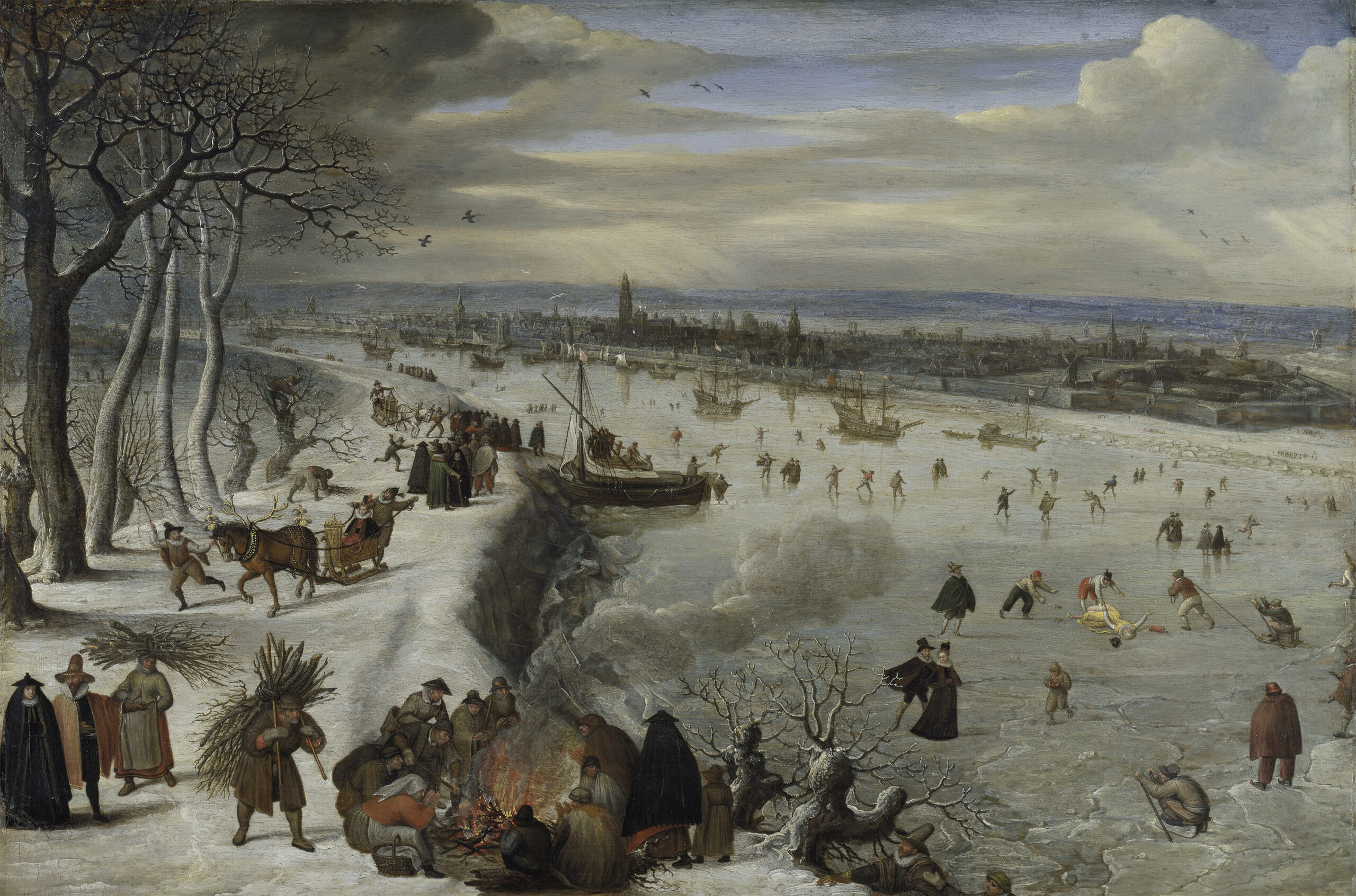
Antwerp, winter 1593. The River Scheldt, nearly 400 metres wide, has transformed into a vast natural ice rink. Beneath a sky where heavy snow clouds mingle with bursts of blue, the city stirs with an extraordinary vitality. Peasants, merchants and townspeople mingle on the ice, brought together by the magic of an exceptional winter. Lucas van Valckenborch, Flemish master, captures this rare moment with remarkable precision.
A winter frozen in time
Look closely at the scene: figures glide, tumble, laugh. Horses pull sledges while a group gathers to warm themselves around a crackling fire. The raking light of the winter sun picks out every detail. Nothing escapes the artist’s eye. Van Valckenborch uses the technique of oil on oak panel to capture a full range of textures, from glints of snow to the folds of heavy cloaks.
Where art meets history
A record of climate: in the sixteenth century, Europe was in the grip of the Little Ice Age. Winters were so severe that entire rivers froze solid, among them the Scheldt at Antwerp. This work is more than a landscape: it is a historical document. Van Valckenborch shows how life went on in spite of the cold, caught between resilience and simple joy. Close to humanist circles, the artist was attuned to the spirit of an age in which nature dictated the rhythm of human existence.
Lucas van Valckenborch: painter of the seasons
Born in Flanders, van Valckenborch (1535-1597) excelled in animated landscapes that blend realism with poetry. Trained in the workshop of his brother Marten, he developed a style in which nature becomes a protagonist. His works, often commissioned by European elites, capture the cycles of the seasons with near-scientific precision.
Think about it
💭 Which winter memory makes your heart stir?
About this work
- View of Antwerp with the Frozen Scheldt
- Lucas van Valckenborch
- 1593
- Oil on oak panel
- 42.4 × 63.2 cm
- Städel Museum, Frankfurt am Main
- https://sammlung.staedelmuseum.de/en/work/view-of-antwerp-with-frozen-schelde
The Winter of 1593 Documented on Panel
View of Antwerp with the Frozen Scheldt (1593) is not a generic winter landscape: it is a visual document of a precise climatic event. In 1593, the Scheldt froze solidly enough to support pedestrians and vehicles, a real occurrence that Lucas van Valckenborch chose to represent with the rigour of a chronicler. The painting (42.4 × 63.2 cm, oil on oak panel, Städel Frankfurt) adopts a slightly elevated viewpoint that encompasses both the frozen river animated with human silhouettes and the city of Antwerp in the background, with its recognizable towers and steeples. This dual register, genre scene on the ice and urban topography, is characteristic of late 16th-century Flemish landscape, a genre that documents as much as it composes.
The Little Ice Age and the Painting of Winter
View of Antwerp with the Frozen Scheldt belongs to a specific climatic context: the Little Ice Age (approximately 1550-1850) brought significantly harsher winters to northern Europe than we know today, with regular freezing of rivers and harbours that left a deep mark on collective memory and fed the iconographic imagination. This climatic context nurtured a distinctly Flemish and Dutch pictorial genre: the winter landscape and frozen river scene, whose principal practitioners were Hendrick Avercamp, Jan van Goyen, and Pieter Bruegel the Elder (from whom Van Valckenborch drew direct inspiration). Lucas van Valckenborch (c. 1535-1597), born in Leuven, worked in Mechelen, Liège, and Linz before settling in Frankfurt in 1593, the very year he painted this canvas, from exile in the city that now holds the work in its collections.